Where AI Gets Its Answers: The Most-Cited Domains and What They Mean for Your PR and Content Budget
Jitender • 11/16/2026

When someone asks ChatGPT to recommend a software platform, Gemini to compare service providers, or Perplexity to identify the best products in a category, the answer is rarely based on a single website. AI platforms draw information from multiple sources, including company websites, editorial publications, community discussions, review platforms, and reference pages.
For businesses, this changes how content and public relations investments should be evaluated. Having useful information on your own website is still necessary, but it may not be enough to establish a strong presence in AI-generated answers. Your brand also needs to be represented accurately across the sources that potential customers encounter during their research. This broader concept of AI visibility and why it matters for your brand is becoming an important consideration for marketing teams.
The challenge is deciding where to invest. Reddit, YouTube, LinkedIn, Wikipedia, and established publications frequently appear in AI citation research. However, that does not mean every business should spend its budget trying to get featured on all of them.
The more useful question is which sources appear when your target customers ask questions about your products, services, and industry, and what your brand needs to do to become part of those conversations.
What Recent Research Reveals About AI Citation Sources
Several large-scale studies have examined the websites AI platforms reference when generating answers. Although their findings differ, they reveal an important pattern: citation behaviour varies across platforms, industries, and search intent.
A March 2026 analysis covered 30 million sources across ChatGPT, Google AI Mode, Gemini, Perplexity, and Google AI Overviews. The findings, reported by Search Engine Land, identified Reddit as the most-cited domain, followed by YouTube and LinkedIn. Wikipedia and Forbes also appeared among the leading sources. Review platforms such as Yelp and G2 were frequently cited in recommendation-related queries.
Another study published in March 2026 examined 75,000 AI answers and more than one million citations across ChatGPT, Google AI Mode, and Perplexity.
Its findings revealed that three content formats accounted for more than half of the citations:
The same research found that articles accounted for 45.5% of citations for informational queries, while listicles represented 40.9% of citations for commercial-intent queries.
These findings matter because they show that AI citations are not distributed randomly. The type of question a user asks influences the type of content that appears in the answer.
However, these figures should not be treated as a permanent ranking of the websites every business needs to target. The studies used different datasets, prompts, and AI platforms. Their results provide useful direction, not a universal formula for improving visibility.
The takeaway is not to chase the most-cited website. It is to understand which sources appear for the questions relevant to your business.
Why AI Search Engines Cite Different Websites
AI platforms do not necessarily retrieve information from the same sources. Their answers depend on the question, available information, retrieval systems, and the sources each platform accesses.
Community Discussions: Reddit and Quora
Community platforms provide something a company website generally cannot: conversations between people who have used, evaluated, or experienced a product or service.
Someone considering a software subscription may want to know whether the product is reliable, how its customer support performs, or whether existing users recommend it.
These questions are often answered through discussions rather than official product descriptions.
For businesses, this creates an opportunity to understand the concerns customers repeatedly raise. Genuine participation in relevant discussions can also help establish a more complete public record of the brand.
However, community visibility should not become a promotional exercise. Fake recommendations, coordinated comments, and undisclosed brand promotion can damage credibility and violate community rules.
Video Content: YouTube, Facebook
Video content is useful when customers need to understand how something works.
Product demonstrations, tutorials, expert explanations, and independent reviews provide information that may be difficult to communicate through a short product description.
YouTube's position among frequently cited domains reinforces its relevance as a source of information for AI-generated answers.
Brands should consider whether their customers would benefit from seeing a product demonstrated, a process explained, or a service evaluated.
A video created solely to repeat marketing claims offers limited value. A detailed demonstration that answers actual customer questions gives viewers more useful information.
Professional and Reference Sources: LinkedIn and Wikipedia
Professional platforms and reference websites help establish information about companies, founders, industry experts, and organisations.
LinkedIn can provide context through professional commentary, company updates, and subject-matter expertise.
Wikipedia serves a different purpose. It is an encyclopaedic reference platform with strict editorial and notability requirements. Businesses should not treat it as a promotional channel or attempt to create pages simply to influence AI answers.
The practical objective is to ensure that relevant, independently verifiable information about your business is available wherever it appropriately belongs.
Editorial and Review Publications
Independent publications and review platforms help customers evaluate businesses from perspectives beyond their own marketing messages.
Editorial coverage may provide industry context, expert analysis, or product comparisons. Review platforms provide customer experiences that help prospective buyers assess suitability.
For B2B companies, a relevant software review or industry publication may be more valuable than a mention on a high-traffic website with little connection to the target audience.
This distinction matters because citation frequency alone does not establish commercial relevance.
Why Your Industry and Search Intent Matter More Than a Global Ranking
One of the biggest mistakes in AI visibility planning is assuming that the most-cited domains across all industries are automatically the best sources for every business.
A software company, a healthcare provider, and a local service business have different customers and different information requirements.
A person researching enterprise software may look for detailed product comparisons, implementation experiences, integration information, and independent reviews.
Someone looking for a local healthcare provider may be more interested in professional credentials, location details, patient experiences, and service information.
The sources that appear in their AI-generated answers can therefore be very different.
Search intent also changes the type of content that receives citations.
The March 2026 study of more than one million citations found that articles were particularly prominent for informational queries, while listicles performed strongly for commercial-intent queries. Product and category pages also played a role in transactional and navigational searches.
The implication for content teams is straightforward: the format and source of information should match what the customer is trying to accomplish.
Publishing more articles will not necessarily solve a visibility problem if your customers are looking for product comparisons or independent recommendations. When customers compare multiple products or service providers, AI systems need clear information about their features, pricing, use cases, and differences. Comparison pages that address these details help make that information easier to interpret and reference in AI-generated answers. This is why the structure of a comparison page matters.
What This Means for Your PR and Content Budget
The citation data changes how businesses should evaluate their content investments.
A traditional content strategy often places most of its attention on the company's own website. External coverage, reviews, and community participation may be treated as separate public relations activities.
AI search makes the relationship between these activities more relevant.
Your website provides information about your products, services, expertise, and business. External sources provide additional perspectives, customer experiences, and independent coverage.
A practical investment strategy should consider three areas.
Owned Media: Build a Reliable Source of Information
Your website should remain the foundation of your content strategy.
Product pages, service descriptions, pricing information, comparison resources, case studies, and FAQs should clearly explain what your business offers and who it serves.
Pay particular attention to information that customers repeatedly ask AI platforms about. If your pricing, product capabilities, or service details are difficult to understand, information available elsewhere may become more prominent in the answers.
Invest in keeping these pages accurate, specific, well-structured, and updated.
Earned Media: Build Independent Brand Recognition
Editorial coverage, industry publications, expert commentary, and relevant press mentions help establish your business beyond its own website.
The objective should be relevant coverage, not the highest possible number of published articles.
For example, a B2B software company may benefit more from an in-depth mention in a respected technology publication than from several unrelated press releases.
Similarly, a company entering a new market should prioritise publications that its target customers already read.
A focused PR strategy can support this work by building a consistent and credible public record. Businesses can also explore how press releases strengthen AI entity recognition when planning their external communication activities.
Community and Review Platforms: Understand Real Customer Experiences
Reviews, product discussions, and customer conversations provide information that businesses cannot create through brand messaging alone.
Encourage genuine customer feedback, respond to concerns, and maintain accurate business profiles.
For businesses where customer recommendations influence purchasing decisions, review platforms deserve particular attention. This is especially relevant because online reviews can influence whether AI recommends your business.
The right balance between these three areas depends on your industry, existing brand presence, and the sources that appear in your own AI citation research.
There is no universal budget split that works for every business.
How to Decide Which Websites Deserve Your Investment
Before increasing PR spending or launching a community marketing programme, establish which sources actually appear in answers related to your business.
This can be done through a structured citation analysis.
Start with questions that reflect different stages of the customer journey. Include informational questions about your industry, commercial comparisons, vendor recommendations, and purchase-related searches.
For example, a SaaS company offering AI visibility tracking might investigate questions such as:
- Which platforms help businesses track brand mentions across AI search engines?
- What should marketing teams look for in an AI visibility monitoring platform?
- How can businesses compare their brand visibility across ChatGPT and Gemini?
- Which solutions help companies monitor competitor mentions in AI-generated answers?
You can check these prompts using the branviz tool and also track customized prompts visibility in LLMs.
This is where prompt-level visibility tracking becomes useful. Instead of relying on broad brand searches, teams can examine how their business appears for specific questions and compare results across different topics and platforms.
Next, record the domains cited in each answer. Separate them into editorial publications, community discussions, review platforms, video sources, reference websites, and brand-owned properties.
The important part is to go beyond counting domains.
Look at the actual pages being cited. A domain may appear frequently because of one particularly relevant article, while its other pages receive little attention. Understanding the individual URLs helps you identify the type of information being used.
Compare the results with your competitors.
If competing businesses consistently appear through independent product reviews, comparison articles, or industry publications, investigate what those pages provide that your own brand presence lacks.
Finally, prioritise opportunities using three considerations:
With Branviz, businesses can go beyond global citation rankings and examine which sources actually appear in AI-generated answers for their target prompts. By comparing citation sources, brand mentions, and competitor visibility, marketing teams can identify relevant publishing opportunities and make more informed decisions about where to invest their PR and content budgets.
A publication that appears in hundreds of AI answers may still be irrelevant to your target customers. Conversely, a smaller industry-specific website may be an important source for your category.
How to Measure Whether Your PR and Content Investments Are Working
Publishing an article, receiving a brand mention, or participating in a discussion does not automatically improve AI visibility.
You need to measure what happens after those activities.
Start by maintaining a fixed set of customer-focused prompts and tracking how your brand appears in the resulting answers.
Monitor changes in brand mentions, citation frequency, share of voice, competitor presence, and sentiment. Where possible, record the specific URLs that AI platforms reference.
A dedicated AI citation tracking process or tools like branviz can help teams move beyond occasional manual checks and maintain a record of which sources appear in AI-generated answers.
Then compare those results with your PR and content activity.
For example, if your business receives coverage in an industry publication, check whether that publication begins appearing in relevant AI answers. Examine whether the cited page actually mentions your brand and whether the answer uses it as supporting evidence.
This does not establish that the coverage caused an increase in AI visibility. Other sources and changes in the AI platform may also influence the result. However, repeated observations can help identify useful patterns and guide future investment.
It is equally important to monitor whether the brand is being recommended accurately. An increase in citations is not necessarily positive if the answers contain outdated product information or unfavourable customer experiences.
This is why AI visibility reporting should include both the frequency and the context of brand appearances.
How Branviz Helps Businesses Monitor AI Citations
Manually checking citation sources across several AI platforms can become difficult as the number of prompts, competitors, and products increases.
Marketing teams need a consistent way to understand where their brands appear, which competitors receive visibility, and how AI-generated answers describe their businesses.
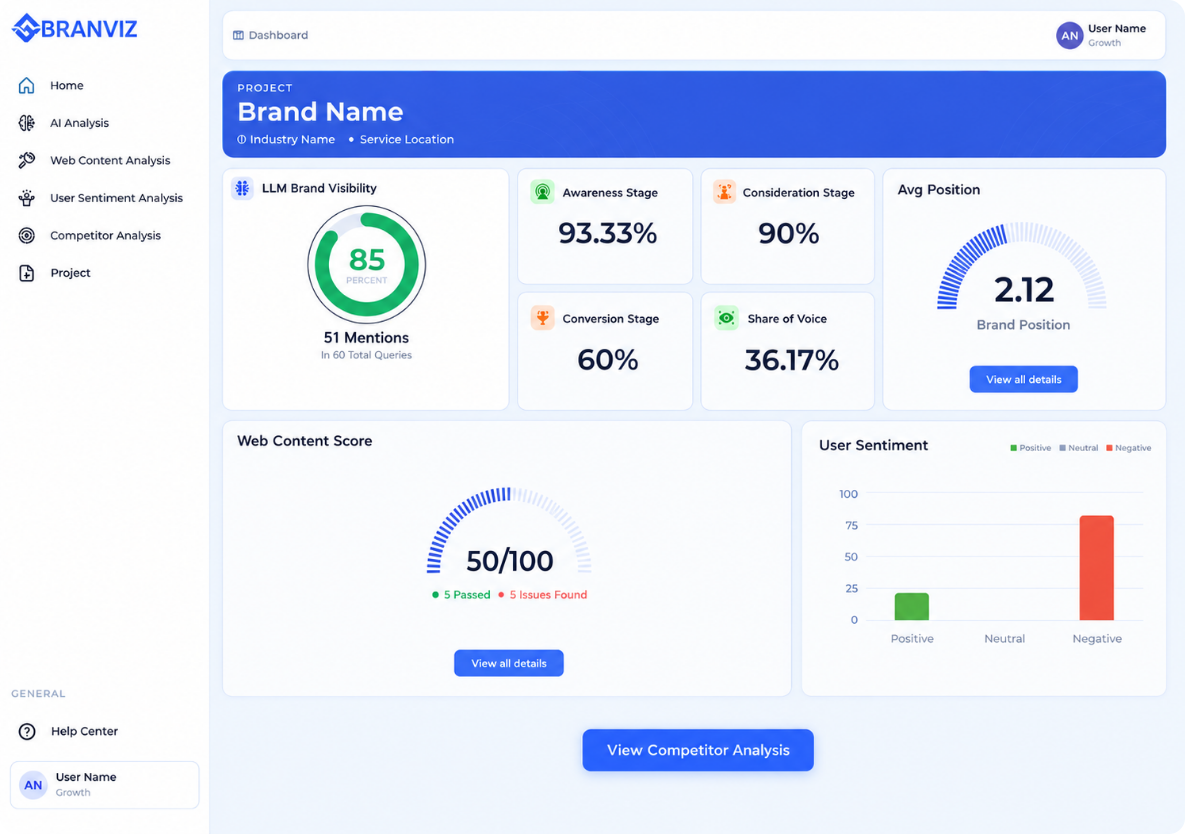
Branviz helps businesses monitor their brand visibility across ChatGPT, Gemini, Perplexity, Grok, and Google AI Overviews.
It brings together brand mentions, citation sources, share of voice, sentiment, visibility scores, and competitor comparisons, allowing teams to examine their performance across different AI platforms.
For PR and content teams, this information can help identify areas where the brand has limited visibility or where competitors are appearing more frequently.
Branviz or any other tools like that promises AI Visibility tracking, does not determine how much revenue a particular citation generates or guarantee that publishing on a specific website will result in an AI recommendation. Its purpose is to make brand visibility and citation patterns easier to monitor so that marketing teams can make more informed decisions.
Stop Chasing Citation Rankings. Start Understanding Your Market.
The growing volume of AI citation research offers useful insights into how different platforms retrieve and reference information. But a global ranking should never become a substitute for understanding your own customers.
Reddit may be a leading source in one dataset, while YouTube or an editorial publication may be more relevant in another. The difference depends on the platform, query, industry, and reporting period.
For businesses, the real opportunity lies in connecting this information with their PR and content strategy.
Understand which sources appear for your customers' questions. Examine what those sources say about competing brands. Identify where your own business is missing or being represented inaccurately. Then invest in the publications, content formats, and customer conversations that address those gaps.
The objective is not to appear everywhere AI search engines look. It is to build a credible brand presence in the sources that matter when your customers are deciding whom to trust.

FAQs