What is Prompt-Level Visibility (and Why It's Not the Same as Keyword Rankings)
Jitender • 7/22/2026

For two decades, digital success has been measured one way: where a page ranks on a search engine results page. Rank #1 for the right keyword, and the traffic (and the customers) follow.
That model is starting to crack.
A growing number of buyers no longer type keywords into Google and scroll through ten blue links. They ask ChatGPT, Gemini, Claude, and other AI assistants a direct question and expect a direct answer, often with a brand recommendation built right in. When that happens, there's no results page to rank on. There's just the AI's response, and your brand is either part of it or it isn't.
This is where keyword rankings stop telling the full story. A brand can rank #1 on Google for its most important terms and still be completely absent when an AI assistant answers that same question. That gap is what Prompt-Level Visibility measures, and it's quickly becoming a metric modern brands need to track alongside traditional SEO.
What is Prompt-Level Visibility?
Prompt-Level Visibility is a simple idea: it measures whether your brand actually shows up when someone asks an AI assistant a question related to your industry, product, or service.
Instead of tracking a position on a search results page, it tracks something more direct: does the AI mention your brand, cite your content, or recommend you at all when a real user prompt is run?
That distinction matters. A keyword ranking tells you where a page sits in a list of links. Prompt-Level Visibility tells you whether you exist inside the answer a person actually reads. There's no "position #4" in an AI-generated response. You're either part of the conversation or you're invisible to it. For a deeper breakdown of this concept, see what LLM visibility means and why it matters for your brand.
How Prompt-Level Visibility Works
AI assistants don't generate answers by matching exact keywords the way a search index does. They interpret the intent behind a question, draw on training data and, increasingly, live web content, then compose a response that pulls together information from multiple sources.
A few things shape whether your brand makes it into that response:
- User intent, not exact phrasing. The AI is answering the underlying question, not matching a search string.
- Context and topical relevance. Content that clearly and thoroughly addresses a topic is more likely to get pulled into an answer.
- Authority signals. Brands that get mentioned consistently across trusted sources carry more weight in how an AI "understands" who the credible players in a space are.
- Structure and clarity. Well-organized, easy-to-parse content is easier for an AI system to extract and reuse accurately.
Showing up in an AI answer has less to do with optimizing for a search algorithm and more to do with becoming a genuinely reliable, well-referenced source of information on your topic.
Why Prompt-Level Visibility Matters
The customer journey itself is changing. More people are getting their answer directly from an AI assistant without ever clicking through to a website. Product comparisons, recommendations, and even purchase decisions are starting to happen inside the AI conversation, before a brand's own website ever enters the picture.
That shift creates real business stakes. Strong Prompt-Level Visibility can drive:
- Higher brand awareness, since your name enters the conversation even when no one searched for it directly.
- Increased trust, because being recommended by an AI carries an implicit third-party endorsement.
- Better consideration during buying decisions, so you're on the shortlist before the buyer even starts comparing options themselves.
- Competitive advantage, since if competitors are absent from AI answers and you're not, you win consideration by default.
Brands that ignore this shift risk becoming invisible at exactly the moment more of their prospective customers are asking questions and expecting answers. That risk is more widespread than most companies realize. A recent analysis found that a large share of brands are effectively invisible in AI search without knowing it.
Prompt-Level Visibility vs Keyword Rankings
Traditional SEO is built around ranking web pages. It's driven primarily by keyword targeting and backlink profiles, and success is measured by position on a results page.
Prompt-Level Visibility is built around being part of the answer itself. It's driven by authority, contextual relevance, and topical depth, and success is measured by mentions, citations, and recommendations rather than rank.
These two approaches aren't competitors. They're complementary. But they require different strategies, and a brand that only tracks the first one is flying blind on the second.
What Factors Influence Prompt-Level Visibility?
Several overlapping factors determine whether an AI assistant surfaces your brand:
- Content quality: thorough, accurate, well-written content is simply more useful to pull from.
- Brand authority: how consistently and credibly your brand is referenced across the web.
- Topical expertise: depth of coverage on a subject, not just a single optimized page.
- Structured content: clear headings, lists, and definitions that are easy to extract.
- Digital PR and brand mentions: being referenced by other trusted publications and sites.
- First-party data: original research, statistics, or insights only your brand can offer.
- Content freshness: regularly updated information signals current relevance.
- Customer reviews and reputation: sentiment across review platforms and forums.
How to Improve Prompt-Level Visibility
Improving your presence inside AI-generated answers takes a deliberate content and authority strategy:
- Publish comprehensive content that fully answers a topic rather than skimming the surface.
- Build topical authority by covering a subject area in depth over time, not just with one-off posts.
- Answer real customer questions using the language and phrasing people actually use.
- Create comparison pages and resource hubs that AI systems can reference for decision-making queries.
- Earn mentions from trusted publications through digital PR and third-party coverage.
- Maintain consistent brand information across your website, listings, and social profiles.
- Update existing content regularly so it stays accurate and current.
- Improve E-E-A-T signals: experience, expertise, authoritativeness, and trustworthiness.
- Strengthen internal linking so AI crawlers and search engines can better understand how your content connects.
How to Measure Prompt-Level Visibility
You can't improve what you don't measure. Key metrics to track include:
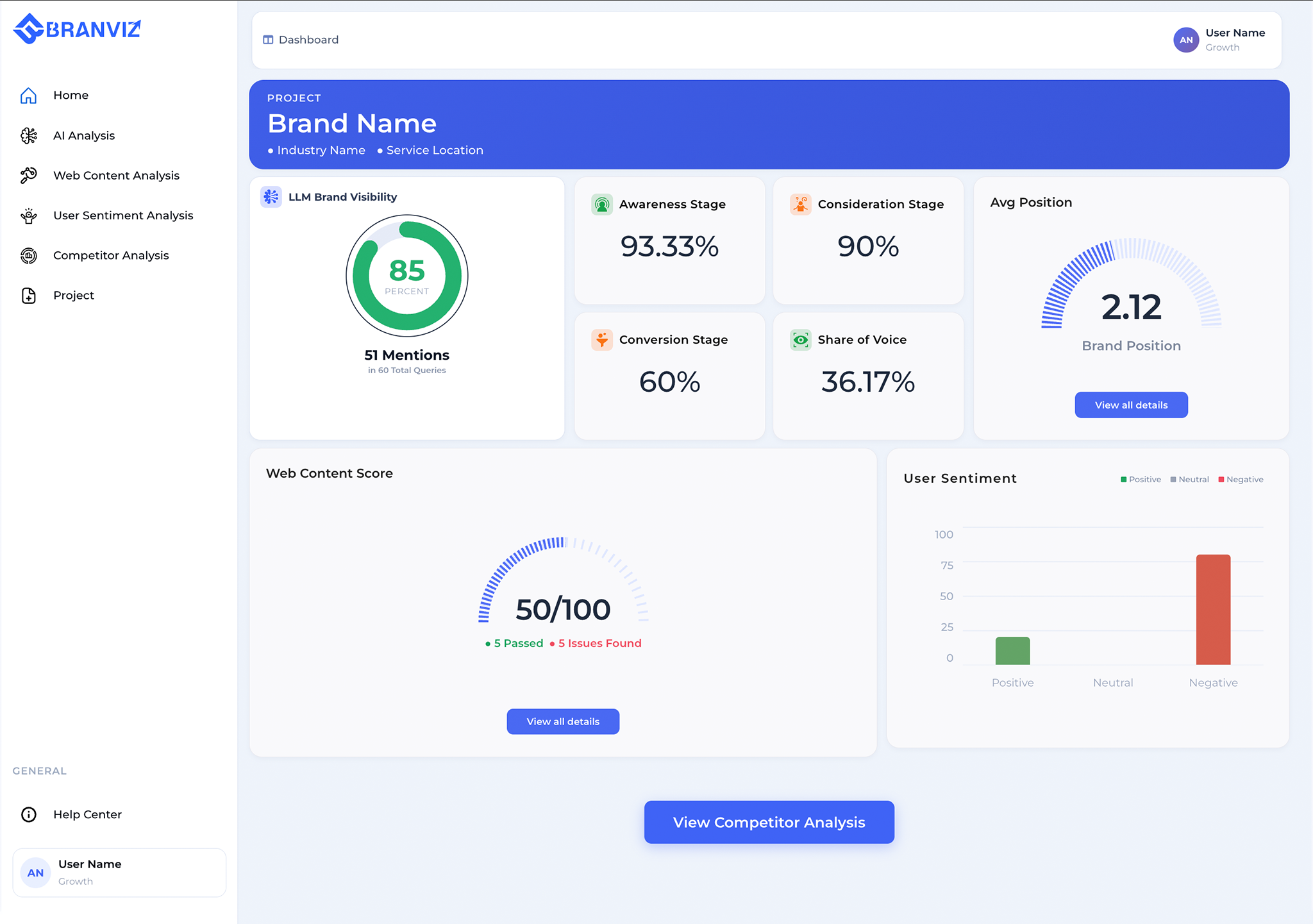
- Brand mentions: how often your brand appears in AI responses
- AI citations: how often your content is directly referenced as a source
- Prompt coverage: the range of relevant prompts where you appear at all
- Share of voice: your visibility relative to competitors
- Recommendation rate: how often you're actively recommended, not just mentioned
- Sentiment: whether mentions are positive, neutral, or negative
- Competitor comparison: how your visibility stacks up against rivals
- Visibility by AI platform: performance across ChatGPT, Gemini, Claude, and others individually
What Metrics Should an LLM Visibility Tool Track?
A purpose-built LLM visibility tool should go further than manual spot-checks and track:
- Share of voice across your competitive set
- Brand mention frequency over time
- AI citation rate, or how often you're the actual cited source
- Recommendation score, the strength and frequency of direct recommendations
- Sentiment analysis of how your brand is described
- Competitor visibility benchmarked directly against yours
- Prompt coverage across the full range of relevant queries
- Funnel stage visibility, showing whether you appear at awareness, consideration, or decision stage
- Geographic visibility, or how mentions vary by region
- Trend analysis over time to catch gains or losses early
Tracking these metrics consistently is what turns Prompt-Level Visibility from an abstract concept into an actionable growth channel. A dedicated AI visibility tool can automate this tracking so you're not manually running the same prompts across every platform every week.
How to Track Brand Mentions Across AI Platforms
Different AI assistants pull from different sources, weight authority differently, and update on different timelines. That means your visibility can vary a lot from one platform to the next, so monitoring just one isn't enough. You need visibility into:
- ChatGPT
- Gemini
- Claude
- Perplexity
Comparing performance across these platforms reveals where you're strong, where you're invisible, and where competitors are quietly winning the recommendation. Rather than manually querying each assistant one by one, a centralized visibility dashboard lets you compare results side by side, spot trends over time, and prioritize the platforms where your audience is actually asking questions.
Common Mistakes Brands Make
Many brands are still applying an SEO-only playbook to a landscape that has already shifted. The most common mistakes include:
- Focusing only on keyword rankings and ignoring AI-generated answers entirely
- Ignoring conversational search intent in favor of exact-match keyword targeting
- Publishing shallow content that doesn't hold up to AI-level scrutiny
- Not building topical authority beyond isolated blog posts
- Measuring success only through website traffic
- Neglecting brand reputation and digital mentions outside their own website
The Future of AI Search and Brand Visibility
AI-powered search isn't a passing trend. It's a growing share of how people find information, compare options, and make decisions. Over time, Prompt-Level Visibility is likely to become a standard marketing metric, tracked with the same rigor as keyword rankings and paid media performance today.
Importantly, this doesn't mean traditional SEO is going away. SEO and AI visibility will increasingly work together, since strong SEO fundamentals like authority, structure, and quality content are also the foundation of strong Prompt-Level Visibility. The brands that start optimizing for both now will have a real head start over those that wait.
Conclusion
Prompt-Level Visibility measures something keyword rankings never could: whether your brand actually shows up inside the answers people are reading right now, across AI assistants like ChatGPT, Gemini, and Claude. It's driven by authority, context, and topical depth rather than keywords and backlinks alone, and it's measured through mentions, citations, and recommendations rather than search engine position.
As more of the customer journey moves inside AI conversations, brands that measure and optimize only for traditional SEO are missing half the picture. The smartest approach isn't choosing one over the other. It's tracking both, understanding how they complement each other in AI search, and treating Prompt-Level Visibility as an essential, ongoing part of your digital marketing strategy.

FAQs