AI Citation Tracker: How to Monitor Every Time an LLM Cites Your Brand
Varun • 8/27/2026
There's a difference between an AI model mentioning your brand in passing and an AI model actually citing you as a source behind its answer. A mention is your name showing up in a sentence. A citation is the model treating your content, your data, or your page as something worth pointing to directly. If you're only tracking mentions, you're missing half the picture of how AI systems actually use your brand.
This is where an AI citation tracker becomes useful. It's the practice of monitoring every time a large language model references your content directly, rather than just noticing when your name comes up in conversation.
AI Citation vs AI Mention: What's the Real Difference
A mention can happen anywhere in an AI answer, sometimes just as part of a list of options. A citation is more specific. It's when a model points to your content as the actual source behind a claim, a statistic, a recommendation, or a piece of advice. In tools like Perplexity, this often shows up as a visible link back to your page. In ChatGPT and Gemini, it's less visible on the surface but still shapes how confidently and specifically the model can describe what you do.
The distinction matters because citations carry more weight than mentions. A brand that gets cited is being treated as a trustworthy source, not just a name the model happened to recall. That's a meaningfully stronger position to be in.
Why AI Citation Tracking Matters for Brand Visibility
Most brands that track AI visibility focus on whether they show up at all. That's a reasonable starting point, but it stops short of showing you something more useful, which sources the model actually trusts enough to pull from directly. Two competitors might both get mentioned in an answer, but only one of them might actually be cited as the source behind a specific claim. That difference tells you a lot about who the model considers authoritative in that category.
This connects closely to prompt-level visibility, since citations tend to show up on specific, detailed prompts rather than broad ones. A vague question rarely produces a specific citation. A detailed, technical, or comparison-style question is far more likely to pull in a direct source, which is exactly where citation tracking becomes valuable.
How to Track AI Citations Across ChatGPT, Gemini, and Perplexity
The manual approach is straightforward in theory. Run prompts relevant to your category across ChatGPT, Gemini, and Perplexity, and check whether your content is referenced directly, not just your brand name in passing. Perplexity makes this easiest since it often shows source links openly. ChatGPT and Gemini require more attention, since citations there tend to show up as specific, accurate details about your product rather than a visible link.
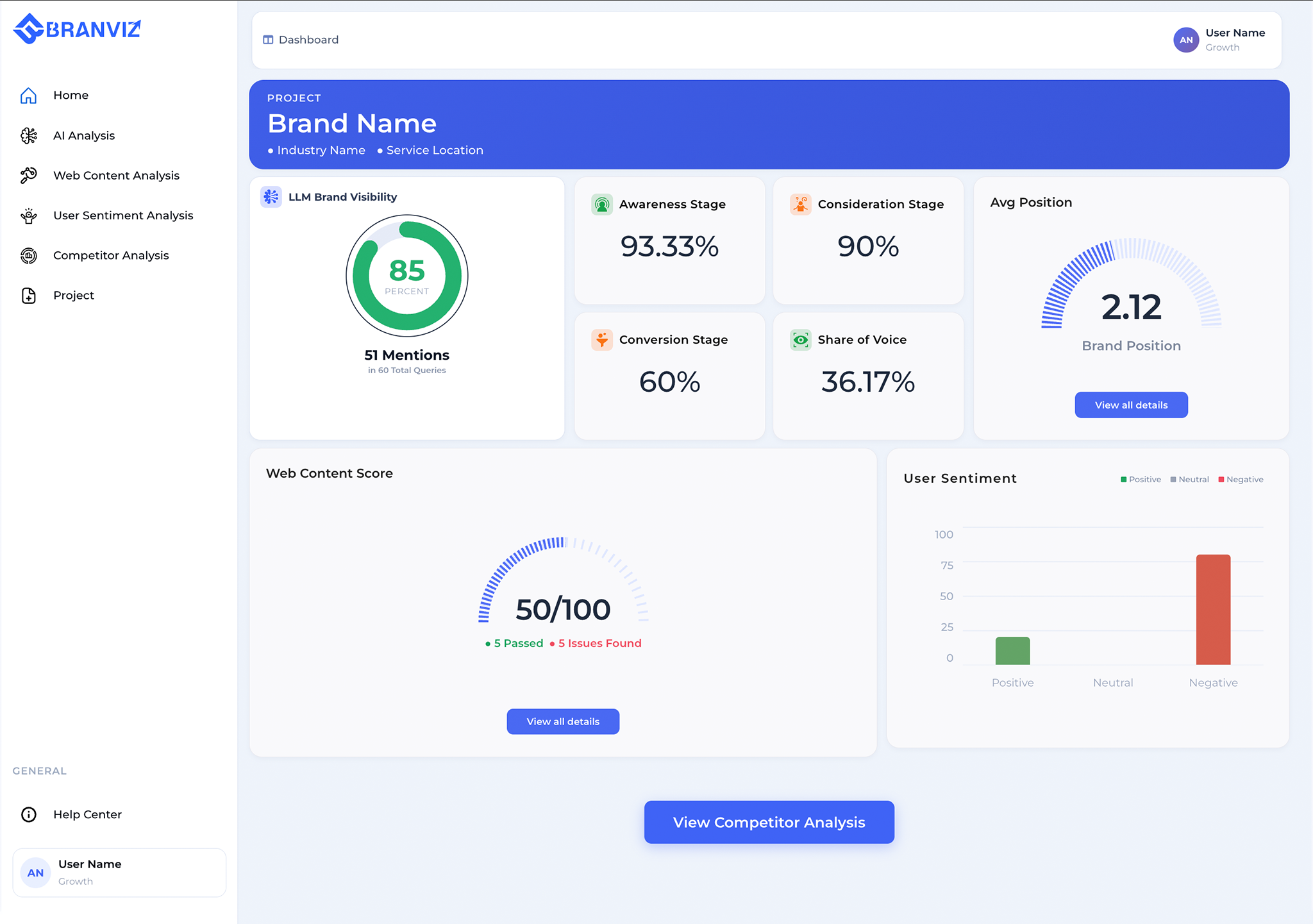
This is also the part that becomes hard to sustain manually once you're tracking more than a handful of prompts. Branviz was built to handle exactly this kind of ongoing citation and mention tracking automatically, across all three models at once, so you're not stuck running the same prompts by hand every now and then.
The harder part is doing this consistently. Branviz make it easy for the users, Since, AI models update regularly, and the content they pull from shifts as the web changes, which means a citation you earned last month isn't guaranteed to hold today. Checking once and calling it done gives you a snapshot, not a real read on your standing. This is also where citation tracking connects to your broader AI share of voice, since consistent citations across multiple prompts and models are one of the clearer signals behind who's actually winning that share.
What Makes AI Models Cite Your Brand as a Source
Not all content earns citations equally, and understanding why helps explain where to focus.
Specific, factual content tends to get cited far more than broad marketing pages. A page with clear data, a defined process, or a direct answer to a common question gives a model something concrete to point to. Vague, promotional language rarely works the same way, since there's nothing precise enough for the model to reference confidently.
Consistency matters too. If a model has cited you before and your content hasn't changed in a way that contradicts that earlier reference, it's more likely to keep citing you. This ties back to how clearly a model understands your brand as a whole, which is really a question of entity clarity. A brand the model already understands well is simply an easier, safer source to cite than one it's still piecing together.
Original data and firsthand information also carry real weight. If you're the source of a statistic, a study, or a specific process rather than repeating something already published elsewhere, models are far more likely to treat you as the citation-worthy origin rather than just another page covering the same ground.
Turning AI Citation Data Into a Content Strategy
Once you know which prompts and questions actually pull citations from your content, the next step is doing more of what's working and fixing what isn't.
If certain pages get cited consistently, that's a signal to keep them updated and accurate, since a citation can quietly disappear if the underlying content goes stale. If you notice a competitor getting cited on questions where you'd expect to be the more relevant source, that's worth investigating directly. Sometimes it comes down to them having more specific, structured content on that exact topic. Sometimes it's a sign your own content is too vague to be pulled from directly, even if it technically covers the topic.
It also helps to look at how this fits into your broader AEO performance, since citation tracking is really one layer of a larger picture that includes mentions, sentiment, and overall visibility across AI-generated answers.
Common AI Citation Tracking Mistakes to Avoid
Treating every mention as a citation is one of the most common mix-ups, and it inflates how strong your actual standing looks. Checking only once instead of tracking consistently is another, since a single check tells you very little about a trend. Some brands also focus entirely on Perplexity because citations are visible there, while ignoring the fact that ChatGPT and Gemini are shaping brand perception just as much, even without a visible link. And it's easy to overlook that citation-worthy content usually needs to be specific and factual, not written the way a landing page or ad copy typically is.
Building an Ongoing AI Citation Tracking Habit
Knowing you got mentioned by an AI model is useful. Knowing you got cited as the actual source behind a claim tells you something stronger, that the model trusts your content enough to point to it directly. Building a habit of monitoring this consistently, rather than checking once and moving on, is what turns citation tracking from a curiosity into something that actually shapes how you invest in content going forward. If you want a clearer, ongoing read on this across your own brand, running an audit with Branviz is a straightforward way to see where you currently stand.

Varun
AuthorVarun is a dedicated search strategist and Technical SEO specialist focused on future-proofing digital brands. With deep expertise in Answer Engine Optimization (AEO) and Generative Engine Optimization (GEO), they help businesses dominate both traditional SERPs and AI-driven platforms. Known for rigorous technical audits and data-backed strategies, Varun shares actionable insights to help brands build undeniable authority, maximize AI visibility, and thrive in today’s complex search landscape.
FAQs