How Online Reviews Influence Whether AI Recommends Your Business
Jitender • 10/22/2026

Online reviews do affect whether AI recommends your business, but not in the way a simple star average would suggest. AI engines are not scanning for a five-star badge and stopping there. They pull together whatever they can find about a business from multiple sources, including reviews, and use that combination to judge whether a business is real, active, and trustworthy enough to actually recommend by name.
Reviews and recommendations work as a trust signal more than a scoring mechanism. A single glowing review barely moves that judgment. Reviews that are recent, specific, and spread across more than one platform move it considerably more.
Why AI Models Treat Reviews as Evidence, Not Just a Rating
When someone asks ChatGPT, Perplexity, or Google AI for a recommendation, the model isn't pulling up a star rating the way a person scanning Google Maps would. It's building an answer from everything publicly available about a business, its website, directories, social mentions, and reviews wherever they're visible. Reviews function as corroborating evidence in that process, helping confirm that real customers have actually interacted with the business, not just that the business exists on paper.
This matters because ai search reviews business behavior increasingly overlaps with how people already evaluate trust. A growing share of consumers now say they trust an AI-generated recommendation roughly as much as they'd trust reading reviews directly, which means reviews and AI answers are feeding into the same underlying trust decision rather than sitting in separate categories.
Where Reviews Matter Most
This weighs more heavily for businesses where trust is the deciding factor before someone commits, medical and dental practices, contractors, legal services, and similar categories where a bad experience is costly to undo. It matters less for businesses competing primarily on price or pure availability, where reviews play a smaller role in the actual decision being made.
Why a Perfect Star Rating Can Backfire
It's tempting to assume more five-star reviews are always better, but research on consumer trust has found that a meaningful share of people become skeptical when every single review is positive with no exceptions. AI models reflect that same skepticism to some degree, since suspiciously uniform praise reads as less authentic than a realistic mix that includes the occasional four-star review alongside evidence that a business responds to concerns when they come up.
Reviews Alone Aren't Enough, Consistency Matters Too
Google reviews ai visibility only tells part of the story, since most AI tools cannot see directly inside Google's own review data the way a person browsing Google Maps can. A business with excellent reviews concentrated entirely on one platform and nothing anywhere else may still be effectively invisible to an AI system pulling from different sources entirely.
This is where review presence connects to a broader pattern. If your business name, address, or phone number differ even slightly across the platforms where your reviews live, an AI system encountering that conflicting information tends to discount the reviews themselves, even when they're genuinely positive.
This is the same underlying problem covered in fixing NAP inconsistencies that quietly hurt your AI visibility], just showing up specifically through review platforms instead of directories or business listings.
How This Fits Into the Bigger Picture of Trust
Reviews are one input into a larger judgment a model makes about whether a business is a confident, well understood entity worth naming. Cross-referencing a business's details across every available platform is part of how that judgment gets formed, and inconsistent details anywhere in that mix lower a model's confidence in the business as a whole. This ties closely to entity clarity, since a model needs to be confident about who a business actually is before review sentiment can meaningfully help its case.
Being absent from AI results entirely carries its own signal too. A business that's hard to find mentioned anywhere by AI systems can come across as less established, even before a single review is factored into the picture.
A Practical Way to Audit Your Review Presence
Start by mapping out where your reviews actually exist today, not only on Google, but on Yelp, Facebook, industry-specific platforms, and anywhere else customers naturally leave feedback. Check that your business name, address, and phone number match exactly across every one of those platforms. Look at how recent your reviews are and whether they mention real specifics, a particular service, a staff member, an actual outcome, rather than generic praise with no detail behind it.
Common Mistakes Businesses Make With Reviews and AI Visibility
Relying entirely on one platform for reviews and assuming that covers the whole picture. Chasing a perfect five-star average instead of a realistic, varied set of detailed reviews. Letting business information drift out of sync across the platforms where reviews are collected. Treating a review push as a one-time campaign instead of an ongoing habit, since recency matters as much as total volume. Ignoring negative reviews instead of responding to them, which removes a signal that the business is actively engaged rather than dormant.
Does Having Great Reviews Guarantee an AI Recommendation
Strong, consistent reviews make a business considerably easier for an AI system to trust and recommend confidently. They do not guarantee a mention on their own. Visibility still depends on a broader set of signals working together, consistent business information, genuine entity clarity, and real relevance to the specific question being asked. Reviews strengthen the case, they don't replace the rest of it, which is part of why regular AI visibility audits matter, checking review presence alongside everything else rather than reviews being treated as a standalone fix.
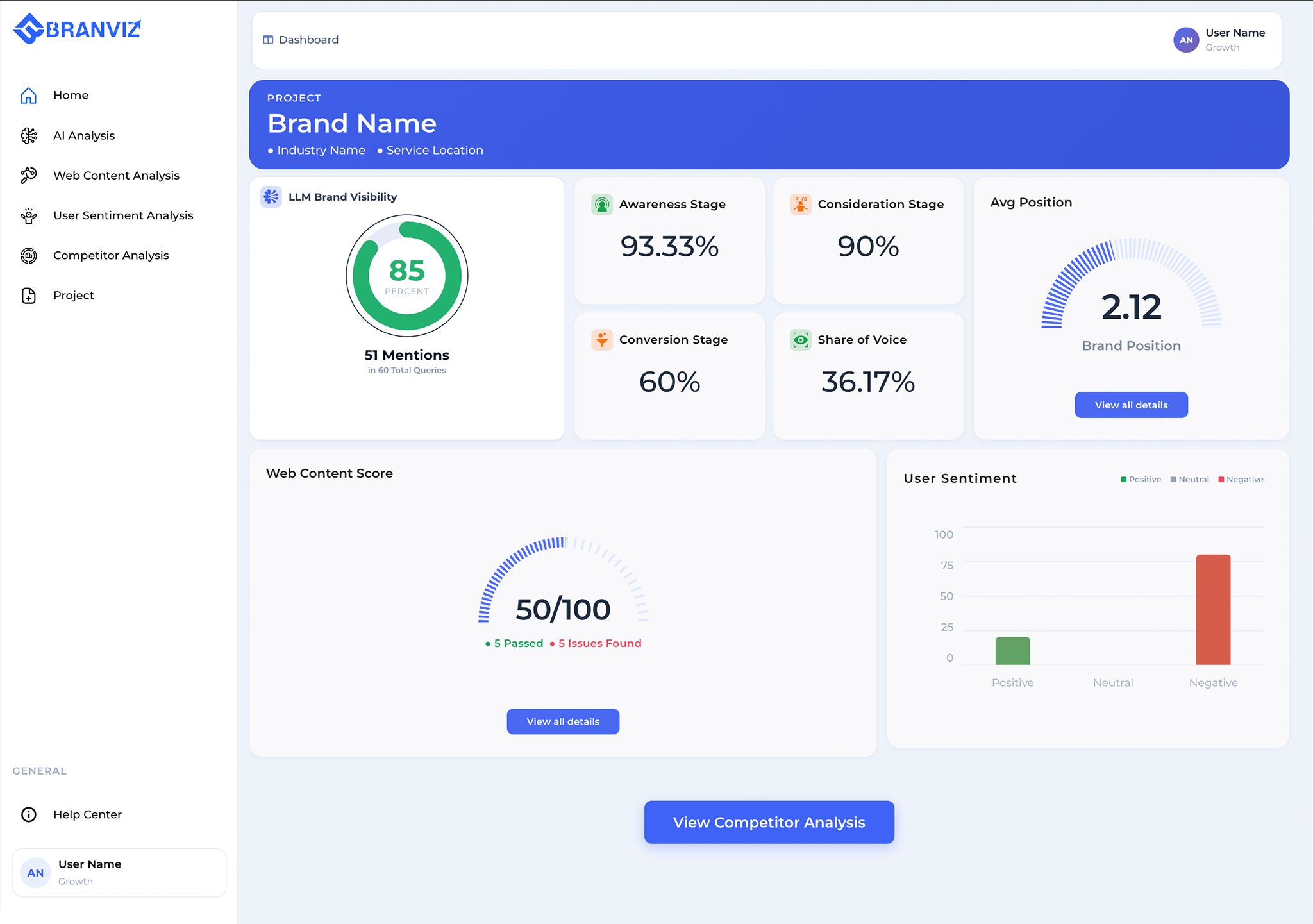
Review management is only part of understanding how your business appears in AI-generated recommendations. With Branviz, businesses can monitor their brand mentions across AI platforms, analyze AI visibility, and compare their presence with competitors. Tracking these signals over time can help you understand whether your brand is being mentioned in relevant AI responses and identify areas where stronger brand information, credibility, and visibility may be needed.
Conclusion
Online reviews shape whether AI recommends a business, but through trust and consistency rather than a simple star count. Recent, specific reviews spread across multiple platforms, backed by consistent business information everywhere they appear, give an AI system real evidence to work with. Treat review management as an ongoing habit tied to the rest of your visibility work, not a one-time push, and it becomes one of the more controllable levers a business actually has in this space.

FAQs