What Is LLM Visibility and Why Does It Matter for Any Brand?
Jitender • 6/23/2026
LLM visibility is how often your brand appears in AI-generated answers from tools like ChatGPT, Gemini, Claude, and Perplexity. It matters because buyers increasingly use these tools to discover, compare, and shortlist products and services before visiting a website.
Your brand can rank well in Google and still be missing from the answers buyers get in ChatGPT, Gemini, Claude, or Perplexity.
That gap is becoming more important. As user behavior evolves, many buyers now use AI tools to research software, compare options, find alternatives, and narrow down shortlists before they ever visit a website. In many cases, the first list of options is no longer shaped by a search results page. It is shaped by an AI-generated answer.
That is where LLM visibility comes in.
LLM visibility is not a broad idea about AI in general. It is a specific way of looking at whether your brand shows up inside the responses generated by large language models. If a buyer asks ChatGPT for the best AI visibility tools, asks Perplexity for alternatives to a competitor, or asks Gemini to compare agencies in a category, does your brand appear in the answer? If it does, how is it described? And if it does not, why not?
What Is LLM Visibility?
LLM visibility refers to how often large language models (such as chatgpt, gemini, claude) mention, recommend, describe, compare, or cite a brand in response to relevant prompts.
In practical terms, it answers questions like:
- Does ChatGPT include your brand when someone asks for the best tools in your category?
- Does Gemini mention your company in a comparison between competitors?
- Does Claude surface your brand when a buyer asks for alternatives?
- Does Perplexity cite your site, reviews, or third-party mentions when answering category-level questions?
This is narrower than general AI visibility.
AI visibility is the bigger umbrella. It can include brand presence across AI search, AI Overviews, answer engines, assistants, and broader AI-driven discovery experiences. LLM visibility focuses on one very specific layer inside that landscape: your presence inside the actual answers generated by large language models.
That distinction matters because a brand can have some level of AI visibility overall and still be weak inside LLM responses that shape real buying decisions. LLM visibility is about whether your brand is present when the model is asked to recommend, compare, shortlist, or explain options in your category.
Where LLM Visibility Shows Up
LLM visibility matters most when buyers use AI tools in the middle of a decision-making process, not just for casual information gathering. These prompts usually fall into a few repeatable patterns.
Recommendation prompts
These are prompts where the user asks the model to suggest options in a category. You can try for your business.
Examples:
- best AI visibility tools
- top SEO agencies for SaaS
- best project management software for remote teams
- top tools for B2B lead enrichment
This is one of the clearest LLM visibility moments because the model is effectively acting as a recommender. If your brand is not included in those answers, you are invisible at a critical point of discovery.
Comparison prompts
These prompts ask the model to evaluate multiple options side by side.
Examples:
- Branviz vs Profound
- Branviz vs Ahrefs vs Semrush for enterprise SEO
- best alternatives to traditional market research tools
- compare AI search visibility platforms for SaaS brands
In these prompts, visibility is only part of the story. The model is also shaping how your brand is framed. It may position one tool as better for enterprise teams, another as more useful for agencies, and another as stronger for tracking citations. That framing can influence buyer perception before a prospect ever reads your product page.
Alternatives prompts
These prompts are often triggered by an existing brand in the category.
Examples:
- alternatives to Branviz
- tools like HubSpot for startups
- alternatives to Branviz for AI brand monitoring
- cheaper alternatives to [software name]
Alternative-seeking prompts are especially valuable because they often signal active evaluation. If your brand appears in those answers, you are being introduced at the moment someone is looking beyond an incumbent.
Category discovery prompts
These prompts are broader and often come earlier in the journey.
Examples:
- what are the best tools for monitoring brand visibility in AI search
- how do companies track mentions in ChatGPT
- top software for measuring AI recommendations
- best agencies for technical SEO and AI visibility
These prompts may not mention any brand at all. The buyer is simply trying to understand the category and see who the key players are. LLM visibility matters here because the model is effectively building the buyer’s mental map of the market.
Why Some Brands Show Up in LLM Answers and Others Don’t
This is the core of LLM visibility. Brands do not appear in model responses by accident. In most cases, visibility is shaped by a mix of how clearly the brand is positioned, how often it is referenced across the web, and whether the available content matches the kinds of prompts buyers actually use.
1. Clear category positioning
If your brand is hard to classify, it is harder for an LLM to surface it in category-level answers.
Large language models work by identifying patterns in the information they have access to and generating answers based on those patterns. If your website, product pages, documentation, and third-party mentions all describe your company in slightly different ways, the model may struggle to place you in a specific category.
For example, imagine a company that presents itself in different places as an AI SEO platform, a content intelligence tool, a search analytics product, and a brand monitoring solution. Each label may be partly true, but the inconsistency weakens the signal. When a buyer asks for the best AI visibility tools, the model may be more likely to surface brands that are more consistently associated with that category.
Strong LLM visibility usually starts with simple, repeatable category clarity:
- what you are
- who you are for
- what use cases you solve
- what category you belong in
If those signals are vague, your visibility will usually be weaker.
2. Strong third-party mentions, reviews, and comparisons
LLMs do not form brand opinions from your website alone. They absorb signals from the broader web, including review sites, listicles, comparison pages, community discussions, editorial mentions, analyst writeups, and product roundups.
That matters because recommendation-style prompts often require the model to decide which brands are credible enough to include. A brand with strong third-party validation has a better chance of being mentioned than a brand that only talks about itself.
This does not mean every brand needs to chase generic press coverage. It means off-site presence matters in places that help the model connect your brand to a category and a use case. Reviews, comparison articles, “best tools” roundups, and expert commentary all strengthen the chance that a model will encounter and reinforce those associations.
If you want a deeper view into the underlying inputs behind AI answers, it helps to understand how AI gets its knowledge, especially the role of training data, retrieval systems, and external sources.
3. Consistent brand messaging across the web
LLM visibility is not only about whether your brand is mentioned. It is also about whether the model can build a coherent picture of what your brand does.
If your homepage says one thing, your LinkedIn page says another, your guest posts focus on a different angle, and review sites categorize you inconsistently, the result is a fragmented brand signal. LLMs are more likely to produce reliable brand mentions when the message is stable across sources.
That consistency should show up in:
- category labels
- product descriptions
- use-case language
- comparison positioning
- proof points and differentiators
When those elements line up across your owned and earned presence, the model has a stronger basis for including and describing your brand accurately.
4. Content that matches buyer-intent and recommendation-style prompts
One of the biggest mistakes brands make is creating content that is useful for ranking but not especially useful for LLM-driven recommendation prompts.
A lot of content is built around informational SEO terms, generic product messaging, or feature pages that never answer the kinds of questions buyers now ask AI systems. But LLM visibility is often won in prompts such as:
- best tools for X
- compare A vs B
- alternatives to C
- software for teams that need Y
- top agencies for Z
If your site and supporting content never address those buying-context questions, you leave a gap between what the model needs to answer and what your brand has actually published.
Brands that perform better in LLM answers usually have content that maps more closely to buyer intent. That can include:
- comparison pages
- alternative pages
- category pages
- use-case content
- “best fit for” messaging
- pages that explain who the product is for and when to choose it
This does not guarantee inclusion in every answer, but it improves the relevance signals that support LLM visibility.
Why LLM Visibility Matters for Brands
The practical reason LLM visibility matters is simple: AI tools are now shaping shortlists before website visits happen.
A buyer might ask ChatGPT for the best tools in a category, ask Gemini to compare two options, then ask Perplexity for alternatives before ever clicking a single vendor site. If your brand is not present in those answers, you may lose consideration before your normal funnel even starts.
AI tools now influence discovery and shortlisting
Search used to be the obvious first stop for category discovery. Now that process is splitting. Some buyers still search traditionally. Others go straight to AI tools because they want a synthesized answer instead of a list of blue links.
That changes where brand discovery happens. Instead of discovering you from a SERP and then researching further, a buyer may discover only the brands that an LLM mentions. If your brand is absent from that first answer, you may never enter the evaluation set.
Absence from AI answers means lost consideration
Being missing from a relevant LLM answer is not just a visibility issue. It is a pipeline issue.
If buyers are using ChatGPT, Claude, Gemini, or Perplexity to find options in your category, then visibility inside those tools affects whether your brand is even considered. This is especially important in crowded categories where the model will only mention a handful of names.
In other words, LLM visibility is not just about attention. It is about inclusion in the shortlist.
LLMs shape brand perception, not just mentions
It is also worth paying attention to how your brand is described.
A model might mention your company but frame it as better for small teams, less mature than a competitor, stronger in one use case, or more niche than the market leader. Those descriptions influence perception, especially for buyers who are still early in the research process.
That means LLM visibility has two layers:
- whether your brand appears
- how the model positions your brand when it does appear
Both matter.
This matters most in competitive B2B categories
LLM visibility is especially important in categories where buyers actively compare options before booking a demo or speaking to sales. That includes:
- SaaS categories with multiple similar tools
- agencies competing in specialist service areas
- B2B software with long evaluation cycles
- products where category education and comparison heavily influence buying
In those environments, the brands that appear consistently in AI answers gain an advantage in discovery, recall, and consideration.
How to Improve and Measure LLM Visibility
Improving LLM visibility is not about trying to “rank” inside a model in the same way you would rank in search. It is about strengthening the signals that make your brand more likely to be included in relevant answers and then measuring how often that actually happens.
Make category positioning clearer
Start with the basics. If your brand is difficult to classify, LLM visibility will be harder to earn.
Review your homepage, product pages, meta messaging, comparison pages, and external profiles. Ask a simple question: if a model had to explain what this brand does in one sentence, would the answer be consistent everywhere?
Your category positioning should be obvious. Your use cases should be obvious. Your ICP should be obvious. If those signals are muddy, clean them up first.
Build comparison and use-case content
If buyers ask for recommendations and comparison prompts, your content should support those journeys.
Useful assets include:
- competitor comparison pages
- alternative pages
- category landing pages
- use-case pages for specific teams or outcomes
- content built around software selection questions, not just top-of-funnel education
This helps connect your brand to the same buyer-intent prompts that trigger LLM recommendations.
Strengthen off-site brand mentions
Owned content matters, but off-site validation matters too. Look at where your category gets discussed and evaluated. That may include software directories, expert roundups, partner ecosystems, industry publications, community discussions, and comparison articles.
The goal is not random mentions. The goal is stronger, clearer evidence that your brand belongs in the category and is relevant to the use cases buyers ask about.
Track visibility across prompts and models
This is where many teams get stuck. They test one prompt in ChatGPT, do not see their brand, and draw a conclusion. That is not a measurement strategy.
LLM visibility should be tracked across:
- multiple prompt types
- multiple stages of the buyer journey
- multiple models
- repeated time periods
A brand may appear in category discovery prompts but not in alternatives prompts. It may be visible in Perplexity but not Claude. It may show up for one use case but disappear for another. Without structured tracking, it is very easy to misread the situation.
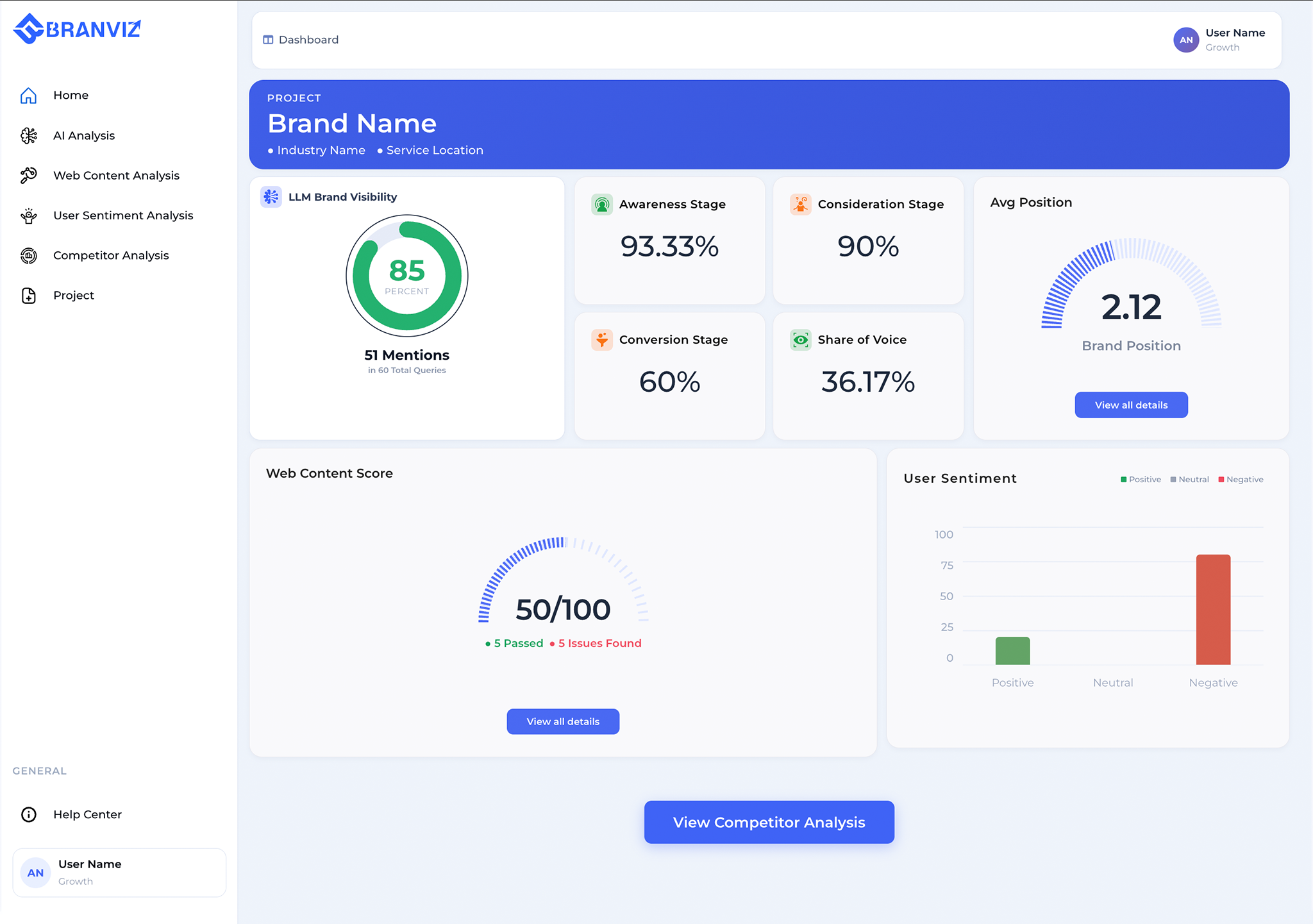
That is why brands need a system to track your brand visibility across models and prompt sets rather than relying on occasional manual checks.
LLM Visibility Is Becoming a New Layer of Brand Discovery
LLM visibility is the layer of brand presence that lives inside AI-generated answers.
It is not the same as broad AI visibility, and it should not be treated as a vague trend. It is a practical question with direct commercial impact: when buyers ask AI systems for recommendations, comparisons, alternatives, and category guidance, does your brand show up?
If the answer is yes, you are more likely to enter the shortlist early. If the answer is no, you risk being invisible during a part of the journey that increasingly happens before a prospect reaches your website.
For brands operating in competitive categories, that makes LLM visibility worth measuring deliberately. Guessing based on a few prompts is not enough. The real opportunity is understanding where your brand appears, where it does not, how it is being described, and what signals are shaping those outcomes across the LLMs buyers actually use.

FAQs