62% of Brands Are Invisible in AI Search (And Most Don't Know It)
Jitender • 6/16/2026
Imagine a prospective customer asking an AI assistant to explain the mechanics of a complex data migration strategy. The AI processes the request, pulls core insights from an insightful whitepaper your team published last month, and delivers a flawless four-paragraph response. The user gets exactly what they need in seconds.
The problem? Your company name appears nowhere in the text.
Even if the AI appends a small footnote at the bottom linking to your site, the user has already found their answer. They close the tab without clicking. Your team produced the foundational research, your server hosted it, and your budget funded it. Yet, as far as the user is concerned, the knowledge came entirely from the AI.
This scenario illustrates a fundamental shift in users' searching behaviors. In traditional search, visibility and recognition occurred simultaneously. If your content was useful, your link appeared at the top of the page, driving clicks and building brand awareness.
In the era of AI-driven answers, information consumption has decoupled from brand attribution. Your content is actively shaping the answers users receive, but your brand is completely invisible.
The Visibility Metrics Most Brands Still Trust
For over two decades, digital marketing teams have relied on an established set of performance indicators. Organic rankings, monthly referral traffic, backlinks, and impressions served as reliable proxies for market share. If a website occupied a top position for a high-intent keyword, the marketing leader could confidently report an increase in brand equity.
These metrics assume a transactional relationship between the searcher and the publisher: the search engine acts as a directory, and the user clicks through to find information. Teams invested heavily in standard organic strategies, focusing heavily on keyword research for SEO to capture those clicks.
To combat this drop-off, forward-thinking growth teams are shifting their budgets toward specialized seo services for saas and comprehensive enterprise seo services that measure true market share rather than empty clicks.
AI search engines change this dynamic by acting as synthesis engines. They ingest vast pools of data, compress the concepts, and present a unified answer directly within the chat interface. When an AI response satisfies the user's intent entirely on the search results page, traditional metrics lose their meaning. A high ranking inside an LLM's training data or retrieval index does not translate to human eyeballs on your logo.
Focusing solely on traditional click-based metrics obscures a critical reality. Focusing solely on traditional click-based metrics obscures a critical reality. A website can maintain stable organic impressions while experiencing a massive decline in actual brand visibility in AI applications.
If users consume your insights through a third-party AI interface, your traditional analytics dashboard will show nothing but a drop in click-through rates. The metrics haven't just shifted; the relationship between holding information and earning recognition has broken down completely.
The Growing Gap Between Citations and Recognition
To address the decline in standard organic traffic, many SEO professionals have turned their attention to tracking citations. The logic seems sound: if an AI engine includes a footnote linking to your article, your brand is still part of the conversation.
Data heavily confirms that relying on source links is a losing strategy for brand building. A comprehensive 2026 study by Semrush revealed a staggering statistic: 62% of AI citations are "ghost citations." This means that in nearly two-thirds of all search instances, an AI engine actively utilizes a website's information as a source link but completely omits the brand name from the actual text answer.
The study, which analyzed thousands of domain appearances across multiple LLMs, shows that the citation rate is nearly double the actual brand mention rate. Furthermore, user behavior within chat interfaces differs fundamentally from traditional search behavior. Users read the generated text block, treat the assistant as the primary authority, and ignore the source links. When an AI appends a link simply to validate an answer it already formulated, it fails to build real awareness.
This behavior introduces severe compliance and visibility hurdles, making it clear why certain AI visibility mistakes keep brands completely hidden from generated summaries.
This creates a severe attribution gap. When an AI appends a link simply to validate an answer it already formulated, the link rarely reflects genuine brand authority. Furthermore, user behavior within chat interfaces differs fundamentally from traditional search behavior. Users read the generated text block, treat the assistant as the primary authority, and ignore the source links.
For marketers, this introduces a difficult truth. Securing a footnote citation is no longer a victory for brand awareness. If your content helps train or inform an AI's response but fails to leave a memorable impression on the end user, your digital footprint is effectively hollow. You are subsidizing the utility of the AI platform while remaining anonymous to your target audience.
The Four Stages of Digital Erasure in Generative Search Optimization
When an AI engine crawls your hard-earned thought leadership, your data goes through a process that actively strips away your brand identity long before a user hits submit on a prompt. Understanding this progression helps explain why great writing goes unrecognized.
When an AI engine processes your content, it moves through a four-step funnel that strips away your brand identity. First, it crawls and indexes your high-quality onsite content. Next, extraction algorithms isolate the raw data, facts, and unique methodologies.
The process then moves into anonymization, where your brand name, logos, and author identity are discarded. Finally, during synthesis, this information is blended with competitor data to formulate a single response, leaving your brand completely separated from the insights you created.
This structural reality means that traditional domain authority offers very little protection. Unless an AI architecture explicitly learns to link a specific proprietary methodology directly to your company entity, your unique corporate insights simply become part of the public domain utility inside the model's neural network.
Being Referenced Is Not the Same as Being Recommended
To understand and work effectively in this environment, marketing teams need a clear way to assess their company's presence within AI platforms. This visibility can be divided into three main levels:
- Referenced: The AI uses your data or text to construct an answer and places a link in a footnote or sidebar. The user reads the information but rarely interacts with the source link. Brand impact is minimal.
- Mentioned: Your company name is explicitly stated within the body of the AI-generated text. For example: "According to data from Company X, cloud migration costs rose significantly last year." Here, the user connects the insight to your brand, creating actual authority.
- Recommended: The AI actively positions your company as the solution to a user’s business problem. When asked, "What are the best enterprise data migration tools for complex infrastructures?", the AI includes your brand in a curated list of top options.
The Strategic Shift: Moving from Referenced to Recommended is the core challenge of modern enterprise digital strategy.
Citation visibility is a technical byproduct of an AI search engine's indexing process. Recommendation visibility, by contrast, represents true commercial value. When an AI engine recommends your brand, it isn't just pulling data from your latest blog post; it has analyzed the consensus of the web and determined that your company is a trusted market leader.
The Fragmentation of Visibility Across Different AI Engines
A major challenge for modern growth teams is that visibility across LLMs is entirely fragmented; a brand that is highly visible in one AI search tool can be completely anonymous in another. AI engines treat citations and brand mentions with wildly different behavioral frameworks.
- OpenAI's ChatGPT: Functions like an academic paper with footnotes. It cites source domains 87% of the time, but explicitly mentions the brand name in only 20.7% of its answers.
- Google's Gemini: Acts like a conversationalist drawing from deep memory. It mentions brand names in 83.7% of its appearances, yet generates a source citation link only 21.4% of the time.
This behavior creates an entirely unique environment for publishers versus consumer brands. Publishers and research-heavy sites will naturally gain more citations than explicit mentions. Conversely, consumer brands must focus on securing unlinked brand mentions on third-party channels like Reddit, tech forums, and industry news coverage, as these external touchpoints directly feed an LLM's familiarity and prompt it to type your name out loud.
AI Understands Brands as Entities, Not Just Websites
To move up this hierarchy, you have to understand how modern retrieval-augmented generation (RAG) systems look at information. AI models do not evaluate the web as a collection of isolated web pages or keyword strings. Instead, they map the digital world as a network of interconnected entities, which includes people, places, organizations, and concepts.
Entity authority is built on the strength of relationships. An AI model determines what your brand represents by scanning across millions of sources: industry publications, forums, social media discussions, customer reviews, and academic papers.
If your company website claims you are an expert in "enterprise cybersecurity," but the broader web only mentions your brand in the context of "small business firewalls," the AI will prioritize the broader web consensus over your self-authored content.
Category ownership in AI search requires consistent, cross-platform association. When an AI engine processes a query about a specific industry problem, it searches its knowledge graph for entities tightly linked to that topic. Brands that consistently appear alongside core industry concepts across independent, authoritative third-party sites are the ones that populate the AI's recommendations.
If your content exists only on your own domain, the AI may reference your data, but it will never recognize your company as a category authority. This transition fundamentally changes modern digital execution, shifting the conversation entirely toward generative search optimization rather than basic on-page alignment.
Why Smaller Brands Often Struggle to Earn Recognition
This focus on entity authority creates a significant structural challenge for emerging companies, startups, and mid-market players. When a new brand produces highly original research, an AI engine can easily crawl the page, extract the insights, and deliver them to a user.
However, because the younger brand lacks a deep footprint across the broader web, the AI often attributes the information to a legacy competitor or drops the attribution entirely.
AI models are trained to optimize for truth and safety, which makes them inherently risk-averse. When forced to provide a recommendation or name a source, the algorithm defaults to entities with established, undisputed authority signals. A legacy brand with thousands of historic media mentions, extensive Wikipedia entries, and decades of digital citations represents a safe response.
This creates an authority bias in AI search. Smaller brands can publish superior, more accurate content, yet find themselves locked out of AI recommendations. Their insights are absorbed into the LLM’s general knowledge pool, while the commercial credit flows to established market incumbents. To break this cycle, growth teams must look beyond standard content production and focus heavily on building independent digital proof points across external, high-authority nodes.
How User Phrasing and Search Intent Trigger Ghost Citations
Brand visibility in generative search is highly sensitive to how a user phrases their query. Semrush's data reveals that short, conversational queries produce 30x to 50x more brand mentions than long, highly structured prompts. A brief, top-of-funnel question dramatically favors immediate brand's AI visibility, whereas a long query with hyper-specific framing forces the AI to provide footnotes, driving up citations while dropping your name..
Content type and search intent also dictate whether your company stays hidden:
- Informational Queries ("What is," "How does"): These trigger the highest volume of ghost citations, yielding an 89.3% citation rate but a meager 18% brand mention rate. The AI consumes your informational content as raw reference data without giving you credit.
- Comparative Queries ("Best," "Vs," "Recommend"): These are highly lucrative for brands, yielding a 43.3% brand mention rate—a 2.4x increase over informational content.
When the search intent shifts to comparing options, the AI is forced to name the industry players it is evaluating. To stop being invisible, growth teams must pivot away from creating purely informational definitions and intentionally craft comparative content that positions their specific tools and frameworks into the AI's direct consideration set.
The Shift From Citation Tracking to Brand Recall Tracking
As the traditional SEO playbook loses efficiency, marketing leaders must change how they define and measure digital performance. Continuing to prioritize keyword rankings and raw organic traffic numbers provides a false sense of security while your actual market share erodes in chat interfaces.
The focus must pivot to tracking AI brand recall and category share of voice. This means analyzing how often your brand appears in unprompted recommendations across major models like ChatGPT, Claude, and Google Gemini.
Marketing teams need to ask different questions during their quarterly reviews:
- What percentage of category-specific queries result in our brand being explicitly mentioned in the text?
- When users ask for a comparison of solutions in our space, which competitors does the AI pair us with?
- Are our executive team, proprietary methodologies, and core products mapped as distinct entities connected to our primary market?
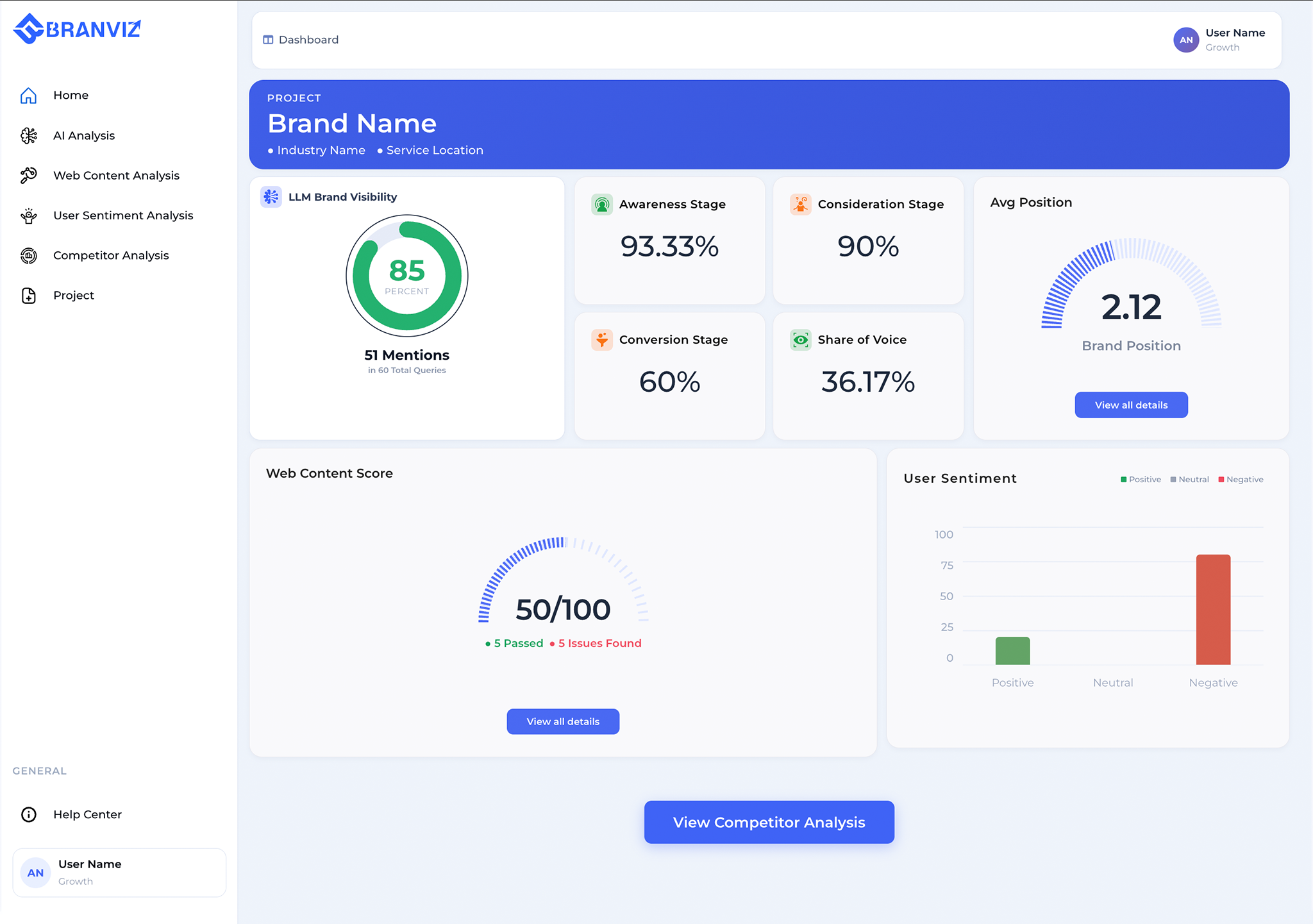
Transitioning to this mindset requires a mix of natural language monitoring and competitive intelligence. Platforms must evaluate the specific phrases, context, and sentiment surrounding your brand inside AI environments. By measuring these generative mentions, your team can identify where your brand is truly visible and where it is being filtered out of the conversation.
NEW SECTION: The Optimization Roadmap for Generative Search
Fixing the AI attribution gap requires a deliberate shift in how your team packages and distributes authority. Instead of optimizing exclusively for standard web crawlers, growth marketers must treat large language models as an entirely new class of digital audience.
- Claim Third-Party Consensus: Move away from relying entirely on your own blog. Invest heavily in digital PR, unbiased platform reviews, and co-marketing initiatives with established market leaders. AI trusts external validation far more than self-published content.
- Establish Proprietary Frameworks: Stop publishing generic industry overviews. Give your unique concepts specific, branded titles (e.g., The Carbon-Zero Framework rather than ways to save energy). When other industry publications cite your specific framework by name, AI models learn to associate the phrase with your specific brand entity.
- Leverage Technical Schema Architecture: Make it easy for RAG pipelines to map your company structure. Ensure your site uses advanced organizational and product schema markup to explicitly clarify your leadership team, parent entities, core service offerings, and target customer profiles.
The Path to Genuine AI Visibility
Succeeding in this new digital environment requires moving past old assumptions. True visibility is no longer about maximizing the number of pages a search engine indexes or collecting low-tier backlink counts. It is about building a brand reputation so distinct and well-distributed that an AI engine cannot answer a category query without mentioning your name.
If your marketing strategy remains focused on optimizing for clicks, you are likely building a library of content that informs AI systems without growing your business. True digital authority belongs to the companies that AI models actively recognize, remember, and recommend.
Conclusion
Succeeding in this new digital environment requires moving past old metrics. True visibility is no longer about maximizing indexed pages or collecting low-tier backlink counts. It is about building a brand reputation so distinct and well-distributed across the web that an AI engine cannot answer a category query without mentioning your name.
If your marketing strategy remains focused purely on optimizing for clicks, you are likely building a library of content that informs AI systems without growing your business. True digital authority belongs to the companies that AI models actively recognize, remember, and recommend.

FAQs