AI Search Visibility in 2026: What Brands Need to Track Beyond Traditional SEO
Jitender • 5/18/2026

For over 20 years, SEO focused on one goal: getting clicks. We worked to rank in the “10 blue links” and grow organic traffic.
Now search has changed. In 2026, AI gives direct answers instead of showing a list of links.
This means a brand can rank #1 on Google but still does not appear in AI answers. That gap is where traditional SEO no longer works well.
AI Search Visibility is how often and how well your brand appears in AI-generated answers when people use tools like ChatGPT, Google AI, or other large language models to search, compare, and make decisions.
It measures whether AI systems recognize your brand, trust your information, and include you in the recommendations that influence user choices. If your brand is not visible in AI search, you are missing a presence where modern decisions are increasingly being made.
What Is AI Search Visibility?
AI search visibility means how often and how clearly a brand, product, or topic appears in AI-generated answers.
Unlike SEO (which tries to rank websites on a list), AI visibility is about whether AI systems mention or recommend the entity in their responses.
When a user interacts with ChatGPT, Perplexity, or Google’s AI Overviews, the system doesn't just "find" a page; it synthesizes information from across the web to build a response. AI search visibility measures your brand’s "share of voice" within that synthesis by using RAG.
Traditional SEO Visibility vs. AI Search Visibility
The difference is structural. Traditional SEO is a game of indexation and relevance. AI visibility is a game of training data, retrieval, and trust.
In the current time, visibility is probabilistic rather than deterministic. A brand might appear in 80% of responses for a specific prompt today and only 40% tomorrow because the model’s retrieval-augmented generation (RAG) process found a more "authoritative" or "fresher" source in the interim.
Why Traditional SEO Metrics Are No Longer Enough
Relying on clicks and keyword rankings in 2026 is like tracking newspaper circulation in the era of social media. The metrics are lagging, incomplete, and increasingly disconnected from actual revenue.
The Rise of the Zero-Click Reality
Current data shows that over 60% of searches now end without a single click. AI summaries provide enough value that users no longer feel the need to visit your website. If your only metric is "Organic Traffic," you are missing the massive brand-building and consideration happening within the LLM interface itself.
Mentions Are the New Backlinks
For a long time, backlinks were seen as the main sign of trust online. But in AI-driven search, mentions matter more than links.
AI systems do not just care about who links to you. They also look at how you are talked about across the internet. For example, are you mentioned in a Reddit discussion about what is ai visibility? Or in a YouTube video about sustainable fashion? These mentions across different platforms help build your online presence. Over time, this makes it more likely that AI systems recognize you and include you in their answers.
The Fragmentation of Discovery
Search is no longer a Google monopoly. Users are researching products directly in ChatGPT or comparing technical specs in Perplexity. Traditional SEO tools rarely account for these "closed" ecosystems, leaving brands blind to their performance in the very places where high-intent buyers are spending their time.
How AI Search Engines Decide Which Brands Appear
To improve visibility, we must understand the "selection criteria" of a probabilistic engine. AI models don't "rank" brands; they calculate the likelihood that including your brand will satisfy the user’s prompt.
1. Entity Authority and Strong Brand Association
AI models tend to prioritize brands that are mentioned positively across many trusted sources. When your brand is consistently linked with qualities like “reliability” and “security” in research papers, news articles, and online discussions, the model begins to strongly associate those qualities with your brand. This creates a stronger overall perception of the brand.
2. Probabilistic Answer Generation
When a model receives a prompt like "best ai visibility tool in india", it doesn't look for a keyword match. It looks for the most "statistically probable" answer based on its training data and real-time web retrieval. It prioritizes brands that appear in comparison tables, "best-of" lists, and expert reviews because those formats provide clear, extractable proof.
3. Citations and Grounding
Modern AI search uses RAG (Retrieval-Augmented Generation) to ground its answers in real-time data. The engines prioritize sources that are:
- Structured: Content that uses clear headers, lists, and schema markup is easier for an LLM to parse.
- Cited: If multiple independent sources (Reddit, TechCrunch, Wikipedia) all point to your brand for a specific solution, the AI is significantly more likely to cite you.
- Fresh: Recency is a massive weight. An AI is less likely to recommend a product that hasn't been mentioned in a reputable publication in the last six months.
The New Metrics Brands Need to Track
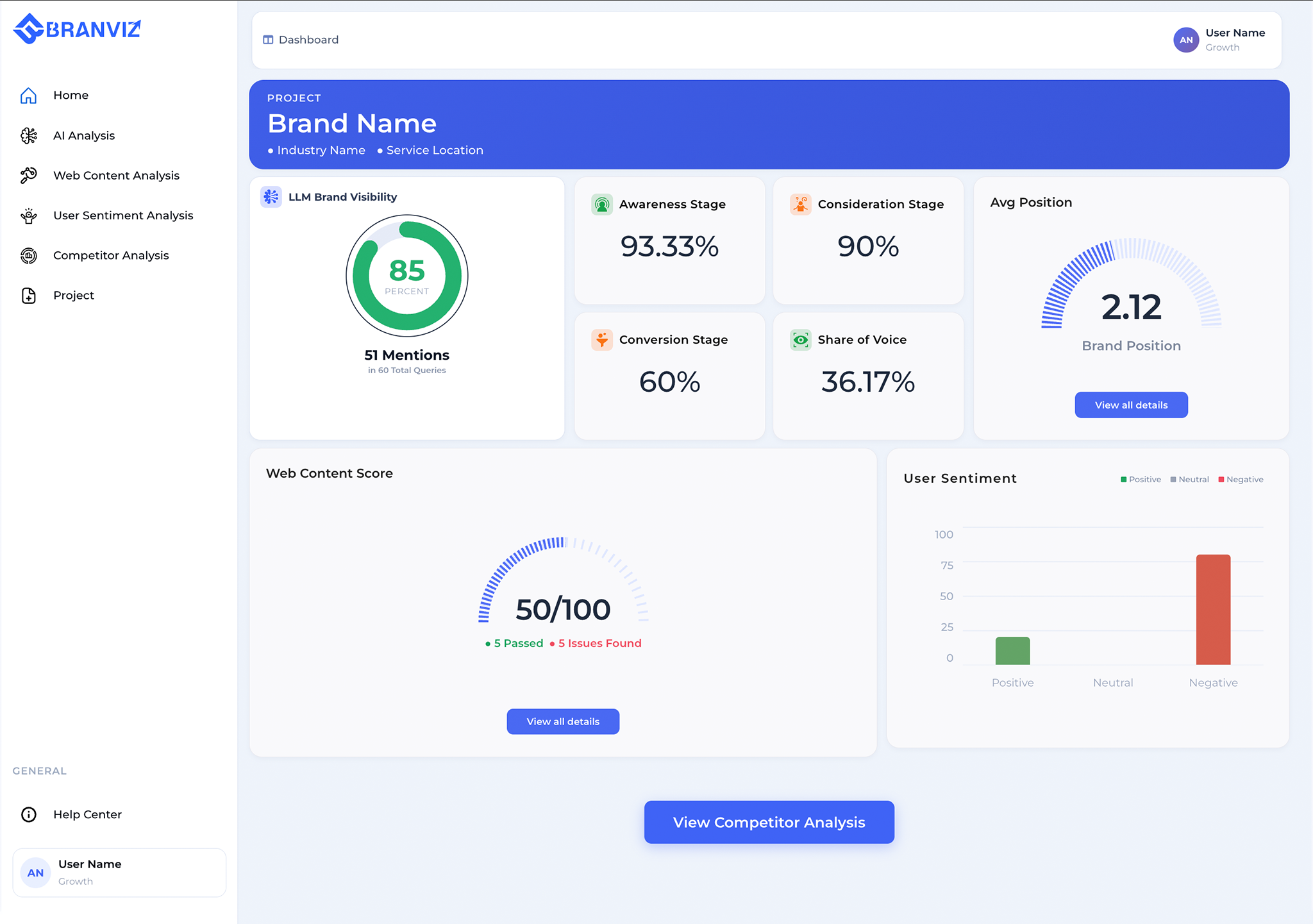
If rankings are obsolete, what should you be looking at? LLM visibility tracking introduces a new set of KPIs that align with how AI actually functions.
Brand Mention Frequency
How often does your brand name appear in the output for target prompts? This is the baseline. You should track this across different "funnel" prompts—from broad awareness ("What is...") to high-intent comparisons ("Brand A vs. Brand B").
Prompt-Level Visibility (Win Rate)
Track your "win rate" for specific high-value queries. For example, if you are a cybersecurity firm, you need to know: "In 100 variations of the prompt 'best cloud security for fintech,' how many times was our brand recommended?"
Citation Presence and Source Share
Being mentioned is good; being cited is better. Citations provide the link back to your site, giving you a chance to capture the "remaining" click-through traffic. You need to monitor which of your pages are being used as the "grounding" for AI answers.
Sentiment and Positioning
AI doesn't just mention you; it characterizes you. If an LLM says your brand is "affordable but lacks advanced features," that positioning becomes the user’s reality. Tracking the sentiment and descriptive attributes associated with your brand is critical for reputation management.
Topic Association
In which topical clusters does the AI "know" you? If you are a coffee brand but the AI only associates you with "discount beans" and never "ethically sourced," you have a visibility gap that traditional SEO cannot fix.
What Impacts AI Brand Visibility the Most?
Improving your standing in AI search results requires a shift from "optimizing pages" to "optimizing the ecosystem."
Content Depth and Specificity
Generic content is the enemy of AI visibility. LLMs are trained on billions of words of generic fluff. To stand out, you need original research, unique data, and expert-driven insights. If your content provides a "new" fact or a specific framework that doesn't exist elsewhere, you become a "high-value" node for the LLM to cite.
The "Third-Party Validation" Loop
LLMs treat your own website with a degree of skepticism. They heavily weigh what others say about you. To increase AI visibility, your PR and community strategy must align with your SEO. Mentions on Reddit, Quora, and industry-specific forums provide the "social proof" that AI models use to validate their recommendations.
Structured Data and Semantic Clarity
While AI models are getting better at reading messy text, Schema markup and structured data remain vital. They act as a "translator," telling the AI exactly what your entity is, what its attributes are, and how it relates to other entities.
Why LLM Visibility Tracking Is Becoming Essential
We are entering a period of "Black Box Marketing." We no longer have the luxury of seeing exactly why a user chose a competitor. LLM visibility tracking pulls back the curtain.
Dynamic Content and Prompt Sensitivity
AI answers keep changing. Even a small change in a user’s query, like “best laptop” vs “best laptop for video editing,” can lead to completely different sources being used.
Without proper visibility tracking, brands cannot see where they are losing visibility until it starts affecting results and revenue.
Competitive Intelligence
In the traditional search era, you could see your competitor's backlinks and keywords. In the AI era, you need to see their "Semantic Share of Voice." Are they being recommended as the "innovator" while you are the "legacy player"? Visibility tracking allows you to see how the AI is framing your competition so you can adjust your content strategy accordingly.
Common Mistakes Brands Make
Even sophisticated marketing teams are stumbling as they transition to AI-first discovery.
- Treating AI visibility like a keyword ranking: AI visibility is a percentage of mentions across a probability cloud, not a "position #1" on a list.
- Publishing "LLM-bait" content: Creating thousands of low-quality pages designed to be crawled by AI is a recipe for disaster. Models prioritize quality and authority; "thin" content will eventually be filtered out as noise.
- Ignoring the "Brand Entity": Many brands focus so much on keywords that they forget to define their entity. If the AI doesn't know who you are and what you stand for, it can't recommend you.
- Relying on old attribution models: If you are only looking at "Last-Click" or "Google Organic," you are missing the influence of AI. A user might spend 20 minutes researching in ChatGPT before typing your URL directly into their browser. Without tracking visibility, that sale looks like "Direct" traffic, hiding the true source of value.
How Brands Can Improve Visibility in AI Search
To win in the age of generative search, you must move beyond the "page-first" mindset and adopt an "entity-first" strategy.
1. Build Topical Authority Through Comparison
AI models love comparisons. To be included in "X vs. Y" or "Top 10" responses, you must create objective, high-quality comparison content on your own site. Don't shy away from naming competitors; instead, provide the data that proves where you win.
2. Create "Citation-Worthy" Assets
Invest in original data, proprietary surveys, and deep-dive technical guides. When you provide information that cannot be found anywhere else, you force the AI to cite you as the primary source. This "information gain" is the strongest signal for AI visibility.
3. Optimize for Conversational Queries
Traditional keywords are often short and fragmented, like “AI SEO agency” or “AI SEO services.” But conversational queries are longer and more specific, like “Which AI SEO agency is best for improving visibility in AI search results for a small business ?”
Your content should focus on answering these clear, real-world questions and user goals instead of just targeting short keywords.
4. Ensure Brand Consistency Across Platforms
If your LinkedIn says one thing, your website says another, and a press release says a third, the LLM will struggle to build a coherent entity profile. Semantic consistency across all digital touchpoints is the key to clear AI visibility.
The Future of Search Visibility
The shift from “search” to “answers” is not just a trend, it is the new normal. Soon, the focus will move from ranking web pages to powering AI agents.
People will rely more on AI assistants to handle tasks like buying products, booking travel, or finding vendors. These systems will depend on trust and visibility signals that go beyond traditional search results.
For brands, trust will matter more than traffic. Being the source an AI relies on is far more valuable than appearing as the top link on a page. In this AI-driven world, visibility means being consistently recognized as reliable, cited often, and seen as an authority.
Brands that start tracking their LLM visibility today will be the ones shaping how they are understood in the future.
Conclusion
The focus is moving from getting clicks on search results to becoming the actual answer people see. AI search visibility is no longer just a tactic, it is changing how brands are discovered online.
As large language models become the main way people get information, strong brands will focus less on traffic and more on clear authority and consistent recognition in trusted sources.
Tracking how visible your brand is in AI results is now important. It helps ensure your brand not only shows up but is also trusted and remembered.

FAQs