How to Build Entity Clarity So AI Models Recognize Your Brand Correctly
Varun • 8/11/2026

Ask ChatGPT about your brand and you might get an answer that's close but not quite right. Maybe it mixes you up with a competitor. Maybe it describes a product line you stopped selling two years ago. Maybe it just doesn't mention you at all, even when your brand is clearly the best fit for the question.
This isn't random. It usually comes down to one thing: the AI model doesn't have a clear, confident understanding of what your brand actually is. In the world of generative engines, that's called entity clarity, and it's quietly becoming one of the most important factors behind ai brand visibility.
This post walks through what entity clarity actually means, why it matters more than most marketing teams realize, and the practical steps you can take to build it.
What Entity Clarity Actually Means
An entity, in the context AI models use, is any distinct thing the model can identify and reason about. A person, a place, a product, a company. When a model has strong entity clarity for your brand, it knows exactly who you are, what you do, who your competitors are, and how you fit into your category.
This is different from traditional SEO. Ranking for keywords is about matching search intent with content. Entity clarity is about identity. You can rank on page one of Google for years and still be an entity the AI barely understands, because search rankings and entity understanding are built from different signals.
Weak entity clarity is why brands sometimes get skipped over in AI answers even when they're objectively a strong fit. The model isn't being unfair. It simply doesn't have enough confident, consistent information to include you.
Why Entity Clarity Shapes Your Brand Presence in AI Answers
Large language models build their understanding of the world from a mix of training data, structured knowledge sources, and retrieval systems that pull in information at the time a question is asked. This mix shapes everything the model assumes about your brand before you ever show up in a conversation.
One of the biggest pieces of that puzzle is the knowledge graph, a structured map of entities and how they relate to each other. Google, Bing, and increasingly the AI models themselves rely on these graphs to understand who's who. If your brand isn't well represented in a knowledge graph, or if the information about you is scattered, outdated, or contradictory across the web, the model has a harder time placing you correctly.
The practical result is simple. Strong entity clarity means your brand presence in ai answers is accurate and consistent. Weak entity clarity means you're either invisible or misrepresented, and neither is a good outcome when a buyer is asking an AI model to recommend a solution.
Signals That Quietly Weaken Entity Clarity
Most brands don't have a dramatic problem. They have a collection of small gaps that add up.
Inconsistent naming is one of the most common. If your website says "Branviz Inc," your LinkedIn says "Branviz Technologies," and a directory listing says "Branviz.com," you've handed the model three slightly different signals instead of one strong one.
A thin About page is another. If your About page is a few vague sentences about "innovation" and "customer focus," there's nothing concrete for a model to learn from. AI models respond to specific, factual statements about what you do, who you serve, and what makes you distinct.
No structured data is a gap plenty of companies don't even know they have. Without schema markup, you're relying entirely on the model to infer facts from unstructured text, which is a slower and less reliable path to recognition.
Sparse third-party coverage matters too. If nobody outside your own website is writing about you, the model has no independent confirmation of who you are. And if your brand name overlaps with an unrelated company or product, the model may genuinely struggle to tell you apart, especially in a smaller or newer brand's case.
A Practical Framework for Building Entity Clarity
None of this requires a total rebuild. It's a series of specific, doable steps.
Standardize your brand identity everywhere. Pick one exact brand name, one short description, and use them consistently across your website, social profiles, directories, and any place your brand appears online. Small inconsistencies add friction that's easy to remove.
Rewrite your About page with real specifics. Instead of broad claims, state plainly what your product does, who it's for, and what category you compete in. Concrete sentences give the model something solid to work with.
Add schema markup to your site. Organization schema, product schema, and FAQ schema all give AI crawlers and search engines structured facts about your brand instead of forcing them to guess from paragraphs of marketing copy.
Build genuine third-party mentions. Press coverage, industry directories, comparison articles, and review sites all act as outside confirmation of who you are. This is slower to build than the technical fixes, but it carries real weight.
Work toward a Wikidata or Wikipedia presence. These are two of the most heavily referenced structured sources behind many AI systems. Getting listed accurately is one of the highest-leverage moves available, though it takes time and needs to be done properly rather than rushed.
Clean up your internal site structure. Clear navigation and logical internal linking help crawlers understand how your pages, products, and services relate to each other, which in turn helps them understand your brand as a whole.
Publish content around your category, not just your brand name. If you only ever talk about your own product, you never demonstrate expertise in the broader space. Writing about the problems your category solves helps models associate you with that category, not just with your own name.
How to Tell If AI Models Recognize You Correctly
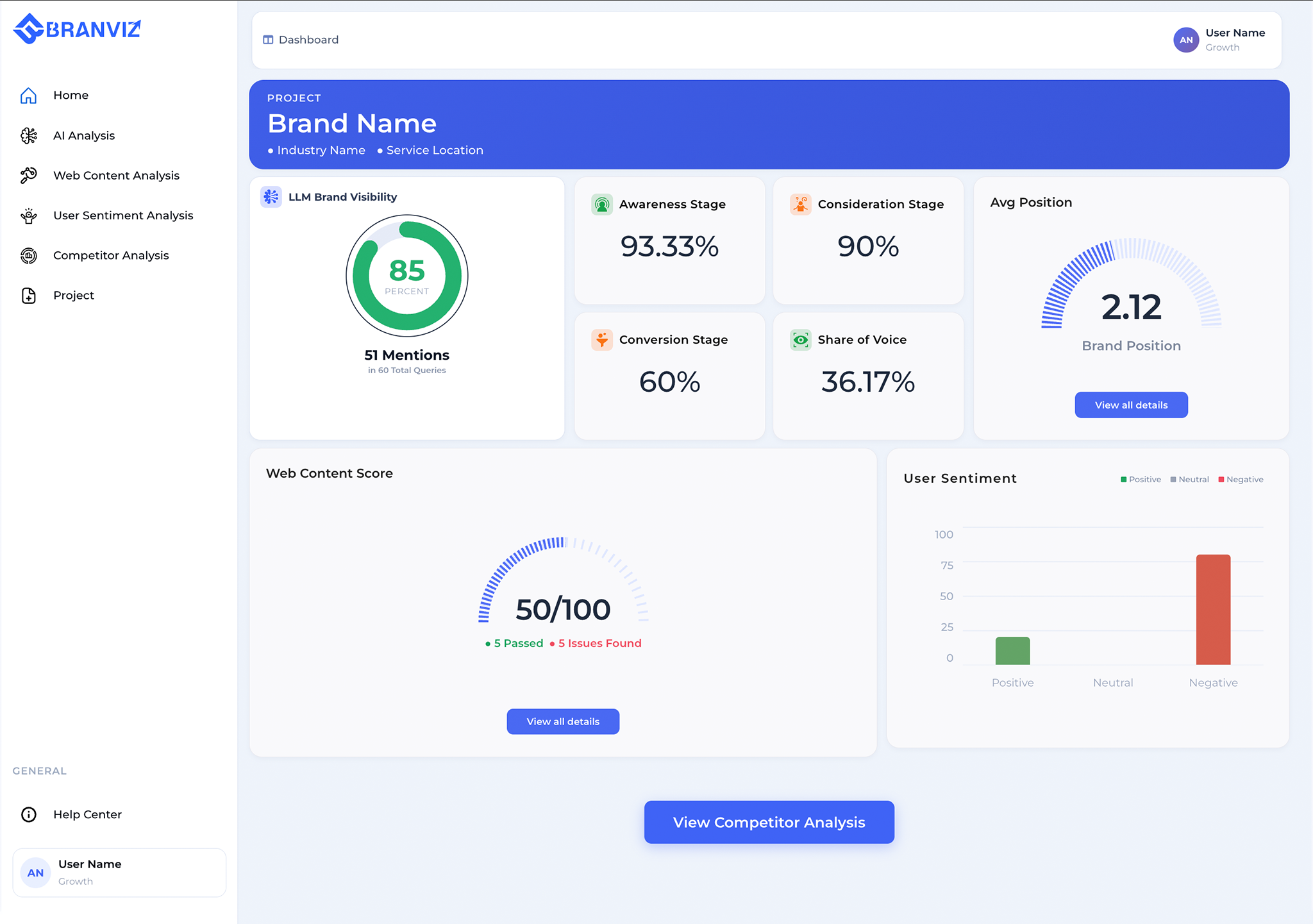
The simplest way to check is to just ask. Run an audit through Branviz.com.
Tracking your brand across ChatGPT, Gemini, and Perplexity on an ongoing basis is what turns entity clarity and generative ai visibility from a one-time guess into a trend you can actually watch and act on.
Mistakes That Undo Entity Clarity Work
A few patterns show up again and again in brands that struggle here.
Generic, copy-paste About pages that could describe a dozen other companies. Inconsistent business details across different platforms, sometimes down to something as small as an old address or an outdated product name still floating around on a directory site. Treating entity clarity as a one-time project instead of ongoing maintenance, when in reality your brand, your offerings, and the AI models themselves are all changing constantly. And relying purely on paid ads or search rankings while ignoring the structural signals that actually shape how AI models understand who you are.
Where This Fits Into Your Bigger Picture
Entity clarity is the foundation. It's what determines whether AI models can find and understand your brand in the first place. But foundation work is only half the picture. You also need a way to see whether it's actually working, since ai visibility is really the ongoing measurement of the entity clarity you build here.
Building entity clarity isn't a single afternoon of work, but it's not a mystery either. Fix the inconsistencies, give AI models real information to work with, and build genuine outside recognition. From there, the visibility takes care of itself.

Varun
AuthorVarun is a dedicated search strategist and Technical SEO specialist focused on future-proofing digital brands. With deep expertise in Answer Engine Optimization (AEO) and Generative Engine Optimization (GEO), they help businesses dominate both traditional SERPs and AI-driven platforms. Known for rigorous technical audits and data-backed strategies, Varun shares actionable insights to help brands build undeniable authority, maximize AI visibility, and thrive in today’s complex search landscape.
FAQs