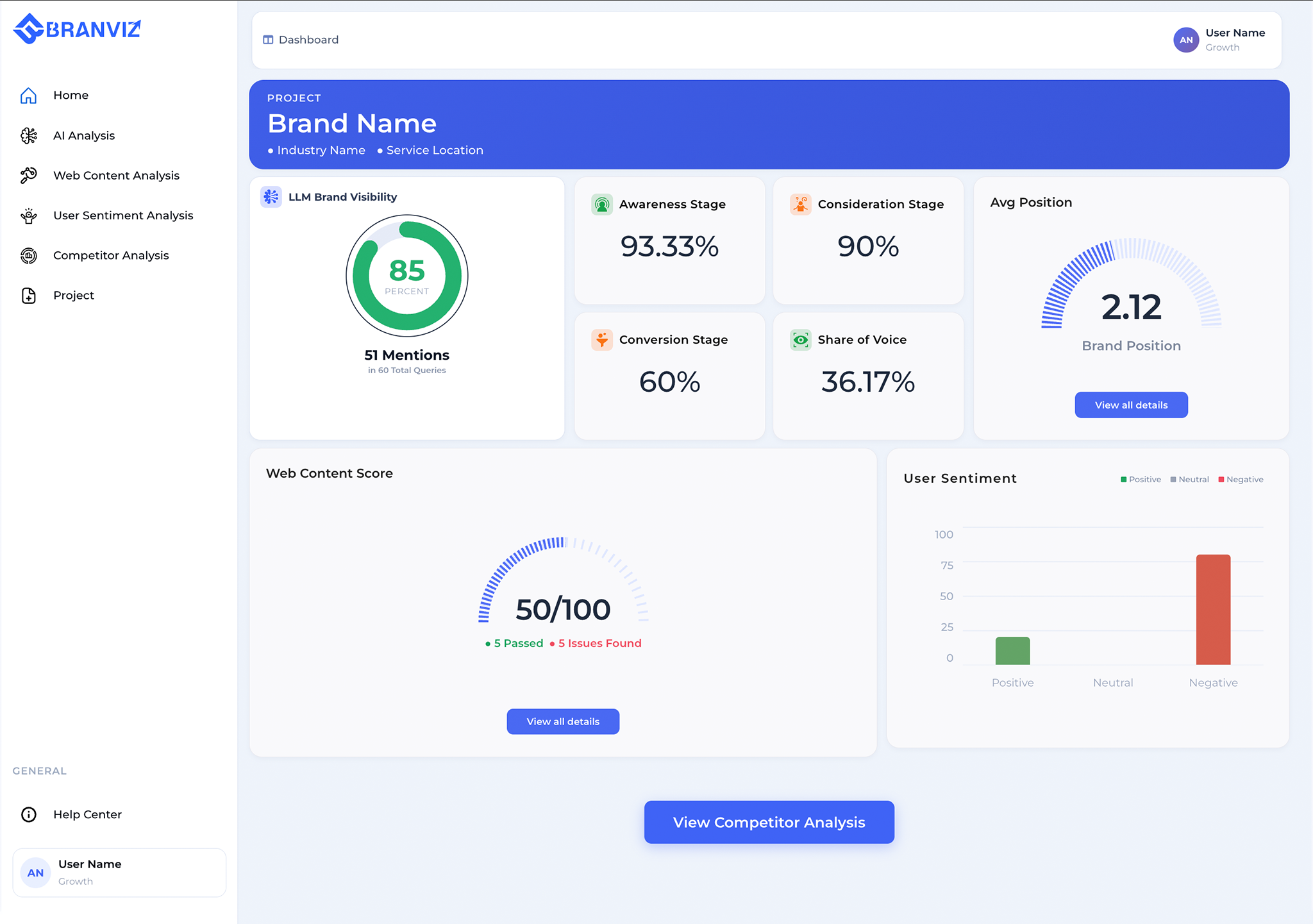
What Is AI Share of Voice? A Complete Guide
Jitender • 7/17/2026

What Is AI Share of Voice?
AI Share of Voice (AI-SOV) measures how often, how prominently, and how favorably your brand appears in responses generated by AI tools like ChatGPT, Google's AI Overviews, Perplexity, Claude, and Microsoft Copilot. In simple terms, it's the AI-era version of "how visible are we" except instead of tracking search rankings or ad impressions, you're tracking whether an AI model chooses to mention, cite, or recommend you when someone asks a relevant question.
As more people get answers directly from AI chat interfaces instead of clicking through ten blue links, AI-SOV is quickly becoming one of the most important AI visibility metrics a brand can track.
AI Share of Voice vs. Traditional Share of Voice
Traditional share of voice was built around channels you could count: keyword rankings, ad impressions, social mentions, or press coverage relative to competitors. It assumed a human was scrolling through a list of results and choosing where to click.
AI-SOV works differently. There's no scroll, no list, and often no click at all. An AI model reads across many sources, synthesizes an answer, and decides based on its own internal logic who gets named. You're no longer competing for a position on a page; you're competing to be included in a single generated paragraph. That's a fundamentally different game, and it rewards different signals than classic SEO ever did.
Why AI Share of Voice Matters in 2026
Search behavior has shifted. A growing share of queries now end inside an AI Overview, a chatbot answer, or a voice assistant response, with no further click to a website. That means a brand can rank well organically and still lose visibility if it's absent from the AI-generated summary sitting above or instead of those results.
For marketers, this creates a new blind spot. You might be watching your organic traffic and keyword rankings hold steady while your actual discovery moment the AI answer a potential customer reads mentions your competitors instead. AI-SOV is how you catch that gap before it shows up in your revenue numbers.
How AI Share of Voice Works (Under the Hood)
To understand AI-SOV, it helps to know roughly how these models generate answers. Large language models are trained on huge datasets scraped from the web, which gives them a general sense of which brands are commonly associated with which topics. Many tools including AI Overviews and Perplexity also use retrieval-augmented generation (RAG), meaning they search the live web in real time, pull relevant pages, and use them to ground the answer, often with citations.
That combination matters. Your AI-SOV is shaped both by what's baked into a model's training (your historical content, reputation, and mentions) and by what's currently retrievable and citable on the open web right now. Neglect either one, and your visibility suffers.
Key Metrics Used to Measure AI-SOV
A handful of metrics make up a working definition of AI-SOV:
- Mention rate – how often your brand appears across a set of relevant prompts
- Citation frequency – how often your specific pages or content are linked as a source
- Position/prominence – whether you're named first, buried in a list, or left out entirely
- Sentiment – whether the mention is positive, neutral, or negative
- Share relative to competitors – your mentions as a percentage of all brand mentions in that topic space
No single metric tells the whole story, which is why most AI-SOV tracking looks at these in combination.
Which AI Platforms Count Toward AI-SOV
Not all AI platforms behave the same way, so a complete AI-SOV picture usually spans several:
- Google AI Overviews / AI Mode – blends retrieval from Google's index with generative summarization
- ChatGPT – uses a mix of training data and, for many queries, live browsing
- Perplexity – built specifically around real-time retrieval and visible citations
- Claude – can browse and cite when web search is enabled, otherwise draws on training knowledge
- Microsoft Copilot – integrates Bing's index with generative answers
Each platform sources and weighs information differently, so it's common for a brand to have strong AI-SOV on one platform and near-zero visibility on another.
Factors That Influence Your AI Share of Voice
Several factors consistently affect whether AI tools choose to surface a brand:
- Content structure – clear headings, direct answers, and well-organized information are easier for models to extract and cite
- Brand authority signals – backlinks, domain reputation, and consistent NAP (name, address, position) details across the web
- Third-party mentions – being discussed on Reddit, review sites, forums, and industry publications, since models weigh independent sources heavily
- Structured data – schema markup that helps machines parse what a page is actually about
- Freshness – regularly updated content signals relevance for time-sensitive topics
Notice that only one of these (structured data) is a purely technical fix the rest depend on genuine authority and content quality.
How to Track and Measure Your AI Share of Voice
You can start tracking AI-SOV manually before investing in any tooling:
- Build a list of 15–20 realistic prompts your customers might ask
- Run each prompt across ChatGPT, Perplexity, Google AI Overviews, and any other relevant platform
- Log whether your brand appears, where, and in what tone
- Repeat on a fixed schedule (weekly or monthly) to spot trends
As your tracking needs grow, dedicated AI visibility and Generative Engine Optimization (GEO) platforms like branviz can automate this process across hundreds of prompts and competitors, which becomes valuable once manual tracking gets too time-consuming to maintain consistently.
AI Share of Voice vs. SEO: How They Overlap and Differ
AI-SOV and SEO share a foundation that both reward authoritative, well-structured, genuinely useful content. Good technical SEO (fast pages, clean markup, solid internal linking) still helps AI crawlers access and understand your site.
But they diverge in what "success" looks like. SEO optimizes for ranking earning a high position a human will click. AI-SOV optimizes for citability earning a place in a synthesized answer a human may never click through from at all. Content can rank well and still be ignored by an AI model if it isn't structured in a way that's easy to extract and quote. In short: SEO gets you found. AI-SOV gets you mentioned.
Step-by-Step: How to Improve Your AI Share of Voice
- Answer the question directly, early. Open sections with a clear, quotable answer before adding nuance or context this is the single highest-leverage change for citability.
- Structure for extraction. Use descriptive headings, short paragraphs, bullet points, and tables so models can easily lift discrete facts.
- Add FAQ sections. Direct question-and-answer pairs are some of the most frequently cited content formats.
- Build genuine third-party presence. Contribute to industry publications, get discussed on relevant forums, and earn mentions if you don't control models and trust independent corroboration.
- Use structured data (schema). Mark up FAQs, articles, and products so machines can parse your content's purpose.
- Keep content current. Update statistics, dates, and examples regularly, especially for fast-moving topics.
- Earn quality backlinks. Authority signals still matter for both training-data reputation and real-time retrieval.
- Monitor and iterate. Re-run your tracked prompts monthly and adjust content based on where you're losing visibility.
Common Mistakes Brands Make with AI-SOV
- Treating it like keyword SEO – stuffing brand names into content doesn't influence whether a model chooses to cite you
- Ignoring third-party sentiment – focusing only on owned content while reviews and forum discussions shape model perception just as much
- Skipping structured data – leaving models to guess at page intent instead of stating it clearly
- Single-source dependency – optimizing for only one AI platform and assuming the results generalize to all of them
- No ongoing measurement – treating AI-SOV as a one-time audit rather than a metric that shifts as models and content update
A Practical Example
Consider a mid-size B2B software company that ranked well organically for its core product terms but noticed it was rarely mentioned when people asked AI tools to "recommend software for [their category]." After auditing their content, they found their pages answered how their product worked but never directly answered comparison-style questions a buyer would actually ask an AI assistant.
By adding direct comparison sections, FAQ blocks, and pursuing a handful of mentions on independent review sites, they began appearing more consistently in AI-generated recommendations over the following months. The lesson: strong SEO content doesn't automatically translate into strong AI-SOV; the two require overlapping but distinct effort.
Tools & Resources to Get Started
- Manual prompting – free, and a good starting point for any brand testing the waters
- AI visibility/GEO tracking platforms – paid tools that automate prompt testing across multiple AI engines and competitors
- Schema markup generators – help implement structured data without manual coding
- Backlink and mention monitoring tools – track where your brand is being discussed across the web
Start manual, then layer in paid tools once you have a clear sense of which prompts and platforms matter most to your business.
The Future of AI Share of Voice
AI-SOV is still an emerging discipline, and it's evolving quickly. Expect answers to become increasingly multimodal (incorporating images, video, and voice), agentic AI to start taking actions on a user's behalf rather than just summarizing information, and personalization to make "the AI answer" less uniform and more tailored to each individual's history and context. Brands that build strong AI-SOV habits now clear, structured, well-corroborated content will be better positioned as these platforms continue to change how people discover information.

FAQs