How to Track AEO Performance: Measuring LLM mention rate,AI share of voice, and AI Citations
Jitender • 8/7/2026
Most SEO teams already have a tracking habit. Rankings get checked weekly, traffic gets reviewed monthly, and everyone knows which dashboard to open on a Monday morning.
Answer Engine Optimization does not have that same muscle memory yet, and it shows. Ask a marketing team how their AEO performance looks this quarter and the honest answer is usually that they are not entirely sure how to check.
That uncertainty is fair. AEO performance does not live in one place the way rankings do. Part of it sits inside Google Search Console as impressions you never clicked into. Part of it sits inside a featured snippet box that changes hands between competitors without warning. Part of it sits inside a ChatGPT or Gemini answer that nobody at your company happens to be looking at that day.
Tracking it properly means pulling these pieces together into one habit. Increasingly, that means looking beyond Google entirely and watching how AI engines themselves talk about your brand.
Clicks were never going to tell the whole story
The biggest mental shift required for AEO tracking is accepting that a lot of your best performance will never show up as a click. When your content gets pulled into a featured snippet or cited inside an AI answer, the user's question is frequently answered right there, with no reason to visit your site at all.
This zero-click pattern is now the majority behavior online, not the exception. Recent analysis from Digital Applied puts the zero-click share of Google searches at nearly 65 percent, up from around half just a few years earlier.
If your AEO tracking only looks at traffic and conversions, you are measuring a shrinking slice of what is actually happening. The larger and increasingly more important slice is impressions, the number of times your content appeared in a result or was pulled into an answer, whether or not anyone clicked through. Our breakdown of zero-click search behavior covers why this shift changes what brands should actually be optimizing for.
Google Search Console is still the most reliable free source for the on-Google half of this picture. Filtering your Performance report to queries containing question words such as how, what, why, and can isolate the traffic pattern that AEO affects most directly.
Rising impressions on these question-format queries, even alongside a falling click-through rate, is usually a sign that your content is winning snippet or AI Overview placement. It is not a sign that something is broken.
What a featured snippet tells you before an AI model does
Featured snippets remain one of the clearest, checkable signals available, even as AI Overviews and chat-based answers have taken up more space in how people search. Data compiled by AirOps shows that pages holding a featured snippet get cited inside AI Overviews at roughly twice the rate of pages without one.
That makes snippet ownership a leading indicator for AI citation, not just a standalone SEO win.
Checking snippet ownership does not require expensive tooling to get started. Build a list of 15 to 30 target questions your customers realistically ask, search each one manually in an incognito browser to avoid personalization skewing the result, and record whether your page holds the snippet, a competitor holds it, or no snippet appears at all.
Refresh cycles matter more here than most teams assume. Research tracking snippet displacement across nearly four and a half million keyword sets found that pages updated within roughly two months displaced competing snippet holders at a meaningfully higher rate than pages left untouched for six months or longer. If a competitor is holding a snippet you want, an update to your own page is often the fastest lever available.
Why AI citation tracking needs its own system
Snippets are just one input into a much bigger picture now. The same question that used to return ten blue links might return a single synthesized answer from ChatGPT, Perplexity, or Gemini instead.
That answer is built through retrieval systems that pull from indexed content at the moment of the query, not from a fixed, memorized list of sources. This is why the same question can surface from a different source one week and a different one the next.
This is where manual, one-off checks stop being enough. Watching how five different AI engines describe your brand, across dozens of questions, on a recurring schedule, is not something most teams can sustain with a spreadsheet alone.
It is the reason dedicated AI visibility tracking exists as its own category now. These tools are built specifically to run this kind of testing continuously across ChatGPT, Gemini, Perplexity, Grok, and AI Overviews at once, rather than one platform at a time.
The four metrics that turn tracking into a real strategy
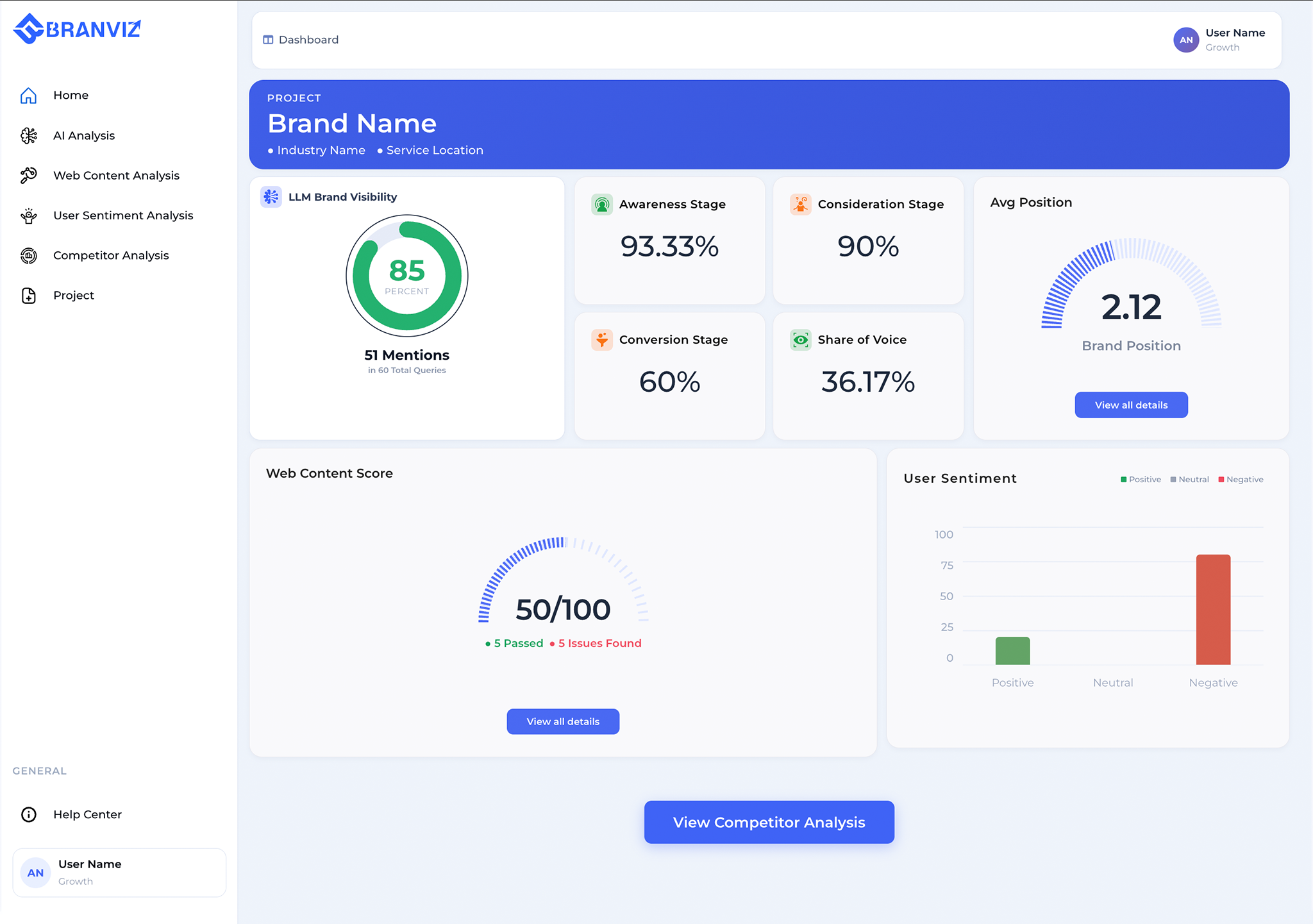
Once you accept that AI citation tracking needs to run continuously across multiple engines, the next question is what to actually measure. Four metrics consistently separate a useful AEO tracking system from a vague sense that you should probably be visible in AI search, and they happen to be the same four dimensions Branviz evaluates every time it audits a brand across ChatGPT, Gemini, Perplexity, Grok, and AI Overviews.
LLM mention rate is the baseline. It is the simple, honest percentage of relevant prompts where your brand actually gets named by a given AI model. Before worrying about ranking or sentiment, this number tells you whether you are even part of the conversation happening inside ChatGPT or Gemini when a buyer asks a category question.
Full-funnel visibility takes that baseline further by breaking it down across the buying journey instead of treating it as one flat score. A brand can dominate broad, educational questions early in the funnel while being nearly invisible in high-intent, ready-to-buy prompts, or the reverse. Mapping visibility across both ends of that funnel shows exactly where the gap sits, rather than leaving a team to guess why leads are not converting.
User sentiment score addresses something mentioned rate cannot. Being named by an AI model is not automatically good news if the framing around that mention is negative or the details are wrong. Tracking the ratio of positive, neutral, and negative sentiment in how AI models describe your brand catches reputation and accuracy problems long before they show up in lost deals.
AI share of voice ties the other three together by putting them in a competitive context. Mention rate tells you if you are visible, sentiment tells you how you are described, and share of voice tells you how much of that conversation actually belongs to you compared to the competitors an AI model keeps naming alongside you. This is the kind of benchmarking AI share of voice tracking is built for, calculating and comparing this figure against direct rivals rather than treating it as an isolated number.
Running all four consistently is exactly what a tool like Branviz was built to do, since checking them by hand across five different AI engines every month is not realistic for most teams.
Bringing it all together on a consistent schedule
None of these signals are especially useful, checked once and forgotten. A monthly view works best. Pull Search Console impressions on question-format queries, your snippet ownership count against a fixed target list, and your LLM mention rate, sentiment, and share of voice across your top AI engines into one place.
The interpretation matters as much as the collection. A single month of lower mention rate is not automatically a problem, since AI models generate answers probabilistically and some variation is expected even with no change on your end.
A consistent decline across three or four consecutive months is the real signal. It usually traces back to one of a few causes: a competitor published stronger, more citable content, your own pages went stale, or a model update changed what kind of sources it prefers to pull from.
It also helps to separate broad awareness performance from comparison and purchase-intent performance, since visibility rarely looks the same across both. Our guide on prompt-level visibility goes further into breaking results down by question type, which tends to reveal gaps a single blended score would hide.
Conclusion
AEO performance is measurable, but only when its signals are brought together in one place. Branviz simplifies this by providing a unified dashboard that tracks key AI visibility metrics like LLM mention rate, AI share of voice, user sentiment, and full-funnel visibility, making it easier to measure and improve your brand's presence across AI search.
Impressions from Search Console tell you whether your visibility is growing even without clicks. Snippet ownership tells you whether you are winning the format that most reliably feeds AI citations. LLM mention rate, full-funnel visibility, sentiment, and AI share of voice tell you whether that visibility is actually working in your favor across the AI engines your buyers use.
Track all of it on a steady schedule, and read the trend rather than any single data point. AEO stops being a guessing game and starts being a system you can actually manage.

FAQs