Simple Content Habits That Help AI Platforms Recommend Your Business
Jitender • 10/27/2026
The content that gets a business recommended by ChatGPT, Gemini, or Perplexity is mostly the same content that helps a customer make a decision. It answers real questions, states facts, and stays accurate. These platforms don't publish exactly how they choose their sources, and they behave differently from one another, so no habit can promise a mention. What you can control is whether your pages are useful and trustworthy to anyone who reads them, including the tools that summarize them.
Good content for AI recommendations is mostly ordinary business writing done consistently. Here are nine habits that fit into the work you're probably already doing.
1. Answer the main question first
Open each page with the answer to the question it targets. If the page is about the cost of a kitchen remodel, give a typical range and what pushes it up or down, then go into detail. Readers get what they came for right away, and anyone summarizing the page can see its point immediately. It's the same idea behind answer engine optimization: being the clearest response to a specific question.
2. Put the facts customers ask about on the page
Prices or price ranges, service areas, opening hours, how long a job takes, what's included, and any licenses you hold. If you would mention it on a phone call, it belongs on the page. A line like "best service in town" tells nobody anything, while a flat inspection fee and a list of neighborhoods you serve do.
3. Use real customer questions as headings
Make a list of what customers ask on calls, in emails, and in reviews, then use those questions as headings with short answers underneath. Use their wording, not your industry's. For key pages, collect the remaining questions in an FAQ at the bottom.
4. Give each service its own page
A single page covering tax prep, book keeping, and payroll ends up thin on all three. Separate pages let you go deeper on each and give customers a clear place to land for the thing they need.
5. Show who is behind the content
Name the author or reviewer, their role, and how long they've worked in the field. Where you can, ground the page in real work. A project write-up can follow a simple format: what the customer asked for, what you found, what you did, what it cost, and how long it took. Use your own jobs for this, with the customer's permission where needed. Specifics from real work are hard to fake, which is exactly why they build trust.
6. Write the comparisons customers are already making
People compare you with competitors and with other ways of solving the problem. If you don't publish that comparison, they will assemble it from other sources. A simple table, clear criteria, and honest notes on where the alternative fits better is enough. Comparison pages written this way are more believable to readers and easier for any tool to summarize accurately.
7. Keep pages current and dated
An old price, a closed location, or a discontinued service can stay on your site for years and get repeated back to customers as if it were true. Add a "last updated" date to important pages and review them on a schedule. Quarterly works for most pages, and monthly for anything with prices or hours.
8. Describe your business the same way everywhere
Pick one clear sentence about what you do and who you serve, then use it on your homepage, About page, social profiles, and directory listings. When your own descriptions disagree, a customer or an AI tool has to guess which one is right. Consistency like this is a large part of entity clarity, and it makes everything else you publish easier to trust.
9. Check what AI actually says about you
Every month or two, ask a few AI platforms the questions your customers ask. Note whether your business appears, how it's described, and whether the answers point back to your own pages. That tells you which pages are working and which need attention.
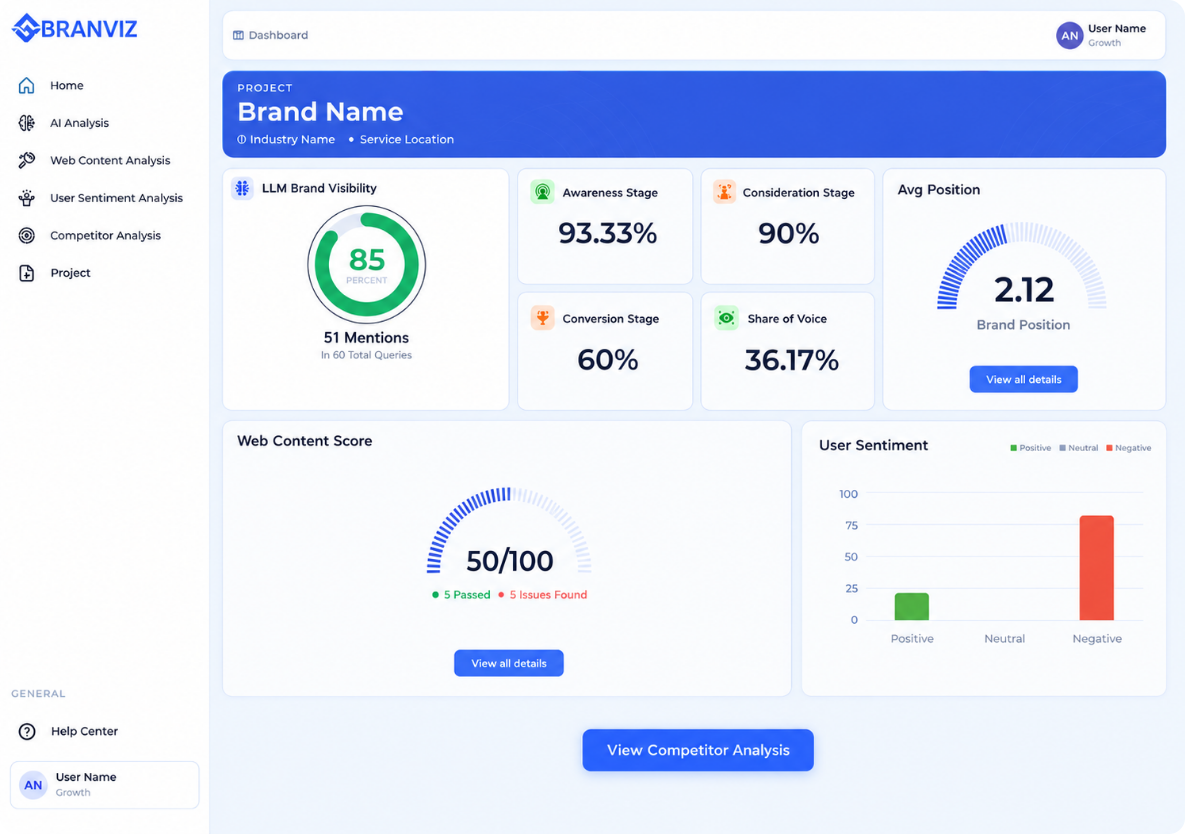
Doing this by hand is fine for a handful of questions, but it gets tedious across several platforms. Branviz simplifies the process by automatically running relevant queries across ChatGPT, Gemini, Perplexity, and other AI search engines. It helps you track when and how your business appears in AI-generated answers, understand how AI describes your brand, and compare your visibility against competitors. With these insights, Branviz makes it easier to identify opportunities, refine your strategy, and measure the impact of your optimization efforts over time.
Will good content guarantee a recommendation?
No. AI platforms also weigh your reviews, listings, reputation, and how crowded your category is. Content is the part you fully control, and it removes the common reasons a business gets overlooked.
Conclusion
None of this is a special set of AI citation content habits. These are ordinary good-writing habits: answer the question, include the facts, show who's behind the page, keep it current, and say the same thing about your business everywhere. Do them consistently, check the results every month or two, and your pages become the kind that customers trust, and that AI platforms have good reason to mention.

FAQs