What is AEO (Answer Engine Optimization)? A Beginner's Guide
Jitender • 7/6/2026
Ranking #1 on Google used to be the finish line. Now it might just mean fewer visitors than before.
Ahrefs studied 300,000 Google searches and found something important:
When Google shows an AI Overview for a search query, fewer people click on normal websites.
Specifically:
- Even if a page is ranked #1 on Google
- Its clicks drop by about 58%
- Because people get their answer directly from Google and don’t need to visit the site
In short:
AI answers on search pages = more “no-click searches” = less traffic for websites, even top-ranking ones.
At the same time, people aren't only searching on Google anymore. They're asking ChatGPT what laptop to buy. They're asking Perplexity to compare project management tools. They're asking Gemini and Claude to explain complex topics in plain language. Google's own AI Overviews now show up across a huge share of search results.
What is AEO (Answer Engine Optimization)?
Answer Engine Optimization (AEO): Refers to the process of creating, organizing, and optimizing online content in such a way that this content can easily be found, interpreted, and quoted by AI-based answer engines when search engines display the best answer to a query.
While old-school SEO is about ranking websites on the search engine results page (SERP) in general, AEO aims at ensuring that the user content gets included in the final consolidated answer provided by the AI system.
A Simple Example of AEO in Action
For example, if someone asks “What is AI visibility?”, an AI system does not just show a list of websites. AI reads a variety of sources, interprets the data, and then produces concise responses in its own words. Your information is more likely to be used in that response or mentioned as a reference if it is provided in an understandable and organized manner.
As the users are more shifting towards the AI chatbots so the AEO is becoming important in marketing for any brand. Websites that create well-structured, easy-to-understand content are more likely to appear in these AI-generated responses.
What Are Answer Engines?
Answer engines are AI-powered systems that generate direct responses to user queries instead of, or in addition to, showing a list of website links. Below are the major Answer engines that users use for answers.
- ChatGPT
- Google AI Overviews.
- Gemini
- Claude
- Perplexity
- Grok
Traditional search engines return a ranked list of pages and let the user do the reading and comparing. Answer engines do that comparison work for the user and hand over a synthesized response based on the AI knowledge and Current Updated information present on the internet.. The user experience is faster, but it also means fewer opportunities for a brand to be seen unless it's part of the answer.
Why is AEO Becoming Important?
At present time, many factors are pushing AEO from a nice-to-have into something marketers can no longer ignore.
AI search adoption is climbing fast. ChatGPT alone handles over a billion searches a week, and Perplexity processes more than a billion queries a month. These aren't niche tools anymore.
Zero-click searches keep growing. Before AI Overviews, features like featured snippets were already answering questions directly on the results page. AI has tremendously accelerated that trend, with a large share of Google searches now ending without a single click to any website. This is happening due to AI Overviews as users got full answers.
A conversational search alters the way people formulate their questions. Nowadays people go ahead and ask an artificial intelligence system questions in a conversational manner based on their circumstances instead of just inputting the keywords.
Voice assistants work in a similar way. With voice search, only a single and straightforward answer is required and this is the same thing that happens with an AI answering engine.
Hence if your content is not structured in a way that will overwhelmingly please the AI comprehension systems and research results have many advantages.
For a business, this means if your content is not structured in a way that AI systems can easily understand and quote, you may still rank well but still lose visibility where it matters most.
How Does Answer Engine Optimization Work?
AEO isn't a completely separate technical discipline from SEO. It builds on many of the same foundations, with a few different priorities.
Content understanding. AI models need to easily parse what your page is actually saying. Clear headings, direct answers, and well-organized sections make it easier.
Entity recognition. AI systems understand brands as entities, not just keywords. They try to recognize who you are and what you do based on consistent naming, clear “About” information, and mentions across other trusted websites. This helps AI treat your brand as a known entity.
Structured data. Schema markup gives AI systems clear signals about your content, such as FAQs, articles, or product details, so they can understand it better.
Semantic relevance. Answer engines focus on meaning, Intent and context, not just exact keyword matches. Covering a topic in a clear and complete way, and using related terms naturally, is more important than repeating the same exact phrase.
Authority. Being mentioned or linked by respected sources signals to AI models that your content is worth citing.
Freshness. AI systems tend to favor recently updated, accurate information, especially for topics that change over time.
Citations. Some answer engines, like Perplexity, show source links directly. Others, like ChatGPT, may reference brands by name even without a link. Either way, being the source an AI model pulls from is the whole point.
AEO vs SEO
AEO and SEO share DNA, but they optimize for different outcomes.
The important thing to understand is that AEO doesn't replace SEO. A page still needs to rank well and be technically sound to have a real chance of being pulled into an AI answer.
Key Components of AEO
Create Question-Based Content
Structure your content around the real questions your audience asks, using natural, simple language instead of fragmented keywords.
Build Topical Authority
Cover a topic in depth using multiple related pages instead of writing one short article and expecting it to rank for everything.
Improve Entity Optimization
Make sure your brand, products, and key people are clearly and consistently described across your site and third-party sources.
Add Structured Data
Use schema markup, particularly FAQ schema and Article schema, to help AI crawlers parse your content accurately.
Keep Content Accurate and Updated
Outdated statistics or old information reduce the chances of your content being trusted and cited.
Strengthen Internal Linking
Help both users and crawlers understand how your content connects, which reinforces topical depth.
Use FAQs
Direct question-and-answer formatting mirrors exactly how answer engines like to extract information.
Best Practices for Answer Engine Optimization
To ensure that you are quoted in the content, make sure you write your answers at the very beginning of each section. The AI writing models like to pull the most straightforward and concise part of the text, so giving detailed information before getting into the answer won’t help your cause.
Use plain language over jargon where possible. Answer engines give answers in a conversational way, so content written in a simple, natural style works better in AI results.
Keep each page focused on one clear question or topic instead of trying to cover everything in one article.
Monitor how your brand appears across ChatGPT, Gemini, Claude, and Perplexity, not just in Google Search Console. If you don't know how AI platforms are representing your brand today, you can't tell whether your AEO efforts are actually working.
Publish original data, case studies, or research where you can. AI models favor content that offers something they can't get from ten other nearly identical articles.
Common AEO Mistakes
Keyword stuffing. Repeating exact-match phrases unnaturally still doesn't help with AI models any more than it helps with modern search engines.
Thin content. A page that skims the surface of a topic gives an AI model little reason to trust it as a source.
Ignoring user intent. Content written for search engines rather than actual reader questions tends to miss the specific phrasing people use when talking to AI assistants.
Weak internal linking. Isolated pages make it harder for crawlers to understand how your content relates to a broader topic.
Outdated information. Stale statistics and old examples reduce the odds of citation, especially on fast-moving topics.
Missing structured data. Skipping schema markup leaves AI crawlers to guess at your content's structure instead of understanding it directly.
How to Measure AEO Success
AEO is still a developing field, and measurement tools are catching up. That said, a few metrics are worth tracking:
- AI citations – how often your content is referenced or linked within AI-generated answers
- Brand mentions – whether your brand name shows up in AI responses, even without a direct link
- AI visibility – your overall presence and consistency across major AI platforms
- Organic traffic – traditional SEO traffic remains a relevant signal, since strong SEO underpins AEO
- Branded searches – an increase can suggest people are discovering your brand through AI answers and then searching for you directly
- Referral traffic from AI platforms – some analytics tools can now isolate traffic coming from ChatGPT, Perplexity, and similar sources
Be cautious with any tool that promises exact, guaranteed visibility numbers. Because AI models don't expose their full reasoning, most AEO metrics are closer to informed estimates than precise counts, and that's worth keeping in mind when reporting results internally.
Conclusion
The nature of search has transformed and seems to be permanent. Nowadays people query AI systems directly and get the results without going to any websites. It doesn’t mean search engine optimization is dead but rather means that visibility is not all about search results anymore.
When conversations take place within tools like ChatGPT, Gemini, Claude, or Perplexity, AEO helps businesses remain visible. Although it concentrates on how AI systems receive and present information, it nevertheless makes use of the fundamentals of SEO, such as authority, clarity, and helpful content.
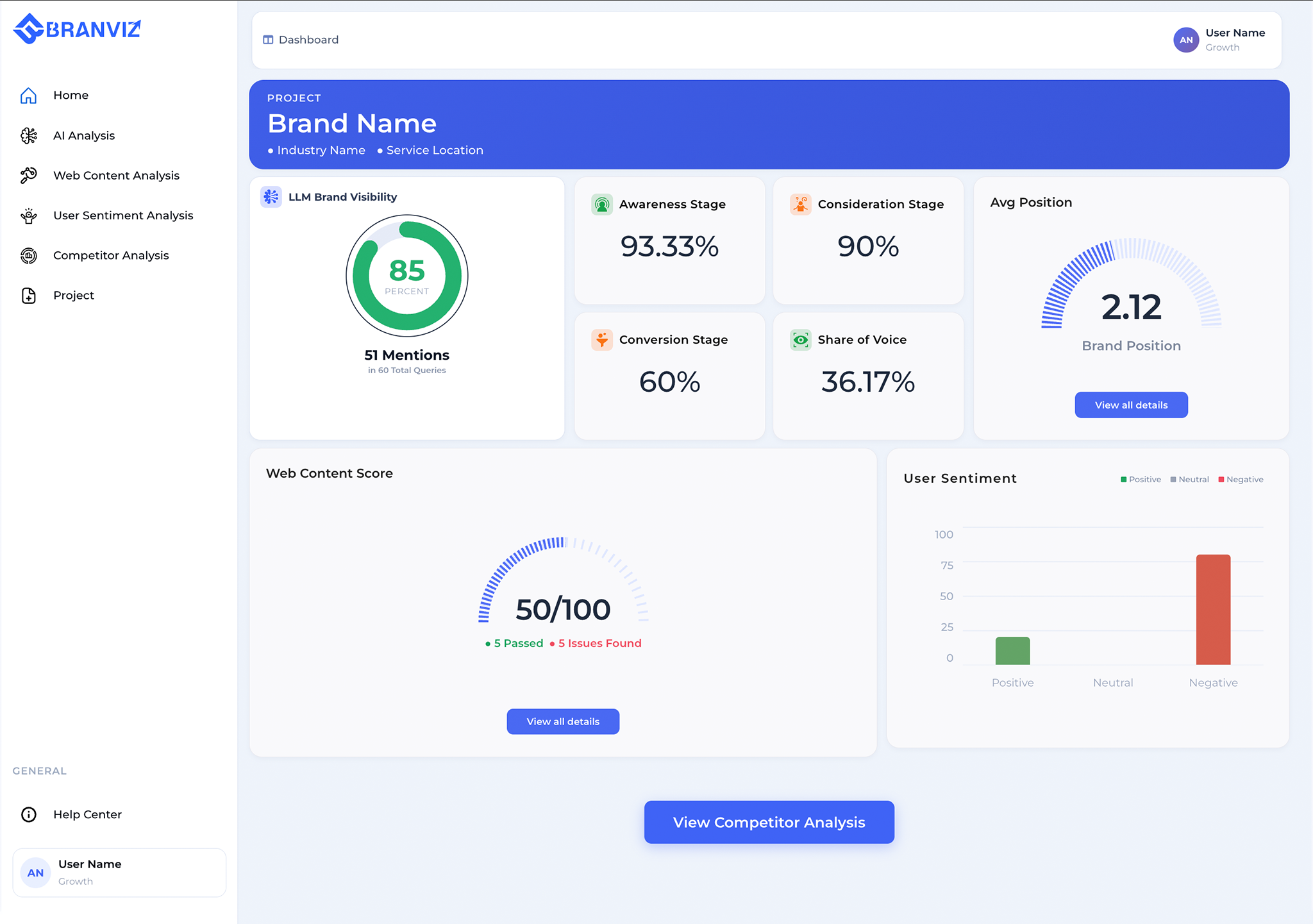
Check your Brand AI Visibility across platforms like ChatGPT, Gemini, Claude, and Perplexity with Branviz and see where your brand appears in AI-generated answers.

FAQs