How to Get Your Product Recommended by ChatGPT
Jitender • 7/31/2026

The way people discover products is changing. Instead of opening ten tabs and comparing spec sheets, a growing number of buyers simply ask ChatGPT: "How can brands measure sentiment in AI-generated recommendations?" or "Which running shoes should a beginner buy?"
The answer comes back as a short, curated list. Three to five products, each with a reason attached. No ads, no page two, no scrolling.
For brands, this creates a new kind of visibility. You are either one of the recommendations or you are invisible for that buyer. That is a very different competition from ranking a webpage. Ranking is about matching a query. Being recommended is about being trusted.
And trust, for an AI system, is built from signals: product information, brand authority, reviews, relevance to the specific question, and consistency across the web.
How Does ChatGPT Recommend Products?
ChatGPT does not maintain a ranked list of products waiting to be served. It generates recommendations in the moment, based on what it understands about the user's question and what it knows about products and brands. That knowledge comes from its training data and, when browsing is active, from live web sources it retrieves and reads.
Four things happen in that process.
Understanding User Intent
First, ChatGPT interprets what the person actually needs. It reads far more than keywords. It picks up on budget, preferences, location, product category, and use case, all from natural language.
Compare these two prompts:
- "Best running shoes for beginners under INR10000"
- "Best premium running shoes for marathon training"
Both are about running shoes. But the first signals a price ceiling, an inexperienced runner, and a need for forgiving, versatile shoes. The second signals a serious athlete, a higher budget, and a need for performance features. ChatGPT will recommend entirely different products for each, and it will explain its picks in terms of those needs.
This matters for brands: your product needs to be clearly associated with the use cases and buyer types it actually serves.
Product Information Understanding
Next, the model draws on what it knows about candidate products. It evaluates descriptions, specifications, features, use cases, reviews, and brand information.
If your product data is clear, complete, and consistent wherever it appears, the model can match your product to the right questions with confidence. If your product pages are vague, your specs conflict between retailers, or your positioning is unclear, the model either guesses or skips you.
Clear product data is not a nice-to-have here. It is the raw material recommendations are made from.
Brand Authority and Trust Signals
ChatGPT also weighs whether a brand seems trustworthy enough to recommend. Signals include brand reputation, mentions across trusted websites, review volume and sentiment, expert opinions in industry publications, awards and industry recognition, and patterns in customer feedback.
A recommendation is a small act of vouching. Models are trained to avoid vouching for things the evidence does not support, so products with independent validation get recommended more readily than products that only describe themselves well.
Contextual Matching
Finally, ChatGPT matches products to context rather than keywords. The same laptop brand can be recommended differently depending on who is asking:
- For students: battery life, price, portability
- For designers: display quality, color accuracy
- For gamers: GPU, refresh rate, cooling
- For business professionals: reliability, security, support
If the web only describes your product in generic terms, the model cannot place you in these contexts. If your content and third-party coverage explain who your product is best for, you become recommendable for those specific audiences.
Why ChatGPT Product Recommendations Matter for Brands in 2026
Customer Discovery Behavior Is Changing
Search engines are no longer the only discovery channel. A meaningful share of product research now starts inside AI assistants, especially for considered purchases where buyers want advice, not links. These conversations happen outside your analytics, so most brands cannot see the traffic they are losing.
AI Recommendations Influence Buying Decisions
Consumers treat a curated shortlist differently from a page of search results. A recommendation carries implied endorsement. Being included puts you in the consideration set before the buyer ever visits a website, and being excluded often means you were never considered at all.
Product Visibility Is Becoming a Competitive Advantage
Two products can be functionally similar and have completely different AI visibility. The one with clearer product data, stronger reviews, and more third-party coverage gets recommended. The other does not, regardless of which is actually better. Brands that invest in these signals early are building an advantage that compounds while competitors focus only on rankings.
ChatGPT Recommendations vs Traditional Google Rankings
The two systems reward different things.
Traditional SEO asks: does this page deserve to rank for this query? AI recommendation asks: does this product deserve to be suggested to this person? The first is a page-level judgment. The second is a brand-level and product-level judgment, which is why entity signals matter so much more here.
What Factors Influence Whether ChatGPT Recommends Your Product?
This is the core of the playbook. Six factors do most of the work.
Strong Product Information
Start with the basics, done completely:
- Complete product descriptions written in plain language
- Clear benefits, not just feature lists
- Accurate, consistent specifications
- Explicit product categories
- FAQs answering real buyer questions
- Documented use cases showing who the product is for
Every gap in your product information is a gap the model fills with a competitor.
Brand Entity Strength
A brand entity is your brand as a distinct, understood thing: what you are, what you sell, who you serve, and how you relate to your category. AI systems recommend entities they understand and skip ones they cannot place.
Strong entities have clear relationships: brand to products, products to categories, categories to audiences. If ChatGPT knows your brand makes ergonomic office chairs for home workers, you are a candidate for every question in that space. If it only knows your name, you are a candidate for nothing.
Customer Reviews and Reputation
Reviews are third-party validation at scale. What matters:
- Quantity. A product with hundreds of reviews is easier to trust than one with six.
- Quality. Detailed reviews teach the model what the product is actually good at.
- Sentiment. Consistent themes, positive or negative, shape how AI describes you.
- Distribution. Reviews across multiple platforms count more than reviews in one place.
Expert Mentions and Digital PR
Coverage in industry publications, expert reviews, comparison articles, and "best of" roundups is heavily weighted. These are exactly the sources ChatGPT retrieves when someone asks for recommendations, and they are the sources its training data treats as authoritative. If credible third parties never mention your product, you are relying entirely on self-description, which is the weakest possible signal.
Structured Data and Product Schema
Structured data makes your product information machine-readable instead of leaving it to inference:
- Product schema for name, brand, description, and category
- Review schema for ratings and review counts
- Organization schema for the brand behind the product
- Offer schema for price and availability
Schema does not guarantee recommendations, but it removes ambiguity, and ambiguity is what gets products skipped or described incorrectly. We covered the ecommerce side of this in detail in our guide to optimizing product data for AI search engines and shopping assistants.
Content That Answers Buyer Questions
ChatGPT retrieves and learns from content that maps to how buyers actually ask:
- Buying guides for your category
- Honest comparison pages, including against competitors
- Product tutorials showing real use
- FAQs on your product pages
- Case studies proving outcomes for specific customer types
This content does double duty. It ranks in search, and it feeds AI systems the exact language they need to recommend you accurately.
Why Some Products Get Recommended and Others Do Not
Put the signals together and the pattern is clear.
Notice that none of this is about tricks. Products with strong AI visibility are simply easier for a machine to understand, verify, and justify recommending.
How to Optimize Your Brand for ChatGPT Product Recommendations
Here is the strategy, in the order most brands should tackle it.
Build a Strong Product Knowledge Foundation
Fix your own house first. Accurate information across your website. Product pages with complete descriptions, specs, and benefits. FAQs on every key product. Comparison pages for the alternatives buyers actually weigh you against. This is the foundation every other signal builds on.
Improve Your Brand's Online Authority
Run digital PR targeting the publications your buyers and AI systems trust. Pursue inclusion in industry roundups and comparison articles. Build partnerships that generate co-mentions with respected brands. Send products to expert reviewers. Every credible third-party mention raises the probability of recommendation.
Create AI-Friendly Product Content
Build content around the phrases recommendation queries actually use:
- "Best for" content: best for beginners, best for small teams, best for sensitive skin
- Alternatives pages: "[Competitor] alternatives" content puts you in switching conversations
- Head-to-head comparisons, written honestly
- Problem-solved content connecting your product to the pain it fixes
- Direct answers to the questions buyers ask before purchasing
Strengthen Entity Signals
Make your brand unambiguous. One consistent brand name and description everywhere. A substantive About page. Real author profiles on your content. Complete organization information. Organization and Product schema tying it all together with sameAs links. This entity work is the same discipline that drives AI visibility generally, applied to products.
Monitor AI Product Visibility
You cannot improve what you do not measure. Track brand mentions and product mentions across AI assistants, which competitors get recommended and for which questions, how often you appear, the sentiment of how you are described, and your share of voice in your category's recommendation queries.
How to Measure ChatGPT Product Visibility
Five metrics give you a working measurement system.
AI Recommendation Share. Of the relevant recommendation prompts in your category, what percentage include your product? This is your headline number.
Mention Frequency. Raw count of brand and product mentions across your prompt set over time. Rising frequency means your signals are landing.
Recommendation Position. Where you appear matters. Track whether you are the first recommendation, listed as an alternative, or mentioned in passing. First-position recommendations carry most of the influence.
Sentiment Analysis. How does AI describe you: positive, neutral, or negative? A frequent mention with lukewarm framing ("a budget option with mixed reviews") can hurt more than absence.
Competitor Benchmarking. All of the above, tracked for your top competitors. Visibility is relative. Being mentioned in 30 percent of answers means something different depending on whether your rival appears in 10 percent or 80 percent.
Run each prompt several times when measuring, since AI answers vary between sessions. Trends over weeks matter more than any single response.
Tools to Track AI Product Recommendations in 2026
Tracking this manually works for a handful of prompts but breaks down at scale. The tool landscape falls into a few categories: AI visibility monitoring platforms built specifically for this job, LLM tracking tools, brand mention monitoring suites adding AI coverage, and competitor analysis platforms.
When evaluating tools, look for:
- Multi-model tracking, not just one assistant
- ChatGPT, Gemini, and Claude monitoring at minimum
- Share of voice reporting against named competitors
- Sentiment tracking on how products are described
- Reporting dashboards your team will actually use
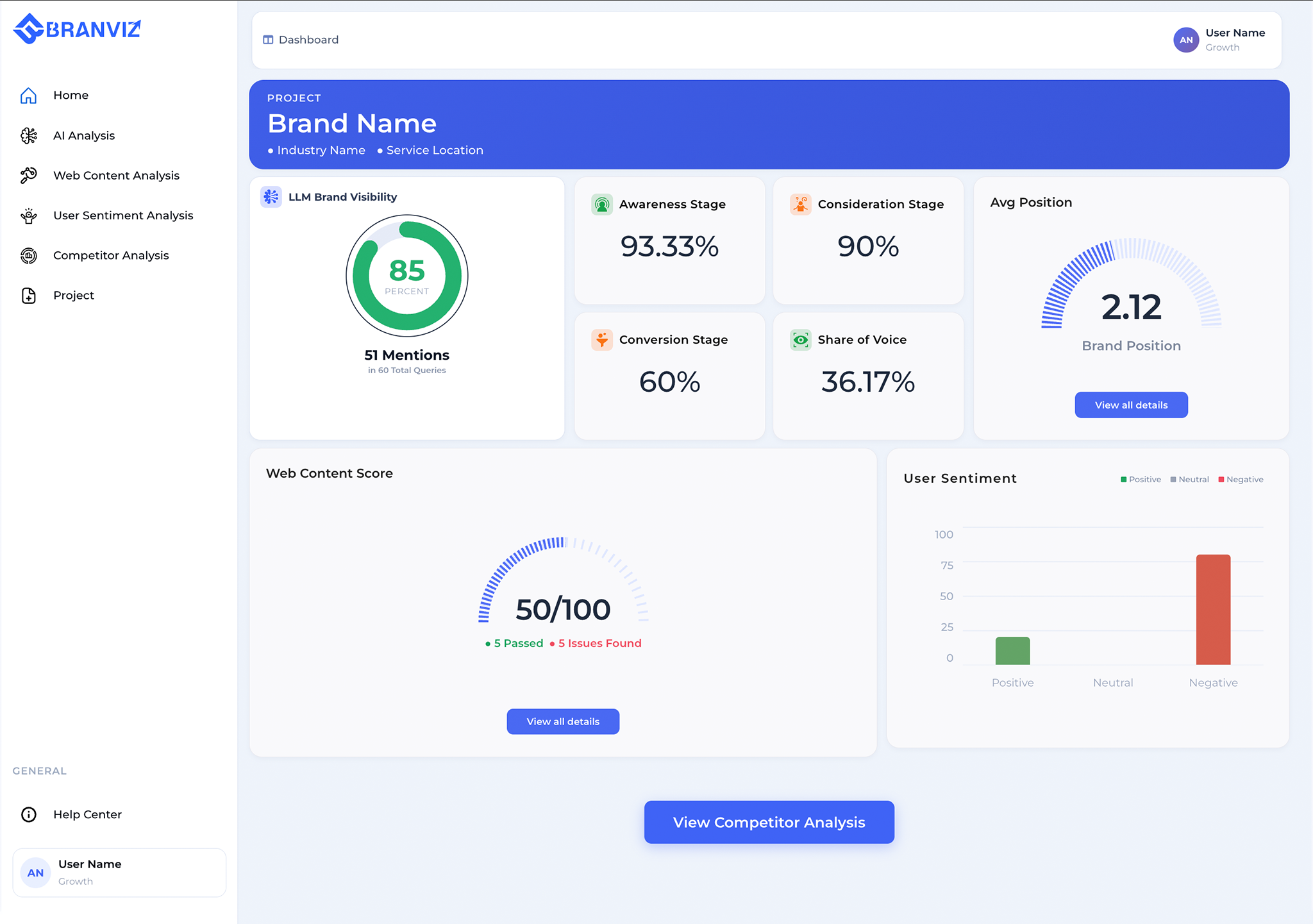
We built Branviz for exactly this: tracking how AI assistants mention and recommend your brand across platforms, benchmarked against competitors.
Common Mistakes That Reduce Your Chances of Being Recommended by ChatGPT
- Poor product information. Thin or vague product pages give the model nothing to recommend.
- Missing reviews. No independent validation means no reason for AI to vouch for you.
- Weak brand authority. Zero third-party coverage leaves you invisible in the sources AI trusts most.
- Duplicate product data. Conflicting names, specs, or prices across retailers and listings destroys confidence.
- No structured data. Forcing machines to guess at your product facts invites errors and omissions.
- Ignoring competitor analysis. If you do not know why competitors get recommended, you cannot close the gap.
- Only focusing on traditional SEO. Rankings alone do not translate into recommendations.
- Creating content only for keywords. Keyword-first content often fails to answer the actual buyer questions AI systems draw on.
ChatGPT Product Recommendations and Ecommerce SEO Strategy
AI visibility is not a replacement for ecommerce SEO. It is a layer on top of it, and most of the work overlaps.
Product SEO keeps your pages indexable and complete. Content marketing produces the guides and comparisons AI retrieves. Digital PR earns the third-party mentions that build trust. Reviews validate your products for humans and machines alike. Technical SEO ensures your structured data is implemented and crawlable. Entity SEO ties your brand, products, and categories into something machines understand.
Do this work well and it pays out twice: in search rankings today and in AI recommendations as that channel grows. The brands treating these as separate projects are duplicating effort. The smart move is one product data and authority strategy serving both.
Future of AI Product Discovery in 2026 and Beyond
A few directions are already clear. AI assistants are becoming shopping advisors, handling more of the journey from research to shortlist, and increasingly toward transaction. Buying journeys are becoming conversational, with follow-up questions replacing filter menus. That raises the bar for brands: you need a digital identity strong enough to survive a probing dialogue, not just a first mention.
Product data quality keeps rising in importance, because agents acting on behalf of buyers will simply skip products they cannot parse. And AI visibility is settling in as a marketing channel of its own, with budgets, tooling, and accountability, the way SEO did twenty years ago. The brands building signals now will be the default recommendations later.
Final Thoughts
AI recommendations are becoming a real product discovery channel, and it operates on different rules than search. An optimized product page is no longer enough. What earns recommendations is the full stack: complete product information, independent authority, genuine reviews, structured data, and a brand entity machines can understand.
None of this requires exotic tactics. It requires doing fundamental brand and product work consistently, then measuring how AI systems respond. The businesses that start monitoring and improving their AI visibility now will hold the recommendation slots their competitors discover too late.

FAQs