AI E-commerce SEO: How to Optimize Product Data for AI Search Engines, Shopping Assistants & LLMs
Jitender • 6/30/2026
AI e-commerce SEO is about organizing and improving your product data so AI shopping tools like ChatGPT, Google Gemini, Perplexity, Amazon Rufus, and Microsoft Copilot can easily understand your products and recommend them when people search in natural language.
Today, shoppers do not just type simple keywords in the search engines anymore. They ask full questions like: “Find a waterproof hiking boot for wide feet under ₹12,000 that works well for winter trekking.”
If your product data is unclear or incomplete, AI systems may ignore it and show better structured competitors instead.
Key facts to know before reading further:
- 61% of consumers now use AI tools at some point in their shopping research process
- Visitors referred from LLMs convert 4.4x higher than standard organic search visitors (Semrush, 2025)
- 83% of ChatGPT's product carousel recommendations pull directly from Google Shopping's top 40 organic listings (Search Engine Land, March 2026)
- Traffic from AI shopping sources to US retail sites grew 693% during the 2025 holiday season (Adobe Analytics)
- Products with 95% or higher attribute completion in their product feed get recommended significantly more often across all five major AI shopping engines
- 60% of searches in traditional search engines now end without a click because AI summaries answer the question directly
If your product is not named inside the AI answer, it does not exist for that buyer. That is the problem this guide helps you fix.
How AI Search Is Changing Product Discovery
AI search is changing how people find products online. Instead of typing short keywords, users now ask detailed questions in natural language.
AI systems do not just match words. Chatbots understand meaning, product features, and user intent to find the best match.
To stay visible, product information must be clear, structured, and easy for AI to understand.
Why Your Product Feed Was Never Built for This
Most product feeds were originally built to satisfy Google’s requirements, not to help AI understand your products. The goal was simple: avoid errors, get approved, and show up in search. Not to help an AI decide what to recommend to a real person.
Most brands already include the basics like product ID, title, description, price, availability, images, GTIN, brand, and condition. These are enough to get listed, but not enough to compete in AI driven shopping.
The problem is what is missing.
AI systems look for extra signals to decide what to recommend, and many feeds do not include them:
Reviews and ratings in the feed
Fields like review count and average rating help AI understand trust at a glance. If this data is not included in the feed, the AI may not consider it during quick comparisons.
Shipping and return details
Clear signals like free shipping and return policy help AI judge risk. If two products are similar, the one with clearer policies often wins.
Popularity signals
Data like popularity score helps AI understand demand, not just product details. Many merchants do not even know this field exists.
Rich media links
Video links and 3D models give AI more context about the product. These help especially in categories like fashion, furniture, and electronics.
Restock dates for out of stock products
If a product is unavailable, showing when it will be back helps AI still recommend it to users who can wait. Without this, the product is often ignored completely.
In short, most feeds are built to be “acceptable,” not competitive in AI search. That is why many products are invisible in AI recommendations even when they are fully indexed.
The Product Data Optimization Process, Step by Step
This is not a checklist to run once and file. It is a sequential process with dependencies. Doing step 4 before step 2 will waste time.
Step 1: Run the Baseline Visibility Test First
Before changing anything, document where you currently stand. Open ChatGPT, Perplexity, and Google AI Mode and run your top 20 product category queries the way a buyer would actually ask them. Not "blue running shoes men" but "What are the best lightweight running shoes for men with wide feet under 5000 that ship quickly?"
Record: which of your products appear, at what position in the response, with what accuracy, and which competitors are being recommended instead of you. This takes about 90 minutes and gives you a real baseline to measure against after optimization. Without it, you are optimizing blind.
Step 2: Fix Crawler Access in robots.txt
This step costs nothing and takes 20 minutes. It is also the step that most ecommerce teams skip because they do not realize they have blocked the wrong crawlers.
After the debates over AI training data scraping, many ecommerce teams blocked all AI crawlers. That decision removed their products from AI shopping recommendations. The problem is that OpenAI operates two entirely different crawlers with completely different purposes:
- GPTBot is the training data crawler. Blocking it is a content protection decision.
- OAI-SearchBot is the shopping crawler. Blocking it removes you from ChatGPT shopping results.
Most teams blocked both when they meant to block only one.
The configuration that supports AI e-commerce visibility:
User-agent: OAI-SearchBot
Allow: /
User-agent: PerplexityBot
Allow: /
User-agent: GPTBot
Disallow: /
User-agent: Googlebot
Allow: /
Step 3: Audit Attribute Completion on Your Revenue-Driving SKUs
Do not start with your full catalog. Start with the top 50 SKUs by revenue. Calculate the attribute completion percentage for each one. The target is 95% or higher before moving to the broader catalog.
The fields to audit in this order:
- Title completeness and structure (see Step 4)
- Review count and average rating in the feed
- Return policy
- Shipping speed and free shipping indicator
- High-quality images including lifestyle shots (not just white background)
- Availability date for any out-of-stock items
- GTIN or unique product identifier
- Video link if a product video exists
Step 4: Rewrite Product Titles for Semantic Reasoning
AI shopping assistants do not keyword-match. They semantically reason. A title optimized for Google's keyword algorithm and a title optimized for an LLM's reasoning process look very different.
A keyword-optimized title: “Samsung Mobile Phone Blue 128GB”
A semantically optimized title: “Samsung Galaxy A54 5G, 128GB Storage, 8GB RAM, Dual SIM, Super AMOLED Display, 50MP Camera, Long Battery Life, Awesome Blue”
The second title gives the AI clear details like brand, model, network type, storage, RAM, display type, camera quality, battery performance, and color. Each detail helps match real buyer queries like “best camera phone under budget” or “5G phone with good battery.” The first title only matches very basic searches like “blue mobile 128GB,” which limits visibility.
The format that consistently performs across AI shopping platforms:
- Brand
- Model or Product Name
- Gender / Audience (if relevant)
- Product Type
- Primary Differentiator
- Use Case
- Technical Specification
This applies to every SKU in your top 50 before you expand the approach.
Step 5: Rewrite Product Descriptions for Question-and-Answer Logic
Write product descriptions in a way that answers common buyer questions directly.
You can test this by asking an AI tool to generate the top 6 questions a buyer may ask about your product and checking if your description already answers them. If it doesn’t, add those missing details.
Different products need different details. Electronics need compatibility and battery info, apparel needs size and material details, and home products need dimensions and usage information.
Step 6: Make Pricing Consistent Across Every Surface
If your product pricing is inconsistent, it can lead to AI systems losing trust in your data. When AI finds different prices on your feed and product page, it may ignore your listing and choose a competitor with more reliable information.
This is why you need automated price syncing between your store and product feed. Any price change should be updated within 15 minutes to keep data accurate and consistent everywhere.
For sale pricing, both the original price and the discounted price must be clearly shown and matched across your product page and feed. If sale pricing is missing or inconsistent, your products may not appear in AI recommendations, especially when users are actively searching for budget-friendly options.
Step 7: Get Reviews Into Your Feed, Not Just Onto Your Page
If your reviews are only on your product page, you are not using their full value for AI search.
Add review count and ratings to your product feed so AI tools can read them directly. Treat review collection as part of your AI visibility strategy, not just customer feedback.
Also remember, AI systems like Perplexity also trust external reviews from platforms like Reddit, G2, and other review sites, not just your website.
Step 8: Implement the Three-Layer Technical Stack
Layer 1: Schema.org Product markup on product pages
This is the base layer that AI crawlers read directly from your website. It acts as a backup when feeds are delayed or not fully synced.
Important fields include:
- offers.priceValidUntil to confirm price freshness
- aggregateRating for reviews and ratings
- brand marked as a proper schema entity
- additionalProperty for extra technical details not covered in standard fields
One key rule: schema must be server-side rendered. If it is added using JavaScript after page load, many AI crawlers will miss it.
Layer 2: Channel-specific product feeds
You should maintain one master product data source that can be exported to different platforms like Google Merchant Center, ChatGPT shopping systems, and Perplexity.
Each platform has its own format, so the goal is not multiple systems, but one clean source that can adapt automatically.
Layer 3: llms.txt file
This is a simple file that explains your brand and product structure to AI systems in a readable way. It helps AI understand what you sell and how your catalog is organized.
It is still not widely used, which means early adoption can improve how clearly AI systems interpret your store.
How Third-Party Sources Influence AI Recommendations
Even with perfect product feeds and complete attributes, AI still checks outside sources to confirm your product.
It looks at reviews, editorial articles, Reddit discussions, comparison sites, and retail ratings. If all sources agree, AI is more confident in recommending your product. If not, it may prefer a competitor with stronger or more consistent information.
Research from 2026 shows that 98% of users who see an AI recommendation verify it before buying. About 45% search on Google, 18% check review sites, and 78% trust reviews the most.
So, you need both: strong visibility in AI results and strong trust across other platforms.
Practically, this means:
- Identify which third-party publications your category buyers trust and that AI tools regularly cite in your category
- Build a PR and editorial strategy aimed at getting accurate, detailed product coverage in those specific outlets
- Optimize your review presence on the platforms that matter for your category (not all review platforms carry equal weight with all AI systems)
- Monitor whether AI tools are describing your products accurately and whether third-party sources contain outdated information
Measuring AI E-Commerce Visibility
Standard SEO dashboards cannot measure AI citations, recommendation share, or sentiment in AI-generated responses. This is not a gap you can close by adding a filter to an existing report. It requires a different measurement layer.
The four metrics that matter for AI e-commerce visibility:
1. Citation frequency How often does your brand and your products appear in ChatGPT, Perplexity, and Google AI Mode responses to your core buying queries? This is the fundamental visibility metric. Run 20 representative queries across each platform weekly and track appearance rate.
2. AI share of voice Your brand's citation rate versus your top three competitors for the same set of queries. This tells you whether your visibility is improving in absolute terms or whether a competitor is taking share from you even as your numbers look stable.
3. LLM referral traffic Set up source-medium segments in Google Analytics 4 specifically for chatgpt.com, perplexity.ai, and gemini.google.com as referral sources. This gives you conversion rate, revenue per session, and average order value data segmented by AI platform.
4. Agentic conversion rate Conversions from AI-referred sessions specifically. The benchmark range based on 2025 and 2026 data is 2x to 4x higher than traditional organic search. If your AI-referred traffic is converting below that range, the issue is typically either product page experience or a mismatch between what the AI described and what the buyer found when they arrived.
A realistic timeline: new and updated product content surfaces in ChatGPT search within 24 to 72 hours on sites with proper technical foundations. Meaningful improvements across a full catalog typically take 60 to 90 days of consistent optimization. Set your measurement intervals accordingly.
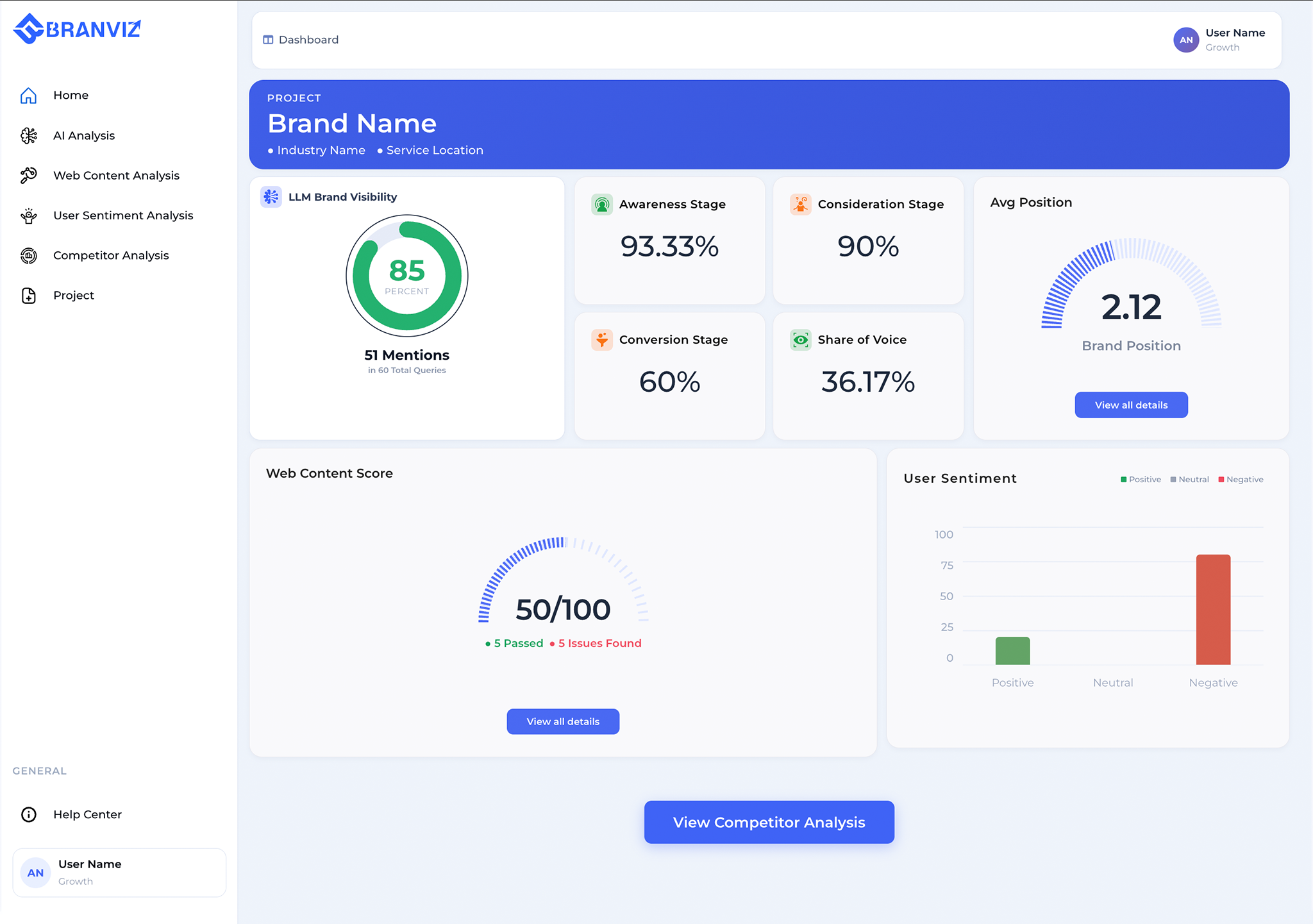
Manual monitoring across five AI platforms for hundreds of queries is not scalable. This is where Branviz fits into the process: tracking citation frequency, competitive share of AI recommendations, and sentiment accuracy in AI-generated responses across platforms, so ecommerce teams can optimize from data rather than weekly spot-checks.
What Brands Are Getting Wrong Right Now
These are real patterns, not theory. They are common mistakes that reduce AI visibility in ecommerce.
One big mistake is treating all AI platforms the same. Optimizing only for Google Shopping may help ChatGPT, but it does little for Perplexity, which needs third-party content, wikidata or Amazon Rufus, which relies on Amazon listings. Each platform works differently.
Another issue is blocking the wrong crawlers. Many brands blocked AI crawlers during the training-data debate, but in doing so, they also blocked shopping crawlers like OAI-SearchBot. That directly reduces visibility in AI shopping results.
Keyword-stuffed product descriptions are also a problem. AI does not rank by keywords. It looks for clear meaning, complete attributes, and consistent information across sources. Writing only for keywords often hurts understanding.
Inconsistent data is another major gap. If pricing, size, or other details differ across your website, feed, or marketplaces, AI loses trust and may prefer a competitor with cleaner data.
Finally, many brands do no visibility tracking. Without monitoring AI traffic and recommendations, they only notice the problem after losing visibility and traffic, often when it is already too late.
The 90-Day Roadmap for AI Product Discovery Optimization
This is a sequenced plan, not a priority list. The sequence matters because later steps depend on earlier ones being complete.
Days 1 to 14: Audit and Access
Run baseline visibility tests across all five AI platforms using natural language buyer queries. Document where your products appear and where they do not.
Fix your robots.txt crawler configuration. Allow OAI-SearchBot and PerplexityBot. Verify GoogleBot has full access. Block GPTBot only if you have content protection reasons.
Audit attribute completion on your top 50 SKUs by revenue. Calculate a completion percentage for each. Identify the three to five attributes that are missing across the most SKUs.
Verify that your Product schema is server-side rendered and present in page source, not injected by JavaScript.
Days 15 to 45: Feed Enrichment and Content
Add the AI-critical fields to your Merchant Center feed that are currently missing: review count, average rating, return policy, shipping speed, and free shipping indicator.
Rewrite product titles for your top 50 SKUs using the semantic title format. Test a sample of these titles by querying the new product names in ChatGPT and observing whether the updated data appears in results within 72 hours.
Run the Q&A description method on your top 20 SKUs. Identify the questions your current descriptions cannot answer and update accordingly.
Set up automated price sync to update your feed within 15 minutes of any price change. Audit for any pricing inconsistencies between your feed and product pages.
Days 46 to 90: Distribution, Authority, and Measurement
Join the Perplexity Merchant Program if you have not already. Submit your product catalog to the ChatGPT e-commerce platform.
Activate the nativecommerce = true flag in Google Merchant Center to enable agentic purchasing capability in Gemini.
Set up GA4 segments for LLM referral traffic by platform. Establish your baseline conversion rate, average order value, and revenue per session from AI-referred visitors.
Build a review collection step into your post-purchase flow if you do not have one. Set a target review count per SKU.
Begin tracking AI visibility metrics weekly: citation frequency, share of voice versus top three competitors, and AI-referred traffic by platform.
At the 90-day mark, compare your AI-referred traffic, citation frequency, and AI-attributed revenue against your Day 1 baseline. This comparison gives you a clear picture of the return on the optimization work and tells you where to focus the next phase.

FAQs