How AI Search Engines Select Content for Citations: Reranking and Information Gain
Jitender • 11/23/2026

AI search engines choose citations in stages. They retrieve a wide pool of candidate passages, rerank them with a model that scores how directly each passage answers the question, filter out passages that repeat each other, and then cite the ones that support the final answer. Two things are within your control: whether a passage on your page answers the question on its own, and whether it adds something the other candidates don't.
A note on certainty. No platform publishes its pipeline. The stages below come from documented retrieval techniques, public statements, patents, and research papers. The exact weights each platform uses are unknown, so treat this as a working model you can test, not a rulebook.
How AI Search Moves from Retrieval to Citation
Stage 1: One question becomes several searches
Google has described a technique called query fan-out for its AI Overviews and AI Mode: the model turns one question into a set of narrower searches and gathers results from all of them. Other products rewrite queries too, though they describe it less openly.
This changes what you compete on. The query your passage faces may be a sub-question the user never typed, such as "does this plan support single sign-on?" or "how long does setup take?" A page that answers one of those narrow questions well can be pulled in even if it never ranked for the broad topic. That is a good reason to cover the small, specific questions around your subject, not only the headline term.
Stage 2: Retrieval works on passages, not pages
Most AI search products rely on some form of retrieval-augmented generation, where the model reads retrieved text before it writes an answer. That retrieved text is usually a passage, a chunk of a page, and not the whole document. Research systems commonly find candidates by combining keyword matching with semantic similarity, which is often called hybrid retrieval. Platforms don't disclose their own setups, but the pattern is a useful guide.
Two practical consequences follow. Exact terms still help, so product names, specifications, and numbers should appear in the passage that discusses them. And a passage has to make sense when it is cut out of its page. Lines like "as mentioned above" or "it also supports this" lose their meaning once the surrounding text is gone.
An illustration, using a made-up company:
- Weak: "It also supports this for larger teams."
- Self-contained: "Acme's Team plan supports single sign-on for up to 500 users."
A comparison table is a good example of the second style, because every row is a complete claim. That is part of why comparison pages with clear criteria are easy for AI tools to quote.
Stage 3: Reranking is where most candidates drop out
Initial retrieval is fast but rough. To sort the candidates, many retrieval pipelines add a second model that reads the question and each passage together and scores how well the passage answers it. These are called rerankers, and the common type is a cross-encoder. Studies of retrieval systems have repeatedly found that cross-encoder reranking improves relevance compared with similarity scores alone.
For anyone working on rerankers for GEO, the practical point is that a reranker scores text against a question. It reads your passage, not your marketing budget. Platforms may add signals like source trust or freshness in other stages, and that is not publicly known, but the reranking step itself rewards passages that actually answer.
Stage 4: Information gain and the redundancy problem
Information gain is the idea that a document is valuable in proportion to what it adds beyond what has already been seen. Google holds a patent on this, titled "Contextual estimation of link information gain," filed in 2018 and granted in 2022. It describes scoring a document by how much new information it contains compared with documents a user has already viewed, and using that score to rank or present results.
Be careful with that reference. The patent is about ranking search results for a person, and no AI platform has said it uses this method to choose citations. But the same idea appears in research on retrieval-augmented generation. Some researchers have proposed picking passages for both relevance and the new information they add beyond passages already selected, because repeated context wastes the limited space a model has to work with.
The practical reading is straightforward. When ten pages say the same thing, an answer needs one or two of them. The rest add nothing to cite. A lot of content aimed at AI search is the fortieth summary of the same five facts, and models gain nothing from a forty-first.
Content adds information when it contains something the other candidates lack:
- Your own data, such as numbers from your customers, your tests, or your operations.
- First-hand detail, such as how a process actually works, what it costs, and where it goes wrong.
- Real examples, with names, figures, and outcomes you can stand behind.
- A clear position with reasoning, not a neutral summary of what everyone says.
- Niche or local specificity that broad pages can't match.
More words, more keywords, and a rephrased version of consensus do not count.
Stage 5: From answer to citation
After retrieval, reranking, and filtering, the model writes its answer from the selected passages and ties claims to sources. In practice, a page tends to be cited because one of its passages supports a particular statement in the answer. That means citations are earned claim by claim, not page by page. A polished page with nothing quotable can be passed over, while a plain page with one unusually useful passage gets cited.
How to earn AI search citations, stage by stage
Working back through the pipeline gives a short list of habits:
- Cover the narrow questions around your topic, since sub-questions are what get searched.
- Make each key passage self-contained, with the subject named and the claim stated.
- Lead each passage with the answer, then add the qualifier or detail.
- Include the exact terms buyers use, including names, specs, and numbers.
- Add something the competing pages lack, such as original data or first-hand detail.
- Keep independent sources consistent with you, because a claim that other sites back up is easier to rely on.
None of this guarantees a citation. It removes the common reasons a good page gets passed over.
How to test whether it's working
Pick 10 questions your buyers ask, including a few narrow ones. For each, identify which passage on your site should answer it, then ask the question in several AI engines and note whether that page is cited. Change one thing at a time, such as rewriting a single passage, and check again after the engines have had time to re-crawl.
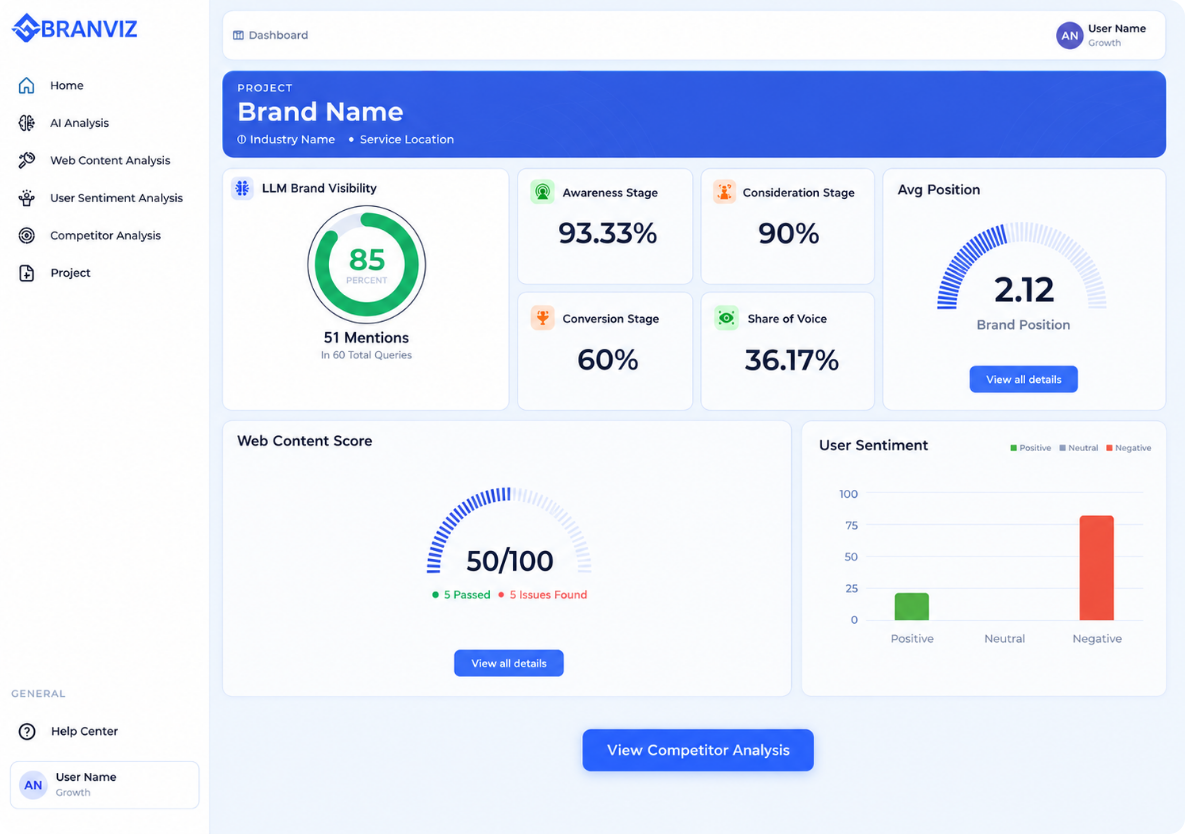
A spreadsheet is enough for a first pass. Once you are testing more than a handful of questions, an LLM visibility checker like Branviz.com does the repeating for you. It runs the same questions across ChatGPT, Gemini, Perplexity, Grok, and AI Overviews and shows whether your brand is mentioned or cited, so a before-and-after comparison doesn't depend on someone rerunning every question by hand.
What nobody outside the platforms knows
It is worth being plain about the gaps. We don't know the weight any platform gives to source trust compared with passage relevance. We don't know how each one handles near-duplicates. And we don't know whether any of them uses a method like the information gain patent. What we do know is that retrieval, reranking, and redundancy handling are standard parts of retrieval systems, and that passages which answer directly and add something new fit what those stages reward. Test your own pages against that, whether by hand or with an LLM visibility checker like Branviz.com, and trust your results over any single article, this one included.

FAQs