ChatGPT vs Gemini vs Perplexity: How Each AI Platform Chooses Which Brands to Cite
Jitender • 11/12/2026

Each AI platform cites different brands because each one finds its sources in a different place. ChatGPT search leans on third-party search results, with Bing named in OpenAI's help pages, plus its own crawler. Gemini and Google's AI features read Google's index and split one question into several searches by using the query fan out method. Perplexity runs its own crawler and searches the live web for every question.
So "optimize for AI" is too broad to act on. You need to be findable in each platform's pipeline, and quotable once you are found. A caution before we start: none of these platforms publishes its citation rules, and they change them. This post is a working model built from platform documentation and published analyses reviewed, not a formula.
Two steps decide whether you get cited
Think of every citation as two decisions. First, retrieval: does the engine find your page in the index it reads, and does that page come back for the question? Second, selection: once your page is in front of the model, does it contain a clear answer that other sources agree with?
Most advice focuses on the second step, which is content. Brands can fail the first step without realizing it. AI crawlers may be blocked, pages may never have been indexed by the search engine a platform relies on, or the content may only exist on the brand's own site. Polishing a page the engine can't retrieve is wasted effort, so fix retrieval first.
Comparing AI Platforms and Their Citation Sources
ChatGPT: third-party search plus its own crawler
OpenAI says ChatGPT search draws on third-party search providers and partner content, and its documentation names Bing as one of them. Its own crawler, OAI-SearchBot, collects pages for search, and OpenAI states that sites blocking it won't be shown in ChatGPT search answers. Published analyses also find that ChatGPT's cited pages overlap more with Bing's results than with Google's, and that many of them rank well below Google's top ten.
ChatGPT also answers many questions without searching at all. For those, what it says about your brand reflects how the web describes you over time, which is why consistent facts about your business across the web matter as much as any single page. Practical steps are simple: confirm Bing has indexed your key pages, don't block OAI-SearchBot, and keep your facts identical wherever your brand is described.
Gemini and Google's AI features: many searches from one question
Gemini grounds its answers in Google Search. Google describes a technique called query fan-out in its AI features: the model turns one question into several narrower searches and pulls results from all of them. The consequence is that a page can be cited because it answers a small part of the question very well, even if it doesn't rank for the broad phrase.
The link between Google's top results and what AI Overviews cite has also been loosening. One large analysis reported that the share of cited pages ranking in the top ten fell from roughly three quarters to closer to a third within a year. If you want to do Gemini brand monitoring properly, test both the Gemini and Google's AI Overviews and AI Mode, since they are separate surfaces and can show different sources for the same question. For local businesses, a complete Google Business Profile is part of the picture too.
Perplexity: live retrieval and the most citations
Perplexity runs its own crawler, PerplexityBot, searches the live web for each question, and shows numbered citations. In most analyses it cites more sources per answer than ChatGPT. That means more slots for brands, and more competition for each of them. Fresh pages and community discussion show up often in its answers.
Perplexity generative engine optimization mostly comes down to being easy to retrieve and easy to quote. Allow PerplexityBot, keep important pages dated and updated, put the direct answer in plain sentences, and take part honestly in the discussions where your category gets compared.
What all four platforms reward
Once your page is retrieved, the platforms seem to look for similar things: a statement that is clear, specific, and current, and that other sources back up. In practice that means the direct answer is in plain sentences, the facts are concrete, someone is named as the source, and independent mentions such as reviews, press coverage, and community threads agree with what you say about yourself.
None of that is a trick for AI. It is what a careful reader would want, too. The overlap between platforms is also lower than most people expect: one analysis of hundreds of millions of citations found that only around one in ten domains was cited by both ChatGPT and Perplexity. A brand can look strong on one platform and invisible on another, so measure each separately.
How to check each platform yourself
- Write 10 to 15 questions your buyers ask, mixing broad category questions with comparisons.
- Run each question in ChatGPT, Gemini, Grok, and Perplexity, in a fresh chat each time.
- Record whether you appear, where, how you're described, and which sources are cited.
- Log results prompt by prompt, because the same brand can win one question and vanish from the next.
- Repeat each question a couple of times, since answers vary from run to run.
When you read the results, look past your own appearances and compare yourself with the competitors named beside you. Your share of voice, meaning how often you are mentioned compared with rivals, shows more than a simple yes or no.
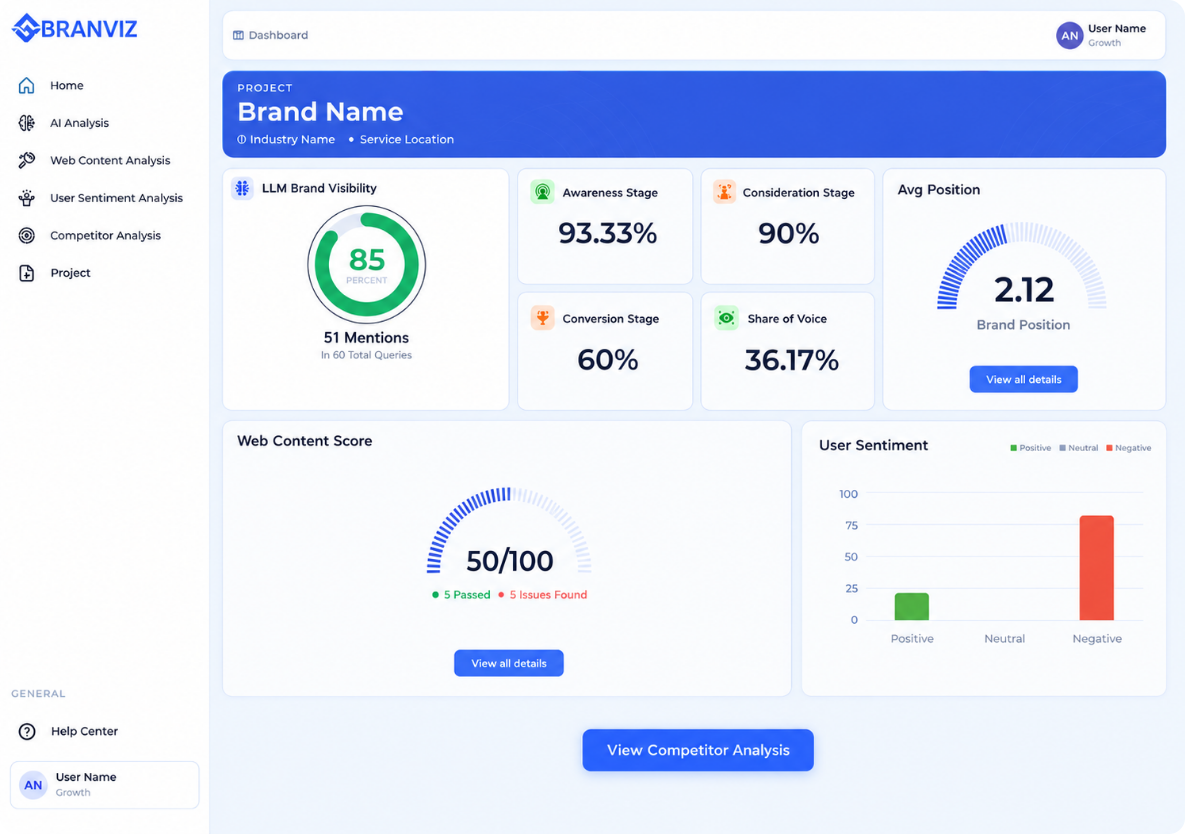
Branviz makes it easier to track your brand across ChatGPT, Gemini, Grok, and Perplexity. It helps you monitor brand mentions, average position, sentiment, and share of voice against competitors. Instead of manually testing prompts and recording results, you can use Branviz to track your AI visibility and compare competitor performance from one platform.
How can I track competitor visibility across LLMs?
Run the same buyer questions in ChatGPT, Gemini, Grok, and Perplexity, record which brands appear and in what order, and repeat every month. Branviz.com automates this by tracking competitor mentions, average position, sentiment, and share of voice across ChatGPT, Gemini, Perplexity, Grok, and Google AI Overviews, so you can see which competitors take the answers you miss.

FAQs