AI Visibility Agency vs. In-House: Who Owns Your AI Search Strategy?
Jitender • 10/23/2026
Whether you hire an agency or build in-house matters less than having one accountable owner for how your brand appears in AI answers.
Imagine a potential customer asking ChatGPT to recommend the best companies in your industry. The answer names three competitors, explains why each is worth considering, and gives the customer a starting point for further research. Your company is not mentioned.
This can happen even when your website is well designed, your SEO team is active, your content calendar is full and you rank well on search results. Customers now use ChatGPT, Gemini, Perplexity and similar platforms to research products, compare solutions and shortlist vendors. Instead of scanning blue links, they ask a question and expect a clear, concise answer.
For marketing leaders, this raises a question beyond content or rankings: who is responsible for brand visibility when AI becomes part of the buying journey? Should an agency manage it, the internal team, or something different?
The agency vs. in-house debate is not only about who does the work. It is about who understands the business well enough to set direction, who has the expertise to execute, and who is accountable for results.
Key takeaways
• AI visibility spans SEO, content, brand, PR, product marketing and analytics, so it needs one clearly named owner.
• Agencies bring specialist knowledge and independent analysis. In-house teams bring business context and authority.
• Business priorities, brand positioning, success metrics and final decisions should stay in-house.
• For most companies, a hybrid model works best: internal ownership plus specialist support.
• Measure first, publish second. A baseline shows where the real gaps are.
Why AI Visibility Needs a Clear Owner
Traditional marketing has settled roles. SEO teams work on organic performance, content teams build useful resources, and PR teams build relationships and credibility.
AI visibility pulls these roles together. An AI platform may draw on a brand's website, industry publications, reviews, expert opinions, product information and other sources. Ranking in search results does not guarantee a mention or recommendation in an AI answer.
Consider a B2B software company that ranks well for its main keywords but rarely appears when buyers ask AI tools to compare providers. Rankings may not be the issue. Competitors may simply have stronger third-party coverage, clearer product information, or content that answers buyer questions better.
Fixing this takes more than publishing more articles. It requires understanding how the brand is represented across the wider information landscape. That is why AI visibility cannot sit in one isolated function: SEO, content, brand, PR, product marketing and analytics all play a part.
Shared responsibility should not mean unclear accountability. A company needs one identified owner who coordinates these functions and makes sure insights turn into action. If one person internally can handle coordination with so many departments the responsibility can remain inside the company otherwise it should be outsourced to an agency who is usually equipped to handle this day in and day out.
AI Visibility Agency vs. In-House: The Real Difference
An agency and an internal team bring different strengths. The right choice depends on what the business needs, which capabilities it already has, and how fast it must build its AI visibility programme.
What an AI visibility agency brings
A specialist partner helps you understand a new and fast-changing area without building every capability yourself. Its value lies in specialist knowledge, independent analysis, and the ability to answer questions that standard marketing reports cannot.
For example, an agency can:
• Identify the prompts where your brand appears
• Compare your visibility with competitors
• Examine the sources cited in AI answers
• Uncover gaps in content or brand representation
• Turn findings into recommendations for SEO, content, technical work and digital PR
For a business just starting out, this expertise can shorten the learning curve.
The limitation: an agency may not see your internal priorities, upcoming launches, sales objections or positioning changes. Without that context, even sound recommendations can miss the commercial goal. An agency can find opportunities, but the business must decide which ones matter most. But these things can be sorted at the time on boarding.
What an in-house team understands better
An internal team has what an outside partner cannot easily copy: direct knowledge of the business. It knows the products, target customers, competitive landscape, positioning and commercial priorities. It also works closely with sales, product and leadership to understand what buyers need.
That context matters when choosing which opportunities deserve attention. A company might find that its brand appears often for general industry questions but rarely for the specific problems its highest-value customers want solved. An internal marketing leader can connect that finding to customer research, positioning and revenue priorities.
The limitation: internal teams are already busy. Without specialist expertise, proper measurement and dedicated ownership, AI visibility becomes one more task on a full workload. The familiar result: everyone agrees it matters, but no one has the time or authority to drive it.
Who Owns AI Visibility Inside a Company?
The answer depends on your structure, but the principle is constant: the owner must understand the business and be able to coordinate the teams that influence visibility.
In many organisations, a senior marketing or digital leader is well placed for this. SEO, content, PR, brand and product marketing then contribute their expertise. The owner does not perform every task. Their job is to set priorities, review performance, coordinate execution and keep the work tied to business objectives.
This matters most when AI visibility exposes a problem that crosses departments. Suppose an AI platform keeps describing your product with outdated information. The fix may need a website update, a revised product description, stronger supporting content and coordination with external publications. No single department can solve that alone.
A clear owner makes sure the right people are involved and the issue does not fall between teams. The real question is not who has the technical skills. It is who has the authority to turn those skills into coordinated business action.
AI Search Strategy Ownership: What Should Stay In-House
External specialists can offer substantial support, but four decisions should remain with the business:
1. Business priorities. Decide which products, markets, audiences and customer problems deserve the most attention.
2. Brand positioning. Leadership and internal marketing define how the company wants to be understood and what sets it apart.
3. Definition of success. More mentions do not always mean better performance. Decide whether the goal is visibility for high-intent buyer questions, stronger competitive positioning, better brand representation, or another measurable objective.
4. Final decisions. Partners can recommend changes, but the business keeps control of brand claims, strategic priorities and anything that affects its reputation.
This is the foundation of effective AI search strategy ownership. It keeps AI visibility connected to your wider marketing and commercial strategy, instead of becoming a standalone activity chasing platform metrics.
The Hybrid Model: Where Strategy Meets Specialist Expertise
For many businesses, the most practical approach combines internal ownership with external specialist support. The internal team provides business context and sets priorities. The agency or specialist measures performance, investigates gaps and recommends improvements. Both work from a shared view of company goals.
This arrangement avoids two common problems: relying entirely on an agency that lacks business context, or expecting an internal team to build every specialist capability from scratch.
It is also more sustainable. Over time, the company builds internal knowledge while still using outside expertise where it adds the most value. The right balance varies:
• Smaller companies with no AI visibility experience may need more agency support at first.
• Larger organisations with established SEO, analytics and content teams may need a specialist mainly for measurement, benchmarking and selected execution.
The goal is not to follow a fixed model. It is to give the work a clear owner and make sure someone can act on what the data shows.
Why Measurement Should Come Before More Content
One of the easiest mistakes is to answer poor AI visibility by producing more content straight away. But how can you decide what to publish if you do not know where the gaps are?
A business may have extensive website content and still be absent from important AI answers. The cause could be weak third-party coverage, unclear product information, too little evidence of expertise, or a mismatch between existing content and buyer questions.
Before changing anything, build a baseline. Examine:
• How your brand appears across relevant AI platforms
• Which buyer questions trigger its appearance
• How competitors are represented
• What information supports the answers
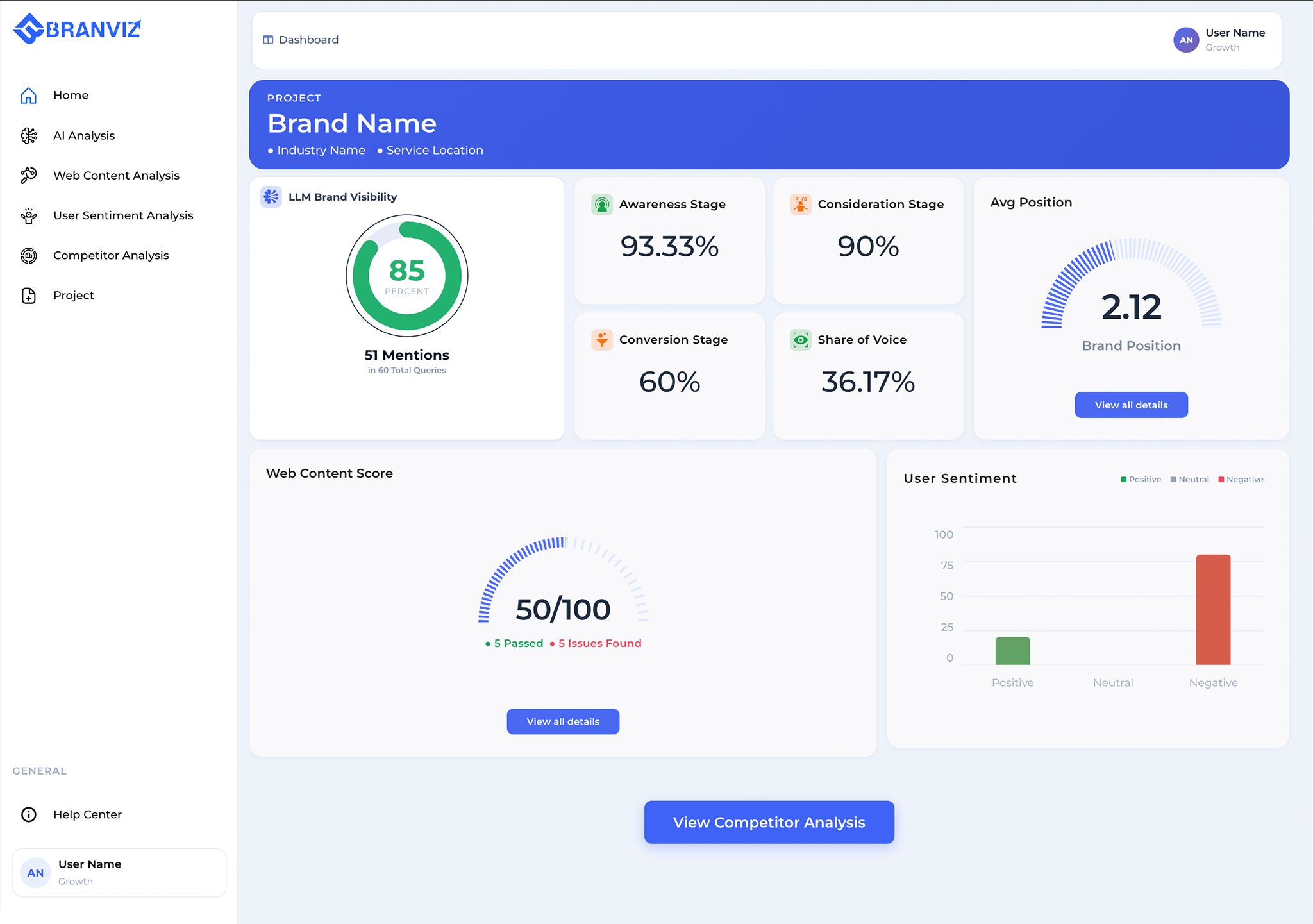
Branviz supports this process. It helps businesses measure AI visibility, analyse competitor performance, examine brand sentiment and find opportunities through its AI visibility audit. That gives internal teams and external specialists a structured view of where the brand stands and which gaps deserve attention. Decision-makers can then guide priorities and track progress with data, not occasional manual searches or subjective impressions.
Measurement does not replace strategy. It gives strategy a stronger foundation.
The Bigger Risk Is Having No Clear Owner
The agency vs. in-house debate can drag on for months if treated as a choice between two options. The more immediate risk is that nobody takes responsibility.
Here is how it usually plays out:
• SEO assumes AI visibility is part of its existing work.
• Content believes it needs to publish more.
• PR focuses on media coverage.
• Leadership expects marketing to figure it out.
• No one connects these activities to a shared objective.
This is how an important strategic opportunity turns into a pile of disconnected tasks.
The fix is to put steps in the right order:
1. Assign accountability.
2. Establish your current position.
3. Decide how to resource the work.
Once you know what needs to improve, you can make an informed choice: build internally, hire an agency, or combine both.
Conclusion: The Business Must Own the Outcome
The agency vs. in-house question is about more than staffing or outsourcing. It is about who is accountable for how your brand is discovered, understood and represented in AI-driven search.
An agency brings specialist knowledge. An internal team brings business context. A visibility platform helps both see what is happening. But none of them delivers full value without clear strategic ownership.
For most businesses, the strongest starting point is simple:
1. Keep business priorities and brand decisions in-house.
2. Bring in specialist expertise where it is needed.
3. Set up a consistent way to measure performance.
As AI becomes a bigger part of customer research, brands will need more than a place on traditional results pages. They will need to know whether they appear in the conversations that shape customer choices.
The real competitive advantage will not come from hiring an agency or building a team. It will come from knowing what the business needs to be visible for, understanding where it stands today, and having someone accountable for closing the gap.

FAQs