How Often Should Businesses Conduct AI Brand Visibility Audits
Jitender • 6/25/2026
AI Brand visibility Audits should be done every month. If you launch new products, run major campaigns, or make big changes to your content or positioning, then you should also do weekly checks for a short period.
This is because AI Brand Visibility can change quickly. Competitors can show up more in AI results, your info can get outdated, and new content can change how your brand is shown. If you don’t check regularly, you may only notice after it affects your traffic or leads.
In short, do audits every month, and check weekly when you launch new products or make big updates.
What Should Be the Frequency of AI Brand Visibility Audits?
There is no single schedule that works for every company. Instead, your audit frequency should match your growth stage and business activity. Fast-growing brands and startups benefit most from monthly audits to catch new opportunities and competitive shifts early, while established companies with steady markets can safely rely on quarterly reviews to track long-term trends.
Additionally, any business undergoing a major change, such as a product launch, rebranding, or website restructure, should immediately trigger an event-driven audit to ensure AI systems reflect the updates accurately.
Monthly Audits for Fast-Growing Brands
Monthly AI visibility audits make sense for brands in motion. That includes startups, fast-growing B2B SaaS companies, DTC brands expanding aggressively, businesses entering new markets, and companies actively investing in content, digital PR, AI Search Optimization, or category education.
These businesses create change faster than AI systems can be assumed to reflect accurately. A new product page, fresh thought leadership content, comparison content, third-party mentions, updated positioning, or a surge in branded search interest can all influence how AI platforms mention the brand. If you wait a full quarter to review visibility, you may miss three important things:
First, you may miss new opportunities. A brand might start appearing in AI answers for adjacent category prompts, buyer comparison prompts, or industry recommendation queries. Without monthly monitoring, that growth remains invisible to the team, which means you also miss the chance to strengthen what is already working.
Second, you may miss brand drift. AI systems can sometimes use old or incorrect information about your brand, like outdated pricing, features, or category. For example, if you changed from “marketing automation software” to “llm brand visibility tool,” AI tools may still show the old label. Monthly audits help catch and fix this early.
Third, you may miss competitive displacement. AI answers often change which competitors they show. If another company gets better content or more mentions, it may start appearing instead of your brand in recommendations.
A monthly audit is not overkill for a company trying to grow share in AI Search. It is the minimum level of operational visibility needed to see movement while there is still time to respond.
Quarterly Audits for Established Businesses
Quarterly audits are a practical baseline for established businesses that already have a stable brand position, a consistent publishing schedule, and relatively little week-to-week change in their market. This approach is often best suited for mature B2B companies, regional service providers, and enterprise brands where content, positioning, and messaging remain fairly steady and do not shift significantly from month to month.
Quarterly does not mean AI Search visibility is static. It means the business can safely review bigger changes every 90 days without taking on too much risk. For example, if your company already has strong brand recognition, a stable set of products, and operates in a category where competition changes slowly, a quarterly AI Visibility Audit is usually enough. It helps you spot trends, compare performance from one quarter to the next, and plan any needed improvements.
The benefit of a quarterly cadence is that it gives teams enough time to observe pattern changes rather than reacting to every short-term fluctuation. AI visibility is not always a straight line. A brand may appear in one month, disappear in another, and return after new content gets indexed or cited more widely. Looking at a full quarter can help teams distinguish between noise and meaningful change.
That said, quarterly only works if the business still has some light monthly monitoring in place. If your team is doing no AI Search Monitoring between quarterly audits, you risk learning about a visibility drop long after it has affected demand, demos, or brand perception.
Event-Driven Audits After Major Brand Changes
Even if your core audit cadence is monthly or quarterly, certain business events should trigger an immediate AI Brand Visibility Audit. These are moments when the external understanding of your brand is likely to shift, and AI systems may not reflect that shift cleanly or consistently.
Examples include:
- A rebrand or messaging repositioning
- A major product launch
- Expansion into a new market or category
- A pricing model change
- A merger, acquisition, or company rename
- A major PR event or funding announcement
- Significant website restructuring
- New comparison pages, use-case pages, or solution pages
- A reputation event, positive or negative, that could influence brand mentions
Imagine a company launches a new AI analytics product and wants to appear in searches like “best AI analytics tools for ecommerce” or “top platforms for retail forecasting.” If the team waits for the next quarterly audit, they lose important time.
Doing an audit right after launch helps them see whether AI tools are already linking the brand to the new product, or if they are still showing the old positioning instead.
This is one of the most overlooked principles in AI Search Presence management: audit cadence should not only follow the calendar. It should also follow business events that change what the market should know about you.
Why AI Brand Visibility Changes Faster Than Traditional Search Rankings
Traditional SEO taught marketers to think in terms of rankings, indexing, and gradual movement over time. AI Search behaves differently. While it still depends on information sources that often overlap with the web ecosystem, the way answers are assembled, synthesized, and presented can make brand visibility feel more fluid than a classic ten-blue-links search result.
That is one reason AI visibility audits often need to happen more frequently than traditional SEO audits.
AI Models Continuously Update Their Sources
AI platforms do not all work the same way, but many rely on a combination of indexed web content, structured information, external references, retrieval layers, citation sources, and model-level understanding. That means the information used to mention a brand can shift as new pages are crawled, new references appear, or source weighting changes.
A business that had weak visibility in ChatGPT last month might begin appearing after a cluster of high-quality articles, list mentions, partner pages, reviews, and category pages are published. The opposite can happen too. If outdated third-party content remains more prominent than your current messaging, AI systems may continue repeating old narratives.
Unlike a single ranking position for one keyword, AI Search Visibility is distributed across many prompt patterns, recommendation formats, and answer contexts. That makes it more sensitive to source changes.
Competitor Mentions Can Influence AI Recommendations
In AI-generated answers, your brand does not compete only for your own visibility. It also competes for association within a broader answer set. If a user asks, “What are the best AI visibility platforms for enterprise brands?” the AI system may produce a shortlist. That shortlist can change based on which brands are repeatedly mentioned together across relevant sources.
This matters because competitor activity can influence your visibility even when your own content remains unchanged. If a competitor launches new category pages, earns better editorial mentions, gets listed in more comparison articles, or becomes heavily discussed in industry communities, they can gain recommendation momentum. The result is not simply that they rank higher. It is that they may appear more often in the answer itself.
That is why AI Search Monitoring should include competitor share of voice, not just your own mention rate.
New Content Can Quickly Impact Brand Visibility
One of the strongest reasons to audit regularly is that fresh content can create visibility gains faster than many teams expect. A well-structured glossary, comparison page, use-case article, thought leadership piece, data study, or partner mention can give AI systems new material to reference when answering prompts.
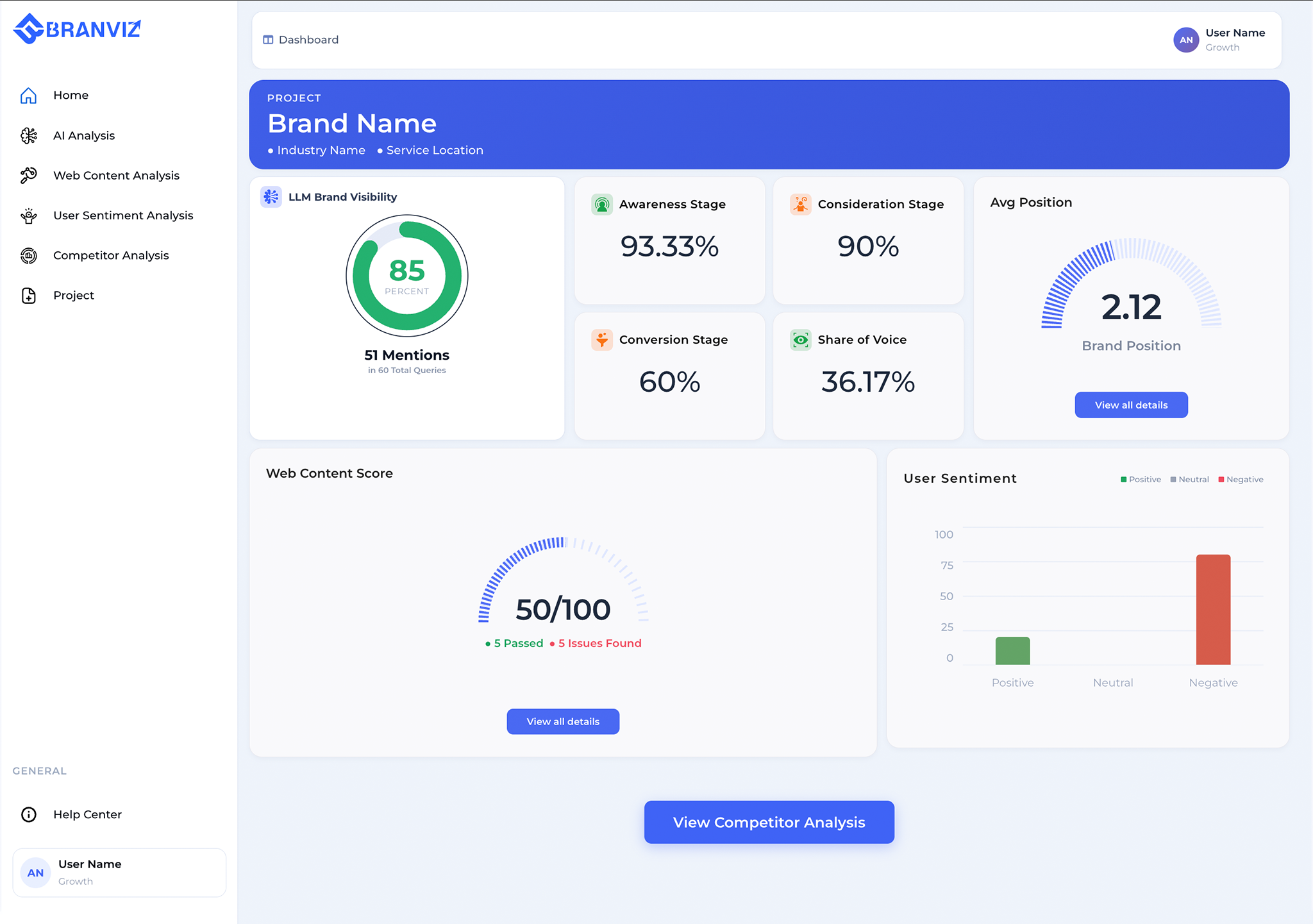
For example, if Branviz publishes a detailed article explaining AI visibility benchmarks for SaaS brands, that content can strengthen its association with AI Search measurement and visibility strategy. Over time, AI tools may start connecting the brand more strongly with those concepts. But that only becomes useful if the team is actively auditing to see whether the association is actually showing up in real answers.
Without a recurring audit process, content teams keep publishing without knowing which assets are influencing AI Search Presence and which ones are not.
The Key Signals to Audit Every Month
Even when a full formal audit happens quarterly, some signals deserve monthly review. These indicators act as an early warning system and help marketing teams spot changes before they become bigger problems.
Brand Mention Frequency Across AI Platforms
The first signal is simple: how often does your brand appear in relevant AI prompts, and on which platforms?
This should be measured across branded, non-branded, category, comparison, use-case, and problem-aware prompts. A company might have strong branded visibility but weak presence in non-branded discovery prompts. Another might appear in ChatGPT but barely surface in Google AI Overviews or Gemini.
Monthly tracking of mention frequency helps answer practical questions. Are we appearing more often than last month? Are we showing up for the right categories? Is our visibility concentrated on branded prompts only, or are we present in broader buying and research queries too?
Accuracy of Business Information
Visibility without accuracy is not a win. AI systems may mention a brand while still getting the details wrong. Monthly audits should check whether the information being surfaced is current and commercially safe.
That includes core business descriptions, product categories, target audience, differentiators, pricing references where relevant, company size signals, and geographic information if the brand serves specific markets.
A simple example: if an AEO tool still describes a company as an “SEO reporting tool” even though it now offers a broader AI Search Optimization platform, that outdated description can confuse potential customers. It may also affect whether the brand shows up in the right recommendation results.
Share of Voice Against Competitors
A visibility audit should not stop at “did we appear?” It should also ask, “how often do we appear relative to the competitors buyers are likely to hear about in the same answer set?”
Monthly share of voice tracking shows whether your brand is gaining or losing comparative presence in AI-generated recommendations. If three competitor brands are repeatedly mentioned across category prompts while your brand appears inconsistently, that is a strategic problem even if your total mentions have not collapsed.
This is where AI visibility becomes a market intelligence function, not just a reporting exercise.
Citation Sources Referenced by AI Systems
If an AI answer includes references, linked sources, or source cues, those sources should be reviewed every month. Over time, patterns emerge. You may find that certain review sites, editorial publications, knowledge pages, partner pages, or industry blogs consistently influence how your brand is represented.
This insight is valuable because it shows where visibility is actually being built. A team may assume its own blog is driving AI Search Presence, while the stronger influence may be third-party comparison pages or category directories. Once you know which sources appear repeatedly, you can improve them, earn more of them, or correct inaccuracies within them.
Category and Industry Association Accuracy
One of the most practical checks in an AI Brand Visibility Audit is whether AI systems place your brand in the right category. This sounds basic, but it is where many companies lose visibility without realizing it.
If your company should be associated with “AI visibility platform,” “brand monitoring in AI search,” and “generative engine optimization tools,” but AI systems still associate it mainly with “SEO analytics software,” your prompt coverage will be limited. You may not appear in the questions that matter most to buyers.
Monthly category association checks help ensure the market language surrounding your brand is moving in the same direction as your positioning.
Warning Signs That Your AI Visibility Audit Frequency Is Too Low
Many businesses do not realize their audit cadence is too slow until they find a problem that has already been present for weeks or months. A few warning signs make that clear.
Sudden Drop in AI Mentions
If your brand used to show up often in AI responses but then suddenly drops, you shouldn’t wait for the next quarterly review. This usually happens for a few reasons: the sources AI tools rely on may have changed, competitors may have become more visible, or your own content and citations may no longer be strong enough.
A drop in visibility is not always serious, but it should always be checked quickly.
Competitors Appear More Frequently in AI Responses
Sometimes your visibility does not disappear. It simply gets crowded out. If competitors are showing up more often in the same prompt clusters, your relative presence declines even if your absolute mention count looks stable.
That kind of shift can be easy to miss without regular audits because the brand still appears occasionally. The problem is that it no longer appears with the same consistency or prominence as before.
Outdated Brand Information in AI-Generated Answers
If AI systems are repeatedly surfacing old descriptions, old product names, legacy positioning, or inaccurate business details, your audit frequency is too low for the amount of change happening in your business. The longer those inaccuracies persist, the more they shape buyer understanding.
Reduced Referral Traffic From AI Platforms
For brands already seeing referral traffic, assisted discovery, or branded search lift from AI platforms, a decline in that traffic can be an important signal. It does not prove an AI visibility problem by itself, but it is often worth pairing traffic analysis with a fresh AI Visibility Audit to see whether answer presence has changed.
Recommended AI Visibility Audit Schedule by Business Type
The easiest way to make audit frequency practical is to map it to business type and growth stage.
Startups
Startups should usually audit monthly, and in some cases every two to four weeks during active growth periods. Early-stage companies are still shaping their category narrative, testing positioning, publishing foundational content, and trying to enter competitive recommendation sets. Their AI Search Presence can change quickly because the market’s understanding of the brand is still forming.
For startups, the risk of waiting too long is high. A quarter is enough time for a competitor to dominate the category conversation while your brand remains invisible in key prompts.
Mid-Sized Businesses
Mid-sized businesses often benefit from a hybrid model: monthly monitoring with a full quarterly AI Brand Visibility Audit. This is usually the right balance for companies with established operations but ongoing investment in content, product marketing, and demand generation.
The monthly layer catches movement. The quarterly audit gives room for deeper analysis, including prompt coverage, competitor benchmarking, source mapping, and accuracy checks across multiple AI platforms.
Enterprise Brands
Enterprise brands can often run full audits quarterly, but they should still maintain monthly monitoring for priority business units, strategic product lines, and high-value categories. Large organizations are more likely to have multiple products, regional variations, complex messaging, and a wider range of third-party mentions. That complexity creates more surface area for inconsistency.
In practice, many enterprise teams do best with a tiered approach: monthly checks for strategic product categories, quarterly enterprise-wide audits, and event-driven audits after launches, acquisitions, or messaging changes.
What a Complete AI Brand Visibility Audit Should Include
Audit frequency matters, but so does audit quality. A weak audit run every month is still weak. A proper AI Visibility Audit should examine where the brand appears, how it is described, what sources shape that visibility, and how competitors compare across the same prompt universe.
ChatGPT Visibility Assessment
A ChatGPT Visibility review should test the brand across branded, category, comparison, use-case, and “best tools” prompts. The goal is not just to see if the brand is mentioned. It is to understand when it appears, what context it appears in, which competitors appear alongside it, and whether the explanation is accurate.
This is especially useful for B2B brands because buyer research increasingly starts with conversational prompts rather than simple keyword searches.
Google AI Overview Analysis
Google AI Overviews deserve separate analysis because they sit close to traditional search behavior while still changing the answer experience. Here, the audit should review which queries trigger AI Overviews, whether the brand is mentioned or cited, what source pages are influencing the answer, and whether the brand appears for commercial-intent or research-intent queries that matter to the business.
Gemini Visibility Review
Gemini can reveal a slightly different picture of AI Search Presence because platform behavior, source use, and response style are not identical across systems. A brand that appears consistently in one AI platform may not appear with the same strength in another. That is why platform-specific auditing matters. Visibility cannot be assumed to transfer evenly.
Competitive AI Visibility Benchmarking
A strong audit compares your brand against direct and adjacent competitors. This should include mention frequency, category association, prompt coverage, recurring co-mentions, and source overlap. If competitors are winning, the audit should help explain why. Are they earning more citations? Publishing stronger educational content? Appearing more often in list-style recommendation pages? Getting associated with the category more clearly?
Benchmarking turns an audit from a status report into a strategy tool.
Brand Sentiment and Citation Analysis
Not every mention is equally valuable. A complete audit should review whether brand mentions are favorable, neutral, inaccurate, or framed in a way that weakens positioning. It should also examine where those descriptions come from.
Citation analysis helps answer a critical question: which external sources are shaping AI answers about your brand? Once you know that, you can prioritize the pages, publications, profiles, and category assets that need attention.
Why Consistency Matters More Than One-Time Audits
One-time audits are useful for establishing a baseline, but they rarely improve AI visibility on their own. AI Search is not a single campaign metric. It is an ongoing layer of brand discoverability that changes as your content, your competitors, and the wider web ecosystem change.
The companies that get value from AI Search Monitoring are not the ones that run one big audit and file it away. They are the ones that build a repeatable system. They review visibility on a schedule, compare changes over time, connect findings to content and PR decisions, and treat AI Search Presence as a measurable growth channel.
That consistency matters because visibility problems usually show up gradually before they become obvious. A slight decline in category prompts, a growing mismatch in brand description, a stronger competitor presence, or a citation pattern shifting away from your strongest sources can all be addressed early if the audit rhythm is consistent.
Conclusion
The right audit frequency is not about checking a box. It is about matching your monitoring cadence to the speed at which your brand story, category visibility, and competitive environment are changing inside AI systems.
If your business is growing quickly, publishing aggressively, entering new markets, or trying to build brand visibility in AI Search from the ground up, monthly audits are the safer choice. If your brand is more established and your market moves more slowly, quarterly audits can work well, provided you still monitor key signals between those reviews. And no matter what cadence you choose, major brand changes should always trigger an additional audit.

FAQs