From 0% to 39%: How Branviz optimized AEO/GEO for a Real Estate brand
Jitender • November 17, 2026
Discover how a premier real estate brand optimized its digital footprint to surge from zero to 39% visibility across major generative AI engines, capturing high-intent property seekers directly at source.
The Business Problem
Every day, commercial tenants, investors, and property buyers are replacing traditional search engines with AI assistants.
Instead of scrolling through pages of Google links, they open ChatGPT, Gemini or Google AI Overviews and ask direct questions:
- Which are the best new commercial projects in Gurgaon?
- Which mixed-use developments offer retail and office spaces on Golf Course Extension Road?
- Where can I find modern Grade-A office spaces for my company?
These AI recommendations shape buyer shortlists long before anyone fills out a website lead form.
The client is one of the region’s premier real estate developers, with decades of experience, landmark physical towers, and extensive retail and office developments. They are well known in the offline market.
Yet, when property seekers asked AI engines for recommendations in their exact locations, the brand simply did not show up.
Their visibility score across major AI search engines was a flat zero.
Why Wasn’t AI Recommending a Well-Known Developer?
We ran a diagnostic audit using Branviz, our platform that checks how brands show up in answers across ChatGPT, Gemini, Perplexity, Grok, and Google AI Overviews. Instead of guessing why the developer was left out, we tested real property-seeker prompts to measure exact brand mentions, citation links, average position, user sentiment, and share of voice across eight visibility dimensions.
When a homebuyer or investor asks an AI assistant about "commercial projects in Gurugram" or "3 BHK flats on Golf Course Extension Road," the models only recommend developers whose sector locations, property configurations, and project facts are written in plain, structured formats across the web. Using Branviz's 10-signal GEO readiness audit, we pinpointed the exact content and technical gaps stopping our client's website from being read the same way.
Across the commercial and residential real estate industry, most legacy developers share the exact same blind spot. Property websites are built for human brochure browsing, relying on downloadable PDFs, image-heavy galleries, interactive floor-plan scripts, and vague lifestyle copy. Meanwhile, third-party listing aggregators and property portals host the structured, machine-readable text that AI models actually pull from. As a result, when buyers ask generative engines for project recommendations, third-party portals control the narrative while the actual builders are left out of the conversation.
The data revealed four straightforward reasons why AI engines ignored the brand:
- Zero AI Presence: The brand held no existing share of voice or recognizable presence in conversational answer models.
- Unoptimized Content: Project descriptions relied on traditional marketing copy rather than the direct, factual details AI models look for when answering questions.
- No Schema Markup: The website lacked structured backend data, making it difficult for automated bots to clearly identify property types, locations, and unit configurations.
- Weak Entity Signals: Search engines and knowledge graphs could not easily connect the developer’s name to the specific commercial corridors where their properties are located.
Because the information was hard for AI crawlers to parse and verify, the engines skipped the brand and recommended other options instead.
Baseline Metrics Before Optimization
Understanding these gaps is why tracking brand visibility in AI search has become essential for property brands looking to protect their deal pipeline.
What We Did to Fix It
We did not rely on generic SEO tricks or heavy keyword stuffing. Instead, we focused on making the developer's real-world authority easy for AI models to read, extract, and cite.
- Rewrote Key Pages with Direct Language: We replaced promotional slogans with clear, factual sentences that describe exact locations, arterial road connectivity, and specific commercial uses.
- Built Dedicated Answer Blocks: We added modular sections that directly answer common buyer questions about retail sizes, office layouts, and tenant facilities.
- Fixed Backend Crawlability: We improved backend technical code so AI web crawlers could access and read project specifications without getting blocked by heavy scripts.
- Added Clear Structured Schema: We organized property details so search systems could connect each development to its exact city sector, neighborhood, and asset category.
By following a standardized schema markup checklist for AI search visibility, we gave AI models the verified facts they need to recommend a property with confidence.
The Results: From 0 to 39 in 6 Months
Over a six-month period, these targeted fixes produced a significant shift in how AI engines perceive and surface the brand.
Overall Campaign Growth
Platform Breakdown
The brand gained steady traction across every major conversational search platform:
- Gemini: Reached 149 mentions with 12 cited resource pages, delivering the highest overall mention count.
- Google AI Mode: Generated 108 mentions and earned citations across 51 individual project pages, proving broad catalog visibility.
- ChatGPT: Rose to 72 mentions with 40 cited domain pages, making the developer a regular pick in conversational comparisons.
- Google AI Overviews: Earned 31 brand mentions and 7 cited pages directly inside search answer panels.
The AI Visibility in Action
The real test of this strategy is what happens when a prospective buyer types an unbranded query into an AI search box.
Instead of being left out, the brand's key commercial developments are now actively cited and recommended:
- When users search for: "commercial projects in gurgaon"
AI engines now cite the developer's flagship mixed-use development on Golf Course Extension Road, specifically highlighting its blend of high-end retail, modern corporate offices, and serviced studio spaces. - When users search for: "new commercial projects in gurgaon"
AI summaries focused on key growth corridors along the Southern Peripheral Road (SPR) and Dwarka Expressway now point directly to the brand's developments for prime retail shops, corporate suites, and high-visibility commercial plots. - When users search for: "upcoming commercial projects in gurgaon"
When buyers ask about modern corporate hubs, engines surface the developer's Grade-A office complex in Sector 66, specifically noting its modern workspaces and dedicated corporate showroom zones.
Tracking Machine Citations with Branviz
Standard website analytics only tell you what happens after a visitor clicks through to your site. They cannot show you what happens inside conversational prompts, where an AI decides which property developers to recommend and which ones to ignore.
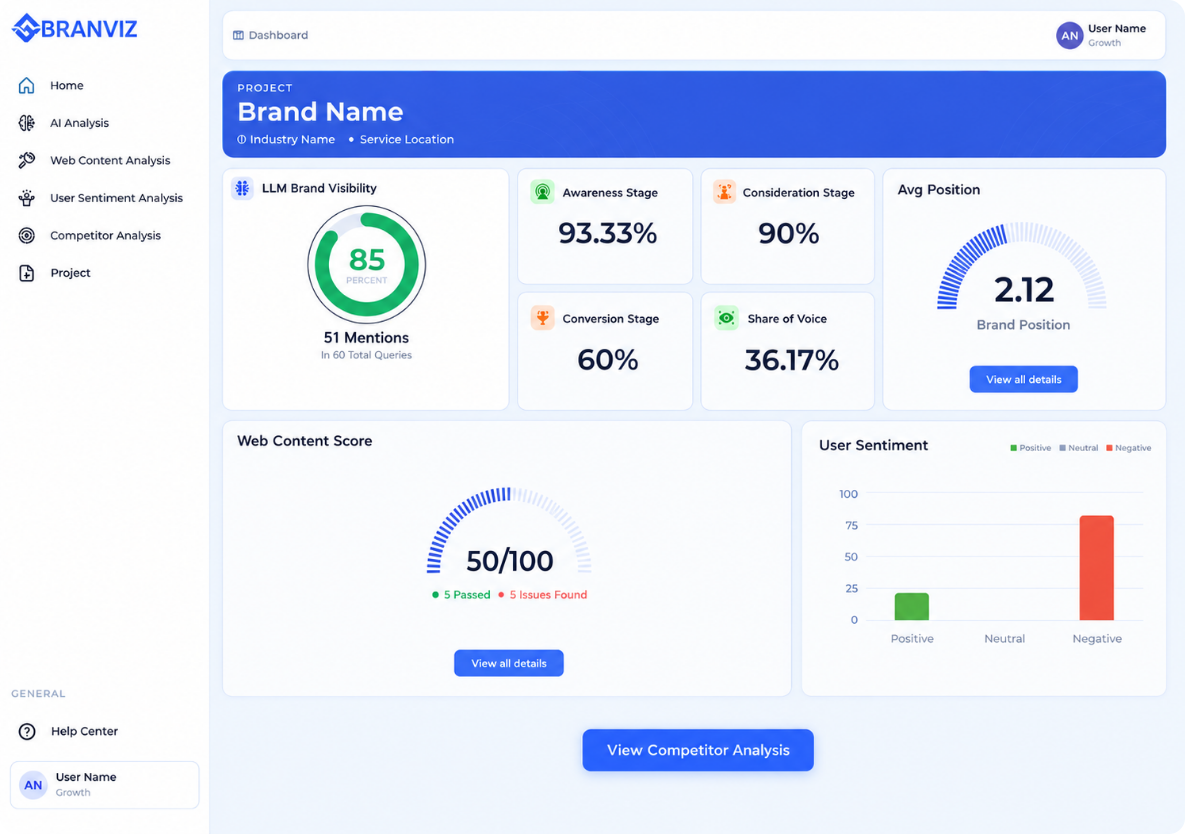
To solve this, the developer used Branviz to monitor its footprint in real time. The platform tracks brand mentions, citations, average position, sentiment (positive, neutral, negative), AI share of voice, competitor benchmarking, full-funnel visibility, and product-level visibility across ChatGPT, Gemini, Perplexity, Grok, and Google AI Overviews. It evaluates eight visibility dimensions and includes a GEO readiness audit covering 10 signals, giving teams the clear diagnostic data needed to see exactly how algorithms present their projects.
Conclusion
Being well known in the physical world no longer guarantees you will be found in the AI world.
When property seekers ask AI assistants to find commercial spaces or residential flats, the models recommend the brands that provide clear, structured, and easily readable answers.
By cleaning up unoptimized content, adding structured data, and maintaining consistent facts across the web, any leading brand can go from completely invisible to consistently recommended.