We Surveyed Online Shoppers: 69% Now Ask AI Instead of Reading Product Reviews
Jitender • November 11, 2026

Online shoppers are fundamentally changing how they discover products, using tools like ChatGPT, Gemini, and Perplexity to bypass the fatigue of reading through dozens of customer reviews.
In our survey of 550 active online shoppers, 69.1% reported discussing a prospective purchase directly with an AI chatbot before buying. However, 96.4% of those shoppers still verify the engine's recommendation on Google, review sites, or YouTube, proving that generative AI is now where purchase consideration starts, not where it ends.
For online brands, achieving strong AI visibility decides whether you make the initial shortlist, while your off-page reviews and verified proof decide who actually wins the checkout.
Case Study at a Glance
Why We Ran This Survey
Brands hear that shoppers are moving from search results and review pages to AI answers. That is easy to say and hard to picture. We wanted to know what one shopper actually does: do they ask AI, do they believe it, and what do they do next?
The answers matter for anyone working on brand AI visibility. If shoppers treat AI as the final word, the only job is to get mentioned. If they treat it as a first draft, there is a second job.
How We Ran the Survey
We collected 550 responses and asked about chatbot habits, product discussions, what people asked for, whether they followed the advice, and what would build trust.
Almost every respondent (96.4%) had used an AI chatbot, and 78.2% used one daily. ChatGPT was the most-used tool at 61.8%. Shopping was not the main use. Only 20% mainly used chatbots for shopping, while research (56.4%), work or coding (52.7%), and learning (52.7%) ranked higher.
Finding 1: 69% Have Already Discussed a Purchase With AI
69.1% said they had discussed a product they wanted to buy with a chatbot. Another 18.2% were not sure, and 12.7% had not.

The “not sure” group is worth noticing. Chatbots now sit inside search engines and apps, so some shoppers may be using AI without labeling it that way.
Finding 2: Shoppers Ask AI to Compare and Suggest, Not Just Answer
The most common requests were comparing options (61.8%) and suggesting products (56.4%). Explaining features followed at 45.5%. Checking reviews (34.5%) and finding the best price (30.9%) ranked lower, which suggests many shoppers do those jobs elsewhere.
Electronics led the categories at 52.7%, then travel (38.2%) and software (34.5%).
Brand names showed up in the answers. 56.4% said the chatbot named specific brands, 36.4% got general categories only, and 7.3% got neither. A made-up illustration: someone asks, “Compare two mid-range phones for battery life,” and gets two names. Those two names are the shortlist, and every other phone has already lost.
That is the core of LLM brand visibility. It is not about traffic. It is about being one of the names inside the answer.
Finding 3: Most Shoppers Follow AI Advice Only Partly
74.5% followed the suggestion partly, 18.2% followed it fully, and 7.3% chose something else.

“Partly” is the number we keep coming back to. Shoppers take what AI gives them and adjust it, for example by keeping one brand from the list and swapping out another. Being named matters, but it does not decide the sale on its own.
Finding 4: Almost Everyone Checks Elsewhere, So Reviews Still Matter
We asked whether people verified the suggestion on Google, review sites, or YouTube. 47.3% said always, 49.1% said sometimes, and only 3.6% said never.

This is why the headline’s “instead of” needs care. AI replaces the early research, not the final check. Review quality does double duty here, since reviews shape AI recommendations in ways we cannot fully see, and they are also what a shopper reads next. We do not know how much weight each AI platform gives reviews, so treat that as something to test, not assume.
Finding 5: Source Links and Price Comparison Build Trust
We asked what would make shoppers trust AI recommendations more. Source links led at 52.7%, then price comparison (43.6%), real user reviews (32.7%), and brand transparency (30.9%). Only 9.1% said nothing would help.

Trust is not blocking adoption. 70.9% said they would definitely or probably use a chatbot again for a purchase decision.
Shoppers want to see where an answer came from. A person may meet your brand inside an AI answer, check it on another site, and buy without ever clicking through from the AI first. That is why brand visibility over traffic is the better first measure for this kind of journey.
What It Means: Shortlist, Then Proof
This is our opinion, built from the survey, not a proven rule. A purchase that starts with AI has two stages:
- Shortlist: the AI names a few brands. This is where AI visibility is won or lost.
- Proof: the shopper checks reviews, prices, and sources. This is where your wider reputation decides the outcome.
Most teams watch one stage and ignore the other. A brand that is named but cannot survive a quick Google check loses the sale. A brand with strong reviews that AI never names never gets checked at all.
How to Check Your Brand AI Visibility This Month
What we know: AI tools name brands in their answers, and different tools can answer the same question differently. What we do not know: exactly how each platform picks and orders brands, or how stable that is week to week. Nothing guarantees a mention or a citation, so test instead of assuming.
- Use real shopper prompts. Start with “compare A and B” and “best [category] for [need],” the top tasks in our survey.
- Test more than one platform. Getting a product recommended by ChatGPT is one result, and Gemini or Perplexity may answer differently.
- Record details. Note whether you were named, where you appeared, the tone of the mention, and which sources were cited.
- Audit your proof. Check that specs, prices, and review pages are consistent and readable on the sites shoppers use to verify.
- Repeat monthly. One test is a snapshot. Several tests show a trend.
Or use branviz for better clarity and without any manual efforts.
Limits of This Case Study
We had 550 responses, and many respondents are young and work in digital or marketing roles, so they likely use AI more than the average shopper. We recorded what people said, not what they did. Treat these results as direction for your own tests, not as a market-wide figure.
Checking LLM Brand Visibility With Branviz
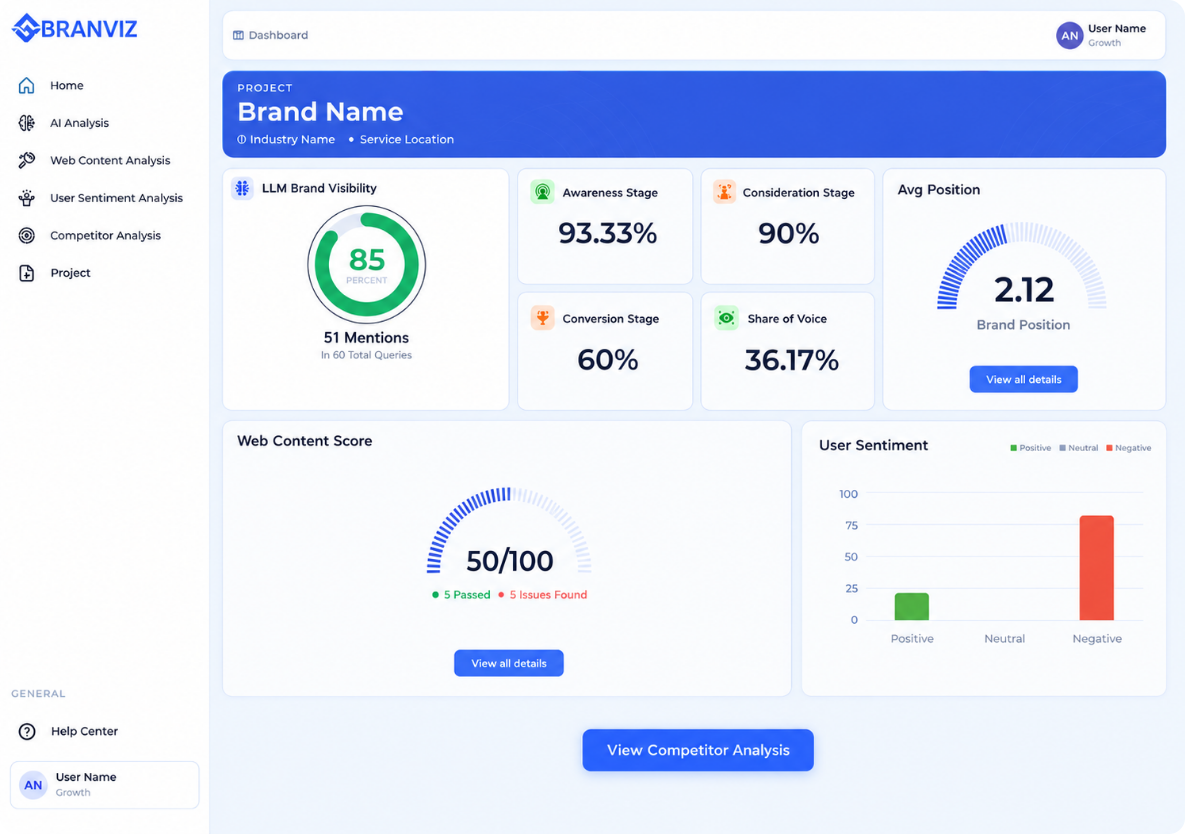
Branviz.com is an LLM visibility checker that we built to show how brands appear in AI answers. It tracks brand mentions, citations, average position, sentiment (positive, neutral, negative), AI share of voice, competitor benchmarking, full-funnel visibility, and product-level visibility across ChatGPT, Gemini, Perplexity, Grok, and Google AI Overviews. It evaluates eight visibility dimensions and includes a GEO readiness audit covering 10 signals.
Conclusion
Shoppers now start with AI and finish with a check. Win the shortlist first, then make sure your proof holds up when they look. Measure both stages, retest regularly, and do not expect any platform to promise you a mention.
FAQs