What is GEO (Generative Engine Optimization) and How Is It Different from SEO?
Jitender • 7/16/2026
Generative Engine Optimization, or GEO, is the practice of optimizing content so AI systems like ChatGPT, Gemini, and Perplexity understand it, trust it, and cite it in the answers they generate when a user asks a query to them. Now marketers are watching a growing share of searches end inside a chat window, with no click and no ranking position involved at all.
That shift didn't happen overnight, but it happened fast enough to catch a lot of experienced marketers off guard. A brand can hold the top three organic positions for a keyword and still be invisible when someone asks an AI assistant the same question in a different way. That gap between search rankings and AI visibility is exactly the problem GEO exists to solve.
How Does GEO Work?
GEO works by shaping how AI systems find, interpret, and repeat information about your brand. Instead of crawling and ranking a page, an AI assistant pulls together facts from multiple sources, cross-checks them against what it already knows, and generates a fresh answer in real time.
That process depends on three things: what the model already learned during training, what it retrieves live from the web when a question needs current information, and how much it trusts the sources it pulls from. GEO influences all three by making sure your brand's facts are accurate, consistent, and easy to extract wherever they appear.
In practice, this means your content has to work harder in less space. A page written for GEO states the key fact plainly, in the first sentence or two, instead of building up to it through a long introduction. The clearer and more consistent that information is across your site and the wider web, the more likely a model is to pick it up and repeat it correctly.
GEO isn't a single tactic. It's an ongoing process of making your brand easy for AI systems to understand, verify, and trust.
How to Measure GEO?
Measuring GEO starts with accepting that traffic and rankings won't tell the full story anymore. A page can drive zero clicks and still be doing its job if it's feeding an AI assistant the exact information that gets your brand mentioned by name.
The most useful metrics fall into a few categories. Citation-based metrics track how often your brand is directly referenced as a source in an AI-generated answer, which is the closest GEO equivalent to a backlink. Mention-based metrics are broader, capturing any instance where your brand name shows up in a response, whether or not it's formally cited.
Share of AI Voice adds a competitive lens, showing how often you're mentioned relative to competitors across a defined set of queries relevant to your category. Brand visibility metrics go one level higher, checking whether you show up at all when someone asks a broad, category-level question rather than a brand-specific one.
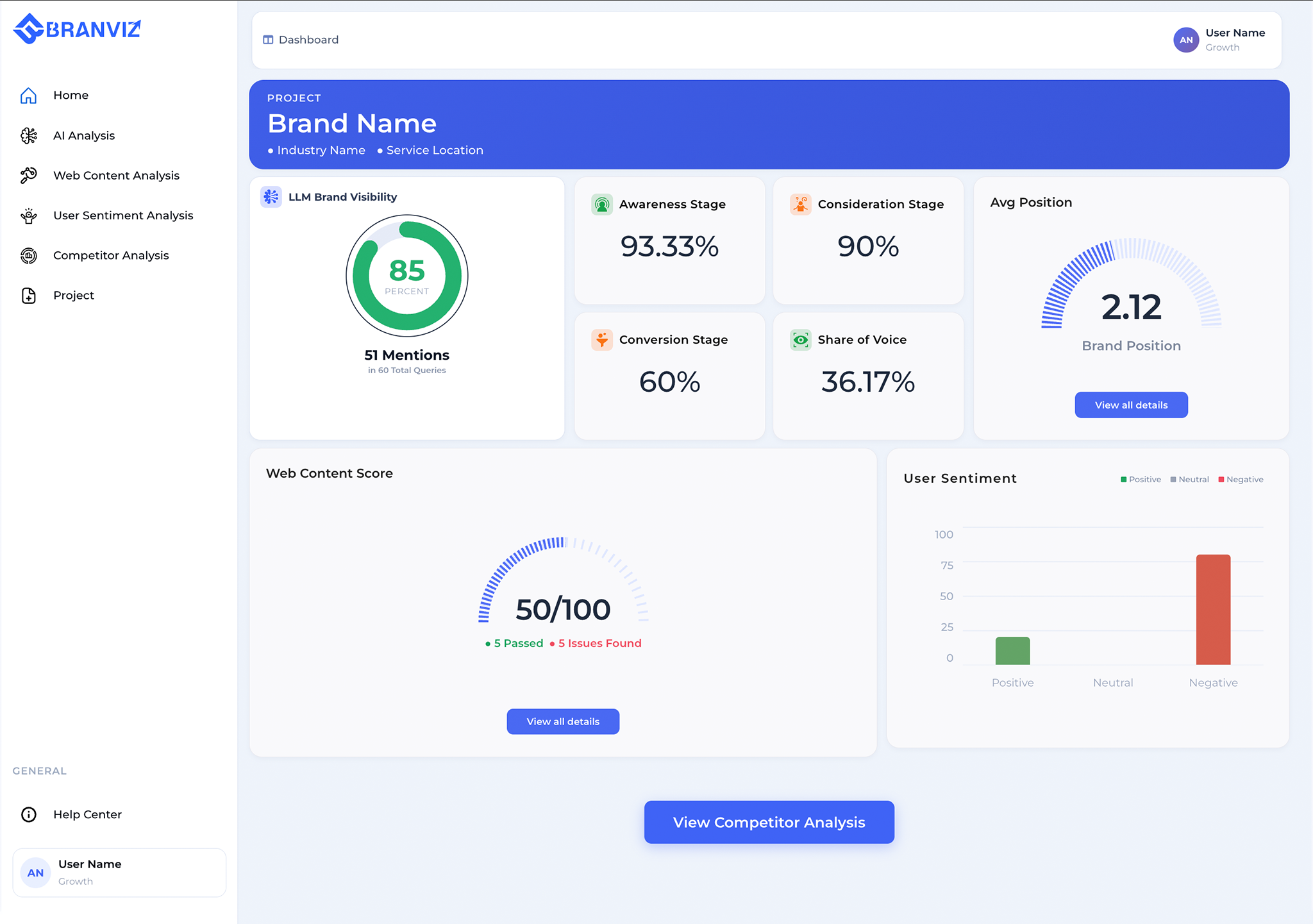
The practical challenge is scale. Testing these signals by hand means manually asking ChatGPT, Gemini, and Perplexity the same set of questions on a recurring basis, then logging the results yourself. That works for a handful of queries, but it breaks down fast once you're tracking a real content library across multiple AI platforms, which is why teams increasingly rely on dedicated tracking tools like Branviz instead of spreadsheets and manual checks.
Why GEO Needed for Business?
GEO exists because the way people search has genuinely changed, not just the tools they use to search. A growing share of queries now start and end inside an AI assistant, with the user getting a synthesized answer instead of a list of links to click through.
That shift changes what "visibility" means. Under the old model, ranking on page one of Google was enough to guarantee a share of the traffic for that keyword. Under the new model, a brand can rank first and still get zero mentions if the AI assistant pulls its answer from different sources entirely.
This isn't a small or temporary shift. Younger users in particular are defaulting to AI assistants for research, comparisons, and recommendations that used to start with a Google search. B2B buyers are using AI tools earlier in the research process, often before a brand's SEO content ever gets a chance to compete for their attention.
If a brand only optimizes for traditional rankings, it's competing for a shrinking share of total search behavior. GEO is what keeps that same brand visible in the part of search that's actually growing.
The Future of GEO: Where Generative Search Is Headed
Looking ahead, the gap between ranking well and being cited well is likely to widen before it narrows. As AI assistants get better at retrieving live, current information, they'll lean even more heavily on signals like third-party validation and cross-source consistency, and less on the kind of on-page optimization that drives traditional rankings.
That doesn't mean SEO becomes irrelevant. Technical fundamentals, like crawlability and clean site structure, will stay necessary because AI systems still need to access your content in the first place. What changes is what happens after access: whether the content gets trusted, extracted, and repeated, or passed over in favor of a source the model considers more credible.
As AI search adoption grows, teams that treat GEO as a bolt-on to their existing SEO checklist will fall behind teams that treat it as its own discipline, with its own metrics, its own workflow, and its own definition of success. Brand visibility inside AI-generated answers is likely to become as standard a reporting metric as organic rankings are today.
What GEO Actually Optimizes
GEO isn't a new set of keyword tricks layered onto old SEO habits. It targets a different set of inputs entirely.
AI retrieval : Generative engines retrieve information from a mix of training data and live sources through retrieval-augmented generation (RAG), using systems that determine which information is relevant and trustworthy. Content written in clear, extractable sections with direct answers near the top is more likely to be retrieved than content buried in long narrative prose.
Brand entities. AI models don't think in keywords. They think in entities: your brand, your product, your founder, your category. GEO work includes making sure these entities are defined consistently everywhere they appear, from your website to Wikipedia to industry directories.
Citations. Being mentioned by name in credible, third-party sources carries far more weight in AI-generated answers than it ever did in classic SEO. A single strong mention on an authoritative industry site can do more for AI visibility than a dozen average backlinks.
Trust. Generative engines lean heavily on signals that indicate a source is reliable: author credentials, publication consistency, and alignment between what different sources say about the same brand or topic.
Knowledge consistency. If your pricing page says one thing, your G2 listing says another, and a third-party review( i,e reddit, quora, or trustpilot) say something else entirely, AI models struggle to form a confident answer about you. Consistency across the web is a ranking factor for AI in a way it was never fully rewarded in classic SEO.
How to Measure GEO Success
GEO metrics look different from the click-through rates and keyword rankings SEO teams are used to tracking, and that shifts trips up a lot of reporting frameworks.
AI citations track how often your brand or content is directly cited as a source in AI-generated answers. AI mentions are broader, covering any instance where your brand name shows up in a generated response, cited or not. Share of AI Voice measures how often you're mentioned relative to competitors across a defined set of relevant queries. Brand visibility looks at whether your brand appears at all when someone asks a category-level question, even without a direct product recommendation. AI recommendation frequency narrows in on how often you're actually suggested as a solution, rather than just referenced in passing.
Manually testing these signals across ChatGPT, Gemini, and Perplexity for every relevant query gets unmanageable fast, which is the exact gap platforms like Branviz are built to close by tracking AI visibility and citation patterns systematically instead of through spot checks.
Why SEO Rankings Don't Always Predict AI Citations
Ranking well and being cited well are not the same achievement, and treating them as interchangeable is one of the most common mistakes SEO teams make right now.
Take a SaaS company that ranks #1 for "Best AI SEO Agency in India for MSME" Their landing page is fast, keyword-optimized, and backed by relevant quality backlinks. Ask ChatGPT the same question, and you may find your competitors mentioned instead of your brand. AI systems often rely on signals such as consistent brand information, authoritative third-party mentions, and clear topical relevance when generating recommendations.
Or consider an ecommerce brand that dominates search results for a product category through aggressive on-page optimization and internal linking. An AI assistant answering "what's the best running shoe for flat feet" isn't parsing that internal link structure. It's pulling from podiatry blogs, Reddit threads, and review aggregators that discuss the actual use case in plain language. The ecommerce site's SEO investment barely registers.
The pattern repeats across B2B too. Your Website might rank for a competitive keyword through years of link building, but if their content never explicitly states who they serve, what makes them different, or what outcomes they deliver, an AI model has nothing concrete to extract and repeat. Rankings reward optimization. AI visibility rewards clarity.
GEO vs SEO: Comparing the Entire Optimization Workflow
The two disciplines share a foundation, but the day-to-day workflow diverges once you look past the basics.
The table makes the differences look tidy, but the real-world implication is messier: GEO requires influence over content you don't fully control, like review sites, forums, and industry publications. SEO teams are used to owning their optimization surface. GEO asks them to manage a reputation surface instead.
Where Traditional SEO Still Matters and Where GEO Takes Over
GEO doesn't replace SEO. It builds on it, and pretending otherwise leads teams to abandon fundamentals that still drive real value.
Technical SEO still matters because AI crawlers need to access and parse your site just like traditional search bots do. Clean site architecture, fast load times, and crawlable content remain the foundation everything else sits on. Keyword research still matters too, because understanding what people actually ask, in their own words, tells you what questions your content needs to answer directly.
Where GEO takes over is in the layer above that foundation. Once your site is technically sound and your content answers real questions, GEO asks you to think beyond your own domain: how your brand is described on third-party sites, whether your claims are consistent across the web, and whether credible sources are willing to mention you by name. SEO gets you found. GEO gets you recommended.
Six Signals AI Systems Look For Before Mentioning a Brand
1. Consistent entity definition. The model needs a clear, stable answer to "what is this brand and what does it do." Conflicting descriptions across your site and third-party listings create hesitation.
2. Third-party validation. Independent mentions on review sites, comparison articles, and industry publications carry more weight than anything you say about yourself.
3. Topical depth on a specific use case. Brands that are recognized as the go-to answer for a narrow, specific problem get mentioned more often than brands that claim to do everything.
4. Structured, extractable content. Answers, definitions, and comparisons written in plain, direct sentences are easier for a model to lift and repeat accurately than content wrapped in marketing language.
5. Recency and freshness signals. Content and mentions that reflect current information (updated pricing, current features, recent reviews) are favored over stale pages, especially for fast-moving categories like software.
6. Cross-source agreement. When multiple independent sources describe your brand the same way, the model treats that agreement as a trust signal. When sources contradict each other, the model tends to hedge or omit the brand entirely.
A Practical GEO Checklist for SEO Professionals
- Audit how your brand and products are described across your own site, review platforms, and industry directories, and fix inconsistencies.
- Identify the specific questions your target audience asks AI assistants, not just the keywords they type into Google.
- Rewrite key pages so the direct answer appears in the first two or three sentences of each section, before the supporting detail.
- Pursue mentions and reviews on sites your industry treats as credible sources, rather than chasing link volume alone.
- Add clear author bylines and credentials to important content to strengthen trust signals.
- Test your brand's visibility by asking ChatGPT, Gemini, and Perplexity your target questions directly, and note who gets mentioned instead of you.
- Keep product facts (pricing, features, use cases) current everywhere they're published, since stale information gets deprioritized.
- Build out comparison and use-case content that positions your brand clearly against specific alternatives.
Conclusion
GEO isn't a rebrand of SEO, and it isn't a replacement for it either. It's a response to a real shift in how people find information: fewer clicks, more direct answers, and a new set of trust signals sitting behind every AI-generated response. Brands that rank well but get skipped in AI answers aren't doing anything wrong by old standards. They're just optimizing for a search experience that's shrinking in share every quarter.
The practical move isn't to panic or overhaul everything at once. It's to start checking, honestly, whether your brand shows up when your customers ask AI assistants the questions your SEO strategy was already built to answer. If you haven't measured that yet, that's the first place to look.

FAQs