How to Go From AI Mentions to Pipeline: Connecting AI Visibility to Revenue
Jitender • 11/13/2026

For business leaders, marketing performance has traditionally been measured through familiar numbers: website traffic, qualified leads, customer acquisition cost, conversion rates, and revenue. These metrics have helped companies decide where to invest and which marketing activities deserve more budget.
But the way customers discover and evaluate businesses is changing.
A potential customer researching software, comparing service providers, or looking for a business solution may now begin with ChatGPT, Gemini, or Perplexity instead of Google. They ask questions, compare recommendations, explore alternatives, and form opinions before visiting a company's website.
Your brand might be part of that conversation without generating a single measurable website visit.
This creates a new challenge for leadership teams. If a company consistently appears in AI-generated recommendations, does that visibility influence purchasing decisions? Does it strengthen brand preference? Can it contribute to qualified pipeline and revenue?
These are no longer questions that marketing teams can answer by reporting impressions or website sessions alone.
The real opportunity is to understand how AI visibility contributes to business growth, even when its influence cannot be traced through a conventional attribution model.
The Revenue Attribution Problem Has Changed
Traditional marketing attribution assumes that customer interactions leave a reasonably visible trail. Someone sees an advertisement, visits a website, downloads a resource, requests a demo, and eventually becomes a customer.
AI-assisted discovery complicates that journey.
Consider a business leader evaluating three enterprise software providers. They ask ChatGPT to recommend suitable platforms, compare capabilities, and identify the strongest options for their requirements.
Your company appears among the recommendations. The prospect remembers your name, discusses it internally, and searches for your brand a few days later.
Eventually, they visit your website and request a consultation.
Your analytics platform might attribute that conversion to organic search or direct traffic. Your CRM records a new inbound lead. Neither system necessarily captures the AI interaction that introduced your company to the prospect.
From a reporting perspective, AI had no measurable contribution. From the buyer's perspective, it may have been the first meaningful interaction with your brand.
This is where traditional attribution starts falling short.
The challenge is not that AI visibility cannot influence revenue. It is that its influence often happens before the interactions that conventional analytics are designed to measure.
For CEOs and CFOs, this distinction matters. If investment decisions are based entirely on last-click attribution, emerging sources of customer influence can remain undervalued.
AI Visibility Should Be Viewed as a Business Growth Indicator
AI visibility is often treated as another marketing metric. That is a narrow way to approach it.
When an AI platform repeatedly recommends one company over another, it can influence which brands enter a buyer's consideration set. This has implications beyond search visibility.
It affects brand awareness, competitive positioning, perceived credibility, and the likelihood of being considered during a purchase decision.
Think about how a company evaluates potential vendors. Before speaking to a sales representative, decision-makers often want to understand which providers are credible, what differentiates them, and which solutions are worth evaluating.
If AI platforms consistently mention your competitors but overlook your business, you may be missing an opportunity before your sales team even enters the conversation.
The reverse is equally important. If your brand appears consistently in relevant, high-intent AI answers, you are building familiarity at a stage when purchasing preferences are still being formed.
For leadership teams, AI visibility should therefore be considered an early indicator of market presence and brand consideration, rather than a direct revenue metric.
The distinction is important: visibility does not guarantee demand, but it can influence where demand eventually goes.
Understanding the Connection Between AI Visibility and Revenue
There is no single metric that accurately captures the complete financial contribution of AI visibility. A more useful approach is to examine how visibility connects with the different stages of the buying journey.
Brand presence and competitive positioning
The first question is whether AI platforms recognise and recommend your business when potential customers ask relevant questions.
Look beyond the total number of mentions. Examine whether your brand appears in product comparisons, vendor recommendations, industry-specific questions, and purchase-related conversations.
Your share of voice on these prompts is particularly useful because it shows how frequently your business appears relative to competing brands.
A company might have thousands of AI mentions across general topics but remain absent from the questions that influence actual purchasing decisions.
That distinction should matter more to leadership than a headline visibility score.
Demand creation and brand consideration
The next question is whether your AI visibility coincides with an increase in interest in your business.
Look at branded search trends, direct website visits, referral traffic from AI platforms, and engagement with commercial pages.
For example, an increase in branded searches following sustained improvements in AI visibility may indicate growing brand interest.
It is not proof of causation, but it is a signal worth investigating.
You can also examine whether visitors arriving from AI platforms engage with pricing pages, service pages, comparison resources, or demo forms.
These interactions provide a better understanding of whether AI-assisted discovery is bringing commercially relevant audiences to your website.
Lead generation and sales conversations
The third stage is where marketing intelligence meets actual customer behaviour.
Are prospects mentioning ChatGPT or Perplexity during discovery calls? Are they arriving with a shortlist of providers already prepared? Are they asking questions based on information they received from an AI assistant?
These details can reveal how AI platforms are shaping buying decisions.
Your CRM should capture this information alongside conventional lead sources. Over time, this can help identify whether AI-assisted discovery is appearing more frequently among qualified opportunities.
Pipeline and revenue contribution
Finally, examine whether these leads progress through the sales process.
Compare qualified opportunities, meetings booked, pipeline value, deal conversion rates, average deal size, and sales cycle duration.
Do not automatically attribute every deal involving an AI-influenced prospect to AI visibility. Instead, identify the extent to which AI played a role in discovery and consideration.
This produces a more credible picture of business impact than assigning an estimated revenue value to every brand mention.
What CEOs, CFOs, and CMOs Should Actually Measure
Different leadership roles have different reasons to care about AI visibility.
For a CEO, the concern is competitive relevance. Is the company appearing where potential customers are seeking recommendations? Are competitors becoming more prominent in AI-generated answers? Is the brand maintaining its position as customer discovery changes?
For a CFO, the question is investment accountability. Is the company allocating resources to a channel that can contribute to future demand? Are there measurable changes in qualified leads, acquisition costs, and pipeline performance? What evidence supports continued investment?
For a CMO, the challenge is connecting brand strategy with commercial outcomes. Is AI visibility improving brand consideration? Is the company being described accurately? Are marketing activities strengthening its presence across the AI platforms customers use?
These perspectives should come together in one business-level reporting framework.
A useful monthly review should connect three areas:
Market visibility: Brand mentions, share of voice, recommendation frequency, competitor presence, and sentiment across relevant AI platforms.
Demand indicators: Branded search growth, direct traffic, AI referral visits, commercial-page engagement, and enquiries.
Commercial outcomes: Marketing-qualified leads, sales-qualified opportunities, pipeline generated, influenced opportunities, closed-won deals, and acquisition costs.
The purpose is not to force every metric into a single ROI calculation. It is to understand whether improvements in market visibility are accompanied by meaningful changes in customer demand and commercial performance.
Why Your Measurement Framework Needs a Longer View
One of the biggest mistakes companies can make is evaluating AI visibility through short reporting cycles.
AI visibility can change as platforms update their models, modify their sources, or respond differently to prompts. Customer decisions also take time, particularly in B2B environments where multiple stakeholders participate in the buying process.
A company may improve its presence across AI platforms this month, but the commercial impact may only become visible in the next quarter.
This is why leadership teams should establish a consistent measurement framework.
Start with a defined set of buyer-focused prompts. Include educational questions, vendor comparisons, industry-specific recommendations, and purchase-intent searches. Measure brand presence and competitor visibility against the same prompts every month.
Then compare these results with branded search performance, lead sources, and pipeline movement over a period that reflects your typical sales cycle.
For a business with a long enterprise sales cycle, three to six months of observation may provide more useful context than a single monthly report.
Consistency is essential. Changing the prompts, measurement criteria, or reporting methodology every month makes it difficult to distinguish genuine progress from measurement differences.
Regular AI brand visibility audits can help maintain that consistency.
The Financial Question: Is AI Visibility Worth the Investment?
For CFOs and business owners, this is ultimately where the discussion needs to arrive.
AI visibility should not be evaluated using the same assumptions as paid search. Paid campaigns can often be measured through clicks, conversions, and attributable acquisition costs. AI-driven discovery frequently influences decisions without producing an identifiable referral or immediate conversion.
That does not mean businesses should invest without accountability.
Instead, leadership should evaluate AI visibility through a combination of investment, market position, demand generation, and commercial performance.
For example, if a company is investing in improving its AI visibility, management should be able to answer:
- Is our brand appearing more frequently for commercially relevant questions?
- Are we gaining visibility against competitors that previously dominated AI recommendations?
- Are branded searches and qualified enquiries moving in a positive direction?
- Are sales teams hearing more references to AI-assisted research?
- Is our presence improving across the markets and product categories we want to grow?
These questions help establish whether the investment is moving the business in the right direction.
A useful financial review should also separate direct, assisted, and unverified influence. Revenue from a lead that explicitly identifies an AI platform as its discovery source is different from revenue that merely coincides with improved AI visibility.
Keeping these categories separate prevents inflated ROI claims and gives leadership a more realistic basis for investment decisions.
Where AI Visibility Tracking Fits Into This Strategy
The biggest challenge for companies is often not collecting more data. It is bringing the right information together consistently.
Website analytics can show referral traffic and user behaviour. Search Console can reveal branded search trends. CRM platforms can track opportunities and revenue. But none of these tools independently explains how your business is being represented across AI-generated answers.
This is where dedicated AI visibility tracking becomes useful.
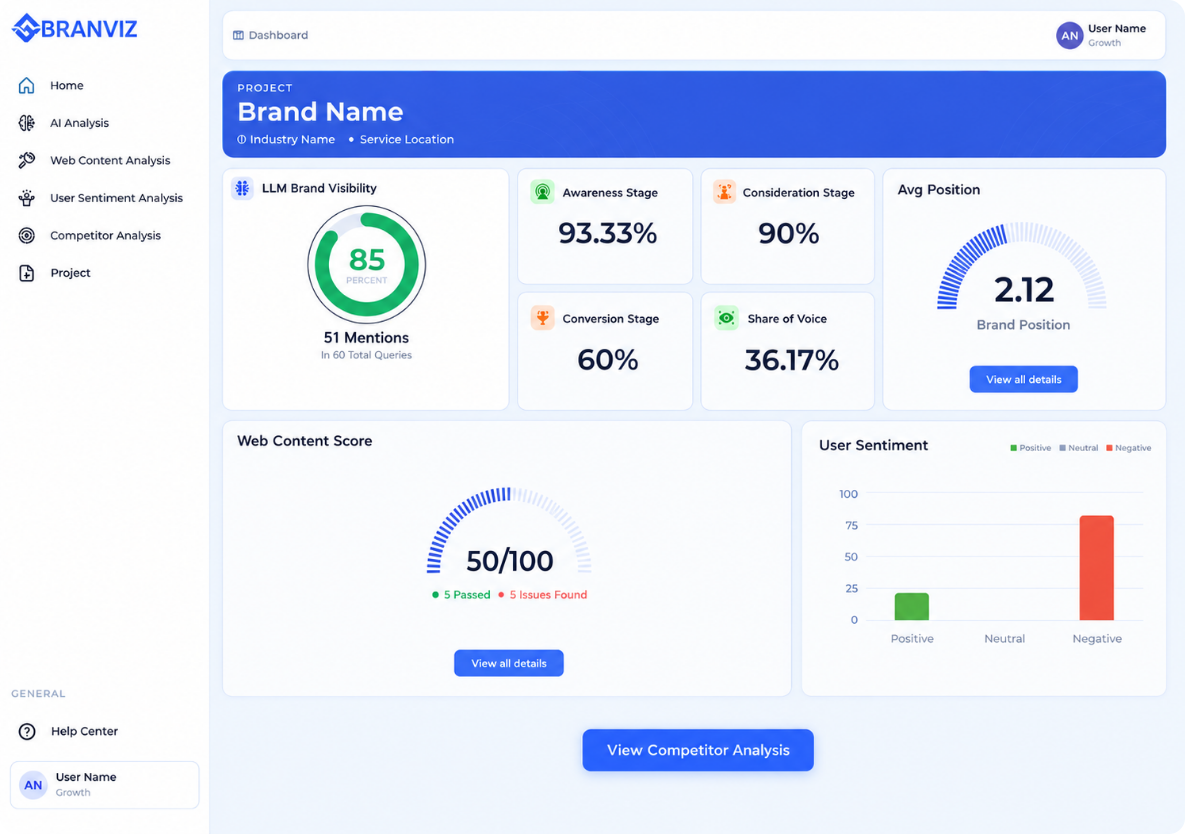
Branviz helps businesses monitor how their brands appear across ChatGPT, Gemini, Perplexity, Grok, and Google AI Overviews.
It tracks brand mentions, visibility scores, share of voice, sentiment, competitor presence, and citation patterns across AI platforms.
For marketing leaders, this provides a consistent view of how their brand is performing in AI-driven discovery. For business leadership, it provides market visibility indicators that can be reviewed alongside demand generation and pipeline data.
It is important to understand what such a platform does and does not measure. An AI visibility tracker does not independently establish revenue attribution. Its role is to make the discovery and competitive positioning side of the equation measurable.
The commercial picture emerges when that information is evaluated alongside analytics, customer feedback, and CRM performance.
The Bigger Leadership Decision
The conversation around AI visibility should move beyond how frequently a brand appears in ChatGPT or how many times it gets mentioned by Gemini.
Those numbers are useful, but they are not the business outcome.
The more important question is whether your company is becoming part of the conversations that shape customer decisions.
If potential customers are using AI platforms to research vendors, compare solutions, and form initial preferences, then being absent from those answers creates a competitive disadvantage worth examining.
Companies do not need to claim that every AI mention generates revenue. Nor do they need to manufacture an attribution model that makes every marketing activity look profitable.
They need a disciplined way to understand where their brand stands, whether customer interest is changing, and how those changes relate to qualified pipeline over time.
For CEOs, this is a question of future market relevance. For CFOs, it is a question of investment discipline. For CMOs, it is an opportunity to connect brand visibility with measurable business performance.
AI visibility becomes a meaningful business metric when leadership stops asking how many times the brand was mentioned and starts asking whether the company is being considered when customers are ready to make a decision.

FAQs