Branviz vs Semrush AI Visibility Which Tool Is Best for LLM Brand Tracking?
Varun • 9/21/2026
LLM Brand Tracking plays a pivotal role in assessing organic reach across generative environments. Rather than relying solely on traditional search rankings , modern teams must analyze how frequently their company surface within answers generated by engines like ChatGPT, Gemini, and Perplexity . This requires evaluating direct recommendations, competitive share, cited references, sentiment indicators, and specific high-intent query triggers .
As the market expands , specialized AI visibility tools employ distinct philosophies . Certain suites embed AI monitoring into broad SEO platforms, whereas others concentrate exclusively on tracking entity presence inside large language models . This introduces a key question: Is generative discovery best handled as an add-on to classic SEO, or as a distinct operational discipline?
This contrast is evident when examining Branviz vs Semrush AI Visibility . Semrush incorporates generative metrics into a comprehensive digital marketing dashboard , while Branviz specializes directly in LLM brand tracking, AI Share of Voice, competitive positioning, and model sentiment . Evaluating both requires looking past basic mention counts to compare reporting depth, analytical framework, and workflow alignment .
What Is LLM Brand Tracking?
LLM Brand Tracking is the process of monitoring how a brand appears inside AI generated responses across large language models and generative search platforms. It goes beyond checking whether a company name appears somewhere online. A useful LLM visibility tracking system needs to answer several questions at once -
1. Is the brand mentioned when users ask relevant questions?
2. How frequently is it recommended?
3. Which competitors appear alongside it?
4. What sources influence the answer?
5. Does the AI describe the brand positively or negatively?
6. Which high intent prompts produce visibility and where is the brand completely absent?
This is where AI brand monitoring becomes different from conventional brand monitoring. For example a marketer might search ChatGPT manually for 'best project management software for remote teams' . Seeing a brand mentioned once is useful but it does not tell the full story. A proper chatgpt brand mentions checker should help determine whether that mention is consistent with how the brand compares with competitors, what prompts trigger visibility and whether the brand is actually gaining a meaningful share of the AI conversation.
Ranking #1 on Google Doesn't Guarantee AI Visibility
Imagine a SaaS company that ranks in the top three Google results for hundreds of commercial keywords. Its SEO team sees strong rankings , growing organic traffic and healthy backlinks. Then potential customers start asking ChatGPT for recommendations. The AI response repeatedly recommends three competitors while the company's website is rarely mentioned from a traditional SEO dashboard the company looks successful. From an AI search perspective it has a visibility problem. This is the fundamental difference between search rankings and generative AI visibility. Google rankings tell you how visible your pages are within a search engine's results . LLM Brand Tracking tells you how visible and relevant your brand is when AI systems construct an answer . Neither measurement replaces the other . They measure different stages of modern search.
Semrush A Strong Foundation for Traditional SEO
Semrush has established itself as a broad digital marketing and SEO platform. Its core strengths include keyword research, rank tracking, backlink analysis, competitor research, content optimization, technical SEO , site auditing and organic search analysis for teams whose primary objective is improving Google visibility these capabilities remain extremely valuable
Semrush has also expanded into AI visibility. Its AI Visibility features can track AI mentions , citations, visibility across AI platforms , competitor performance prompts, sentiment and other signals associated with AI search that makes Semrush particularly attractive for established SEO teams that want to add AI visibility measurement without moving away from their existing SEO workflow. The advantage is breadth , a team can investigate keywords, backlinks technical issues, organic rankings, competitors , content opportunities and AI visibility within a broader SEO ecosystem but breadth can also create a different question: Is an all in one SEO platform the same thing as a specialist AI visibility platform? Not necessarily.
AI SEO Requires a Different Way of Measuring Visibility
Traditional SEO asks 'Where does my page rank?'
AI SEO asks 'Where does my brand appear in the answer?'
That difference may sound small but it changes the metrics marketers need. An AI visibility strategy can involve brand mentions , AI Share of Voice , competitor recommendations , citations , sentiment , prompt level performance , source , visibility , brand perception and content readiness. A ranking report cannot fully explain these signals for example - suppose your brand is mentioned in 40% of relevant AI responses while a competitor appears in 70% . Your brand may technically have visibility but the competitor owns a much larger portion of the conversation. This is why AI Share of Voice is becoming more useful than simple mention counts.
Where Branviz Fits Into the AI Visibility Landscape
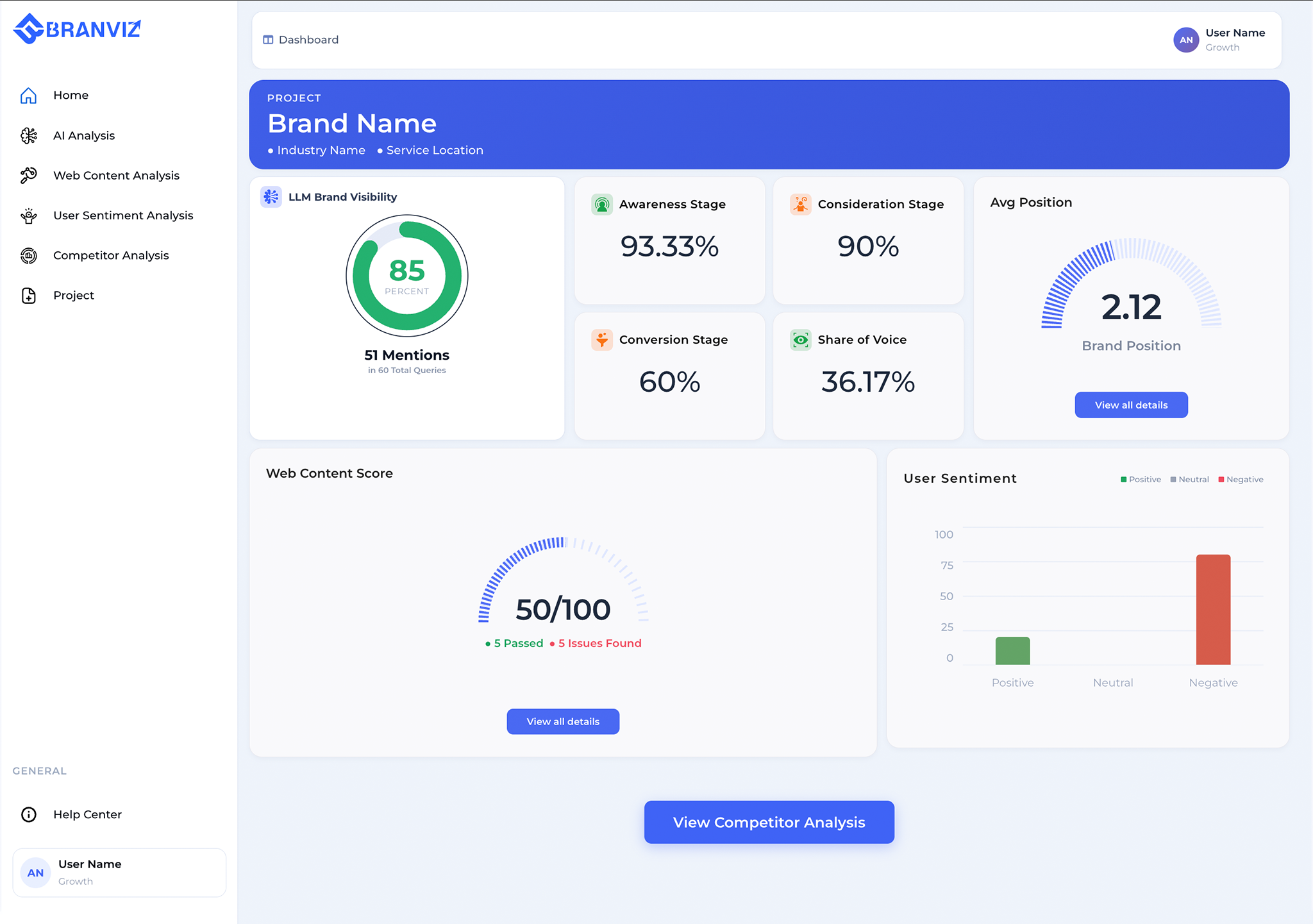
Branviz takes a more specialized approach to this problem rather than treating AI visibility as one additional feature inside a broader SEO platform , it focuses on understanding how brands are represented, recommended and compared inside LLM generated responses. Its approach is centered around LLM Brand Tracking , AI Share of Voice competitor benchmarking, brand perception, prompt analysis and broader AI search visibility. That specialization matters because AI visibility is not only about counting mentions. A brand needs to understand why it appears where it appears, how competitors are outperforming it and what opportunities exist to improve its presence , this makes a specialist platform particularly relevant for teams whose search strategy is increasingly focused on ChatGPT , Gemini Perplexity , Google AI and other generative search experiences.
Branviz vs Semrush What's the Difference
Why AI Share of Voice Matters
One of the biggest mistakes in AI brand monitoring is treating every mention as equally valuable. They are not . Imagine your brand appears in 50 AI responses that sounds impressive until you discover that competitors appear in 150 , now consider another scenario where your brand is mentioned frequently but is rarely recommended . A competitor may receive fewer mentions overall but consistently appear as the preferred solution. This is why AI Share of Voice provides more context than raw mention volume. It helps marketers understand their position within the broader AI conversation rather than looking at isolated responses for brands competing in crowded categories. This can reveal a much more important question that is who is AI choosing to talk about when customers ask for recommendations?
AI Brand Monitoring Needs More Than a Mention Count
A simple brand mention is only the beginning. Modern AI brand monitoring needs to consider the context surrounding that mention: was the brand recommended or simply listed? Was the description accurate? Which strengths and weaknesses did the AI associate with it? Which competitor was recommended instead? Which sources were cited? Are certain commercial prompts consistently producing the same competitor?
These questions turn LLM visibility data into something marketers can actually act on. The goal is not to make AI say a company's name more often for its own sake. The goal is to build the authority content reputation and digital signals that make the brand more likely to appear when it genuinely deserves to be part of the answer.
Turning AI Visibility Data Into Action
The real value of an AI visibility platform is not the dashboard itself . It is what marketers can do with the information if a competitor consistently appears for a group of high intent prompts that can reveal a content or positioning gap. If AI systems repeatedly cite particular sources when discussing a category those sources can reveal opportunities for digital PR partnerships, citations or content distribution and if the AI describes a brand using outdated information the company may need to strengthen or update the sources that shape its online entity. If the brand performs well for informational prompts but disappears during commercial comparisons the problem may be deeper than content volume. This is where brand visibility analytics becomes strategically useful. Instead of simply asking whether visibility increased, marketers can investigate where visibility changed and why .
Which Tool Should You Choose?
There is no reason to treat Semrush and specialist AI visibility platforms as direct substitutes in every situation If your primary objective is traditional SEO . Semrush remains a powerful choice Its strengths in keyword research , rankings backlinks , technical SEO content and competitor analysis make it particularly useful for SEO led teams but if your primary objective is LLM Brand Tracking , AI Share of Voice , AI competitor visibility , brand perception and generative AI discovery a more specialized platform can provide a clearer view of the problem.
That is where Branviz has an advantage. Its narrower focus allows AI visibility to be treated as the central problem rather than simply another reporting layer within a broader SEO platform for teams building an AI first search strategy that distinction can be significant.
Conclusion The Search Result Is Becoming the Answer
The biggest shift in search is not simply that AI can generate text . It is that AI can influence which brands users discover, trust , compare and ultimately consider . That makes LLM Brand Tracking an increasingly important part of brand strategy. Semrush remains a strong option for organizations that want comprehensive traditional SEO capabilities with AI visibility added to the mix . For teams focused more heavily on AI search LLM visibility , tracking AI Share of Voice , AI brand monitoring and generative AI visibility a specialist approach can provide a more focused perspective. The next generation of search will not only be about ranking higher.It will be about becoming the brand AI recommends.

Varun
AuthorVarun is a dedicated search strategist and Technical SEO specialist focused on future-proofing digital brands. With deep expertise in Answer Engine Optimization (AEO) and Generative Engine Optimization (GEO), they help businesses dominate both traditional SERPs and AI-driven platforms. Known for rigorous technical audits and data-backed strategies, Varun shares actionable insights to help brands build undeniable authority, maximize AI visibility, and thrive in today’s complex search landscape.
FAQs