Branviz vs Profound: Which AI Visibility Tool Is Best for LLM Brand Tracking?
Jitender • 10/5/2026
For years, brands measured search visibility through some of the fixed metrics like rankings, keywords, clicks and website traffic. But human search behaviour is evolving and changing. Instead of opening multiple search results, users can now ask AI models questions like:
“What are the best tools for SEO?”
“Which software should I use for my business?”
“What brands are recommended for this problem?”
Now the answer isn't a list of ten blue links. It is often a curated response containing a small number of brands. That creates a new challenge for marketers i.e. how do you know whether your brand is actually visible inside AI answers?
This is where AI visibility platforms such as Branviz and Profound come in. Both help businesses and brands to understand how brands appear across AI engines, but they approach the problem differently. So, which one is better for LLM brand tracking?
And the answer depends on what you want to measure.
The Shift From SEO Visibility to LLM Visibility
Traditional SEO follows - keyword , ranking , click , website , visit and finally conversion. This is why an SEO visibility tool has traditionally focused on rankings, search positions, keywords, and organic traffic. But AI search creates a different journey , which starts from prompt , AI response, brand mention , position , recommendation and then consideration.
A brand doesn't necessarily need to receive a click to influence a customer. If ChatGPT recommends your brand while someone is researching a product, your brand has already entered that person's consideration set.
This makes LLM SEO tracking fundamentally different from traditional SEO tracking. Instead of asking only: “Where does my website rank?” marketers now need to ask: “When customers ask AI about my category, does my brand appear?”. This is where we can see search behavior evolving.
The AI Visibility Tracking Algorithm
To understand the difference between Branviz and Profound, it helps to first understand the underlying process.
Step 1: Define the Brand
The system starts with your brand, category, products, competitors, target markets, and relevant topics.
Step 2: Define Relevant Prompts
Instead of tracking only keywords, AI visibility platforms track questions that users might ask AI. For example:
“What is the best AI visibility tool?”
“Which AI visibility platforms should marketers use?”
“What tools can track LLM brand mentions?”
Step 3: Query AI Engines
Those prompts are run against AI answer engines.The resulting answers become the data set for measuring visibility.
Step 4: Detect Brand Mentions
The system identifies whether your brand appears in each response or not . But simply being mentioned isn't enough.
Step 5: Analyze the Mention
The focused step where LLM mentions analysis becomes important. You can look at -
1. Whether your brand was mentioned
2. Where it appeared
3. Which competitors appeared
4. How the brand was described
5. Sentiment around the mention
6. Which sources were cited
7. How frequently the brand appears
Step 6: Measure Visibility
The individual responses are converted into visibility metrics such as visibility score, position, share of voice, sentiment, and other indicators.
Step 7: Find the Gap
Now the important question becomes finding the actual gap where your competitors are visible while your brand is missing. This gap usually appears for not ranking and appearing on certain industry keywords or prompts . Thus , to appear on all the domain - based keywords and prompt the user to search for your brand or product , the brand needs to analyse and work .
Step 8: Optimize and Track Again
The insights can then inform content, authority, reputation, and broader AI-search strategies.The loop becomes from track to analyze to compare to optimize to Re-track. That is the foundation of generative AI visibility.
Branviz vs Profound: Where Do They Differ?
Both platforms provide AI visibility intelligence but their strengths are positioned differently.
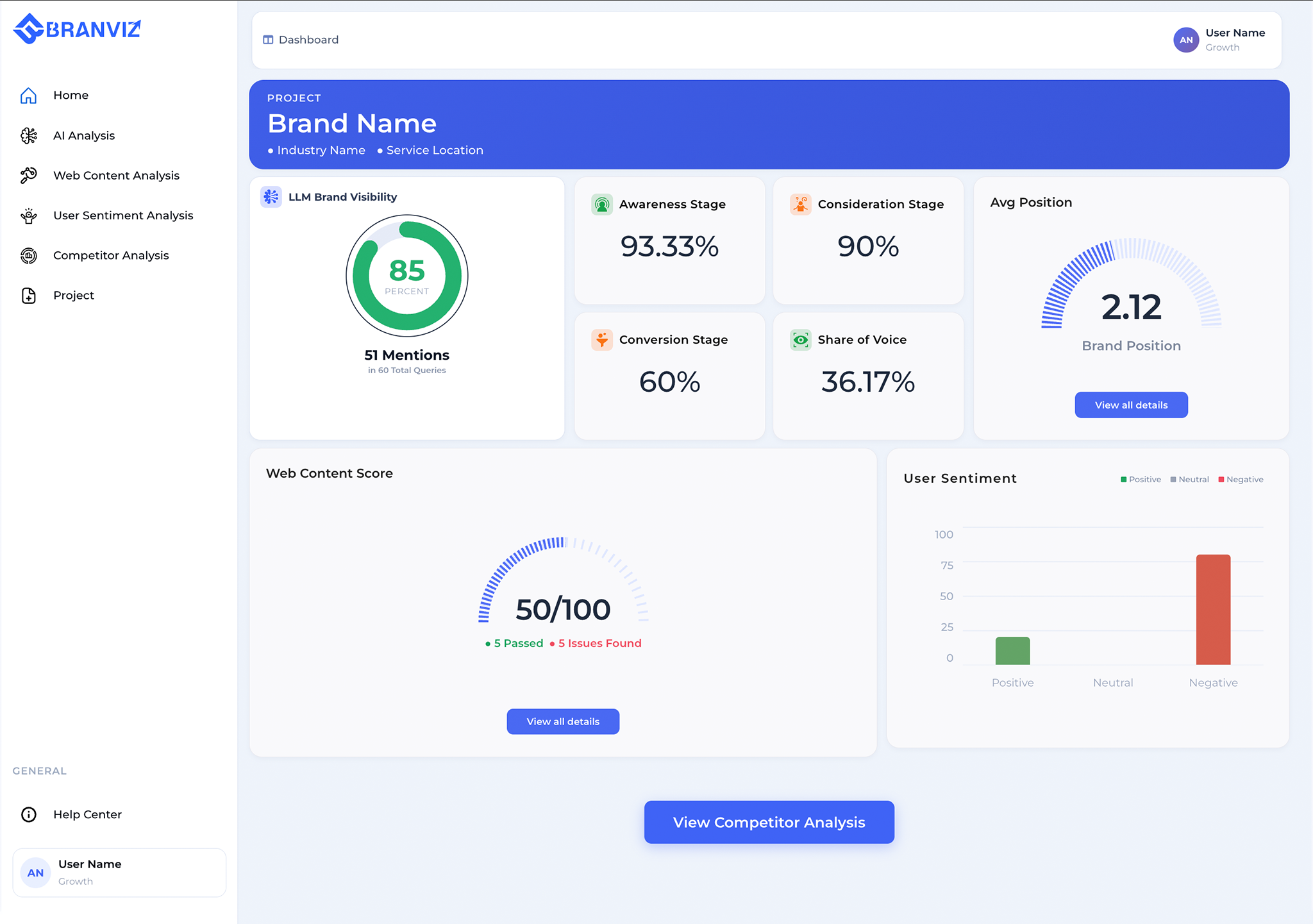
Branviz positions itself as an AI visibility tool focused specifically on tracking how LLMs perceive and recommend a brand. Its platform evaluates eight dimensions of AI visibility and tracks presence across major 5 AI engines. The Branviz framework focuses on areas such as LLM brand visibility , AI brand mentions , Average AI position , AI Share of Voice , Competitor visibility , User Sentiment , Full-funnel visibility , GEO and web readiness
This makes Branviz particularly relevant for brands and marketing teams whose primary question is: “How visible is my brand across AI search and where are we losing visibility?” . The emphasis is on turning AI presence into a broader brand-visibility picture. Its approach is centered around understanding the brand's visibility as a complete picture rather than treating an individual AI mention as an isolated event.
Profound takes a broader Answer Engine Optimization approach, tracking visibility score, citations, sentiment, Share of Voice, and positioning through its Answer Engine Insights product. But that full picture isn't available from day one. Its engine coverage and feature set are split across pricing tiers, starting with ChatGPT only on its entry plan and expanding to Perplexity and Google AI Overviews only on higher tiers. Branviz includes every major AI engine and its complete metric set on every plan from the start, so there's no tier to climb before a team can see the full picture of its brand visibility.
Its platform allows teams to build and manage tracked prompts, while its Prompt Volumes product uses data from real user AI conversations to help identify what people are actually asking. It also places significant emphasis on citations. Teams can analyze which pages, publishers, and domains are being cited by AI answers and compare citation shares against competitors. Its broader platform also includes Agent Analytics and Agents for content and workflow use cases.
The metrics on paper look similar, but access to them isn't. Branviz includes every AI engine, its complete metric set, and a scored GEO readiness audit on every plan from day one. Profound builds toward that same picture, but gates engine coverage and core capabilities behind higher pricing tiers, and has no direct equivalent to Branviz's scored GEO audit at any tier. For a team that needs full visibility now rather than a roadmap toward it, Branviz is the more complete platform out of the gate.
So, Which Tool Is More Feasible for LLM Brand Tracking?
If your primary goal is tracking and understanding your brand’s visibility across LLMs, Branviz can be positioned as a more focused fit. Its approach centers on measuring AI brand visibility across multiple dimensions, including brand mentions, AI position, Share of Voice, sentiment, competitor benchmarking, and broader visibility across the customer funnel. Branviz also structures its analysis around eight key dimensions of how AI platforms perceive and recommend a brand.
If your priority is broader AEO intelligence and action, Profound offers a more extensive platform covering several stages of AI search optimization. Its Answer Engine Insights tracks brand visibility, citations, sentiment, Share of Voice, and competitors, while Prompt Volumes provides insights into real user AI conversations, prompt demand, intent, and buyer-journey signals. It also includes Agent Analytics for AI crawler and AI traffic analysis, along with content optimization workflows that help teams act on those insights.
The bigger shift which is seen is that visibility is no longer just a ranking The most important takeaway isn't actually about choosing between two platforms. It is about understanding what has changed in search.
Traditional SEO asks Did we rank , Did someone click?
AI search asks: Did AI mention us , Did we become part of the recommendation?
And traditional SEO often measures traffic and rankings. Whereas , LLM tracking increasingly needs to measure all the necessary metrics like mentions, position , sentiment , share of voice , citations , competitor presence all along.
That is why LLM SEO tracking is becoming an important extension of traditional search measurement. Your website can rank well and still be missing from the AI conversations that influence your next customer.
Conclusion : What actually your brand needs ?
The future of search isn't simply about getting your website to rank higher. It is about understanding how your brand appears, is perceived, and is recommended when customers turn to AI for answers.
Both Branviz and Profound are strong platforms for navigating this emerging layer of search, but they approach AI visibility from different perspectives. Profound is particularly well suited for teams looking for deeper prompt intelligence, citation analysis, real-user AI query research, AI crawler analytics , broader AEO and content workflows.
Branviz, on the other hand, takes a more focused LLM brand visibility approach. Its framework evaluates a brand across eight visibility pillars which helps teams look beyond simple mentions to understand different dimensions of AI visibility and performance. It is designed to track visibility across 5 AI models with both standard and manually configured tracking capabilities, while bringing metrics such as AI position, Share of Voice, sentiment, competitor performance, and funnel-stage visibility into one structured framework.
So, the choice isn't really about which platform is universally better , neither platform needs to be viewed as a one-size-fits-all solution. Profound is a strong choice when the priority is a broader AEO ecosystem and Branviz is a strong fit when the goal is to systematically measure LLM brand visibility through a structured eight-pillar framework across multiple AI models and track how that visibility develops over time.
Because in AI search, ranking is no longer the whole story. What matters is whether AI can see your brand, understand it, position it, mention it and ultimately recommend it.

FAQs