Brand Sentiment in AI Search: How to Find and Fix Negative Brand Perception in ChatGPT and Gemini
Jitender • 11/10/2026

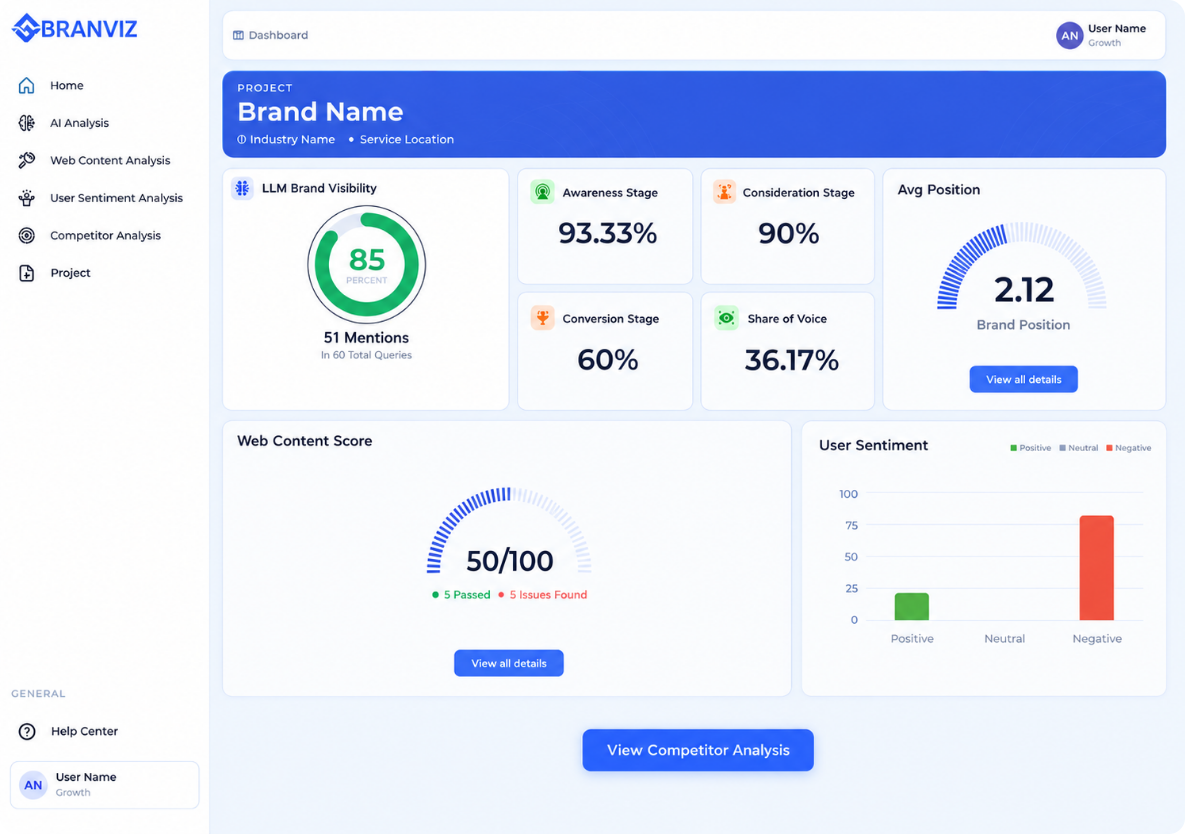
Branviz helps businesses track their brand visibility across AI platforms like ChatGPT and Gemini, while providing an overall view of brand sentiment across AI-generated responses.
Brand sentiment in AI search is the tone and substance of what ChatGPT, Gemini, and similar tools say when someone asks about your business. If the answer leads with a complaint, repeats a problem you fixed two years ago, or describes you as an afterthought next to a competitor, that is negative brand perception, even if no single sentence is hostile.
The good news is that this perception is not a verdict. AI tools don't hold opinions about brands. They summarize what has been written about you and weigh it. That means you can find out what they are saying with a few well-chosen questions, and you can change it mostly by changing what is out there to be summarized. It takes time, and no one can promise how quickly any given tool will update, but the work is practical.
What negative perception actually looks like
It rarely shows up as an insult. More often it looks like one of these:
- A complaint up front. The first thing said about you is a service issue, a pricing gripe, or a slow support experience.
- A stale problem. The answer describes an outage, recall, or policy you changed long ago.
- Faint praise. You are described as "an option" while a competitor gets specific strengths.
- Wrong details. Old pricing, a discontinued product, or the wrong location.
- Mix-ups. Your brand is blended with another company that has a similar name.
Each of these has a different cause, so it helps to sort what you find before reacting to it.
How LLMs Build a Picture of Your Brand
Think of an AI answer as a summary of the public record. That record includes your reviews, news coverage, forum threads, comparison articles, directory listings, and your own pages. Some products rely mostly on what the model learned during training, and others also search the web at the moment you ask. That is why the same question can give different answers in different tools, and why an old story can linger in one and be gone from another.
One opinion worth stating plainly: most brands treat this as a PR problem, when it is usually a record-keeping problem. The brands that come across well tend to have a record that is complete, current, and honest about both good and bad, not a record that has been polished.
How to find out what AI says about you
You don't need special software to start. Set aside an hour and do this:
- Write 10 to 15 questions a customer might ask. Include three types: questions about you by name ("Is [brand] any good?" "Problems with [brand]"), category questions ("best [your category] for [your customer]"), and comparisons ("[brand] vs [competitor]").
- Ask them in both ChatGPT and Gemini, each in a fresh chat so earlier answers don't influence later ones.
- Repeat each question two or three times. Answers vary from one attempt to the next, so one result tells you very little, and a repeated pattern tells you a lot.
- Log what you see. A simple sheet with the columns question, tool, mentioned or not, position, tone, specific claims, and any sources cited is enough.
Doing this regularly, rather than once, is what turns a hunch into evidence. Put a monthly reminder in your calendar to check what AI says about your brand and compare it with the last round. Repeating this process manually can become time-consuming, especially when you are tracking multiple prompts across different AI platforms. With Branviz, you can automate this process by tracking your custom prompts and monitoring how ChatGPT, Gemini, and other AI engines mention and describe your brand. This makes it easier to identify changes in brand perception and compare results over time without manually running every query.
Ask the uncomfortable question first: is it fair?
Before fixing anything, decide which of these you are looking at:
- True and current. Customers really do wait too long for support, or your product really lacks a feature. No amount of content work fixes this. Fix the problem, then let new evidence build up.
- True but outdated. It was accurate once. The task is to make newer, accurate information easier to find than the old story.
- Wrong. A fact is simply incorrect, or another company is being confused with yours. This is the most fixable category.
- Thin. Nothing negative, but nothing specific and positive either. The AI has little to say because little has been said.
Being honest about this saves months. A business that spends a quarter on messaging while the underlying complaint continues will see the same complaint repeated back in every answer.
How to fix it, by cause
If the issue is real, fix it where customers can see. Change the process, then respond to reviews with specifics: what happened, what changed, how to reach you. A thoughtful public reply is part of the record too. So is a steady flow of recent, detailed reviews from customers who had a good experience, which usually says more about you than a perfect average does.
If the issue is outdated, publish the update where it can be found. Put a dated note on your own site, update old help pages, and ask outlets that ran the original story whether they will add a correction or follow-up. A short, factual announcement about what changed can also give models a newer source to pick up.
If the facts are wrong, correct them at the source. Find where the wrong detail lives, usually a directory, an old profile, or a third-party article, and fix it there. Then make sure your own site, profiles, and listings describe the business the same way, because a model that finds three versions of your brand has to guess which one is right.
If the record is thin, add substance. Publish pages that state what you do, who it's for, and what customers can expect. Write honest comparisons. Answer the questions you saw in your log. The goal is to give summaries something accurate to draw from.
What not to do. Don't buy or write fake reviews, don't try to bury every critical article, and don't argue with a chatbot hoping it will remember. Most tools have thumbs-down or feedback options, and reporting a clear factual error there is reasonable, but treat it as a supplement, not a fix. If something is false and damaging, talk to a lawyer about it separately.
How long this takes
Tools that search the live web can reflect new pages and reviews fairly soon. Tools that lean on training data change when the model itself is updated, which you can't predict. So set a rhythm instead of a deadline: make the fixes, then rerun your question list every month and compare against your log. Progress usually shows up as smaller changes first, like a complaint moving from the first sentence to the third, or a competitor's strength being matched by one of yours.
Tracking sentiment over time
Running the questions by hand works, but it gets slow once you have several products, competitors, and AI tools to cover. Branviz helps you measure user sentiment across the web as AI engines interpret it, showing the share of positive, neutral, and negative mentions alongside how often and where your brand appears, so you can see whether a fix actually moved the numbers instead of relying on a few remembered answers.
Conclusion
The brands that read well in AI answers are rarely the ones that shouted the loudest. They are the ones that kept a clear, current, honest public record, fixed what was broken, and said so plainly. That is slower than a campaign, and it is also much harder for a competitor to copy.

FAQs