What Determines Brand Visibility in ChatGPT? Understanding Citations and Mentions
Varun • 8/27/2026
Ask ChatGPT the same question about two competing brands and you'll often get very different results. One gets named clearly, described accurately, and recommended without hesitation. The other barely comes up, or shows up vaguely, as if the model isn't quite sure what to say about it. Both companies exist. Both have websites. Only one of them has actually built the kind of ai brand visibility that ChatGPT can confidently draw from.
This post looks at what actually determines that outcome, and why it has less to do with luck than most brands assume.
Citations and Mentions Are Part of the Answer, Not the Whole Answer
A mention is your brand's name showing up somewhere in a response. A citation is the model treating your content as an actual source behind a claim it's making. Both matter, but they're really symptoms of something deeper rather than the root cause, and monitoring every time an LLM cites your brand directly only tells part of the story if you don't also understand why some brands earn either one consistently while others don't show up at all.
What Actually Shapes Whether ChatGPT Recognizes You
ChatGPT works differently than a live search engine. Much of what it knows comes from training data, patterns and facts absorbed during training rather than pulled fresh from the web in real time. This changes what actually determines visibility.
Consistency across the web is one of the biggest factors. If your brand name, description, and core facts are stated the same way across your website, press coverage, and other public sources, the model has a clearer, more reliable signal to draw from. Scattered or contradictory information makes the model less confident, and an unconfident model tends to either hedge or leave a brand out entirely rather than risk stating something wrong.
Category association matters just as much. ChatGPT needs to understand not just that your brand exists, but where it fits. A company that's clearly and repeatedly associated with a specific category across the web is far more likely to be recalled when someone asks a question in that category, compared to a brand whose positioning is vague or inconsistent depending on where you look.
Depth of independent coverage plays a real role too. A brand that's been written about by industry publications, reviewed by third parties, or referenced across multiple credible sources gives the model more material to draw from than a brand that only exists through its own marketing. This is part of why brand presence in ai answers tends to correlate closely with how much a brand has been discussed outside of its own channels, not just how well its own site is written.
Why Two Brands With Similar Products Can Get Different Results
It's common to see two companies with genuinely comparable products land very differently in ChatGPT's answers. Usually the gap comes down to clarity, not quality. The model isn't evaluating whose product is actually better. It's working from whatever signals exist about each brand, and a brand with clearer, more consistent, better documented signals simply gives the model more to work with.
This is closely tied to entity clarity, since a model that clearly understands who you are and what you do is far more likely to include you confidently, even in a question that doesn't use your exact marketing language. A brand the model is still piecing together tends to get left out or described vaguely, not because it's a worse fit, but because the model has less to be confident about.
Recency and Freshness Still Play a Role
While ChatGPT relies heavily on training data, it also increasingly draws on more current information through retrieval, especially for anything time sensitive. A brand whose public information is outdated, inconsistent with recent changes, or simply hasn't been discussed anywhere in a while can end up underrepresented even if it was well known at some earlier point.
Keeping core brand facts current, and making sure any major changes to what you do are reflected consistently across your site and any external listings, helps prevent this kind of quiet drift where a once-visible brand slowly becomes less recognizable to the model over time.
What Brands Can Actually Do About This
None of this is about gaming the model. It's about giving it accurate, consistent, well documented information to work with, since that's what it's ultimately drawing from either way.
Start by checking whether your brand name and core description are stated the same way everywhere they appear. Fix the small inconsistencies first, since these are usually the easiest wins. From there, focus on building genuine third-party coverage rather than relying entirely on your own website to carry the message. And make sure your content clearly and specifically explains what you do and who you serve, rather than leaning on vague positioning language that leaves a model with little to actually reference.
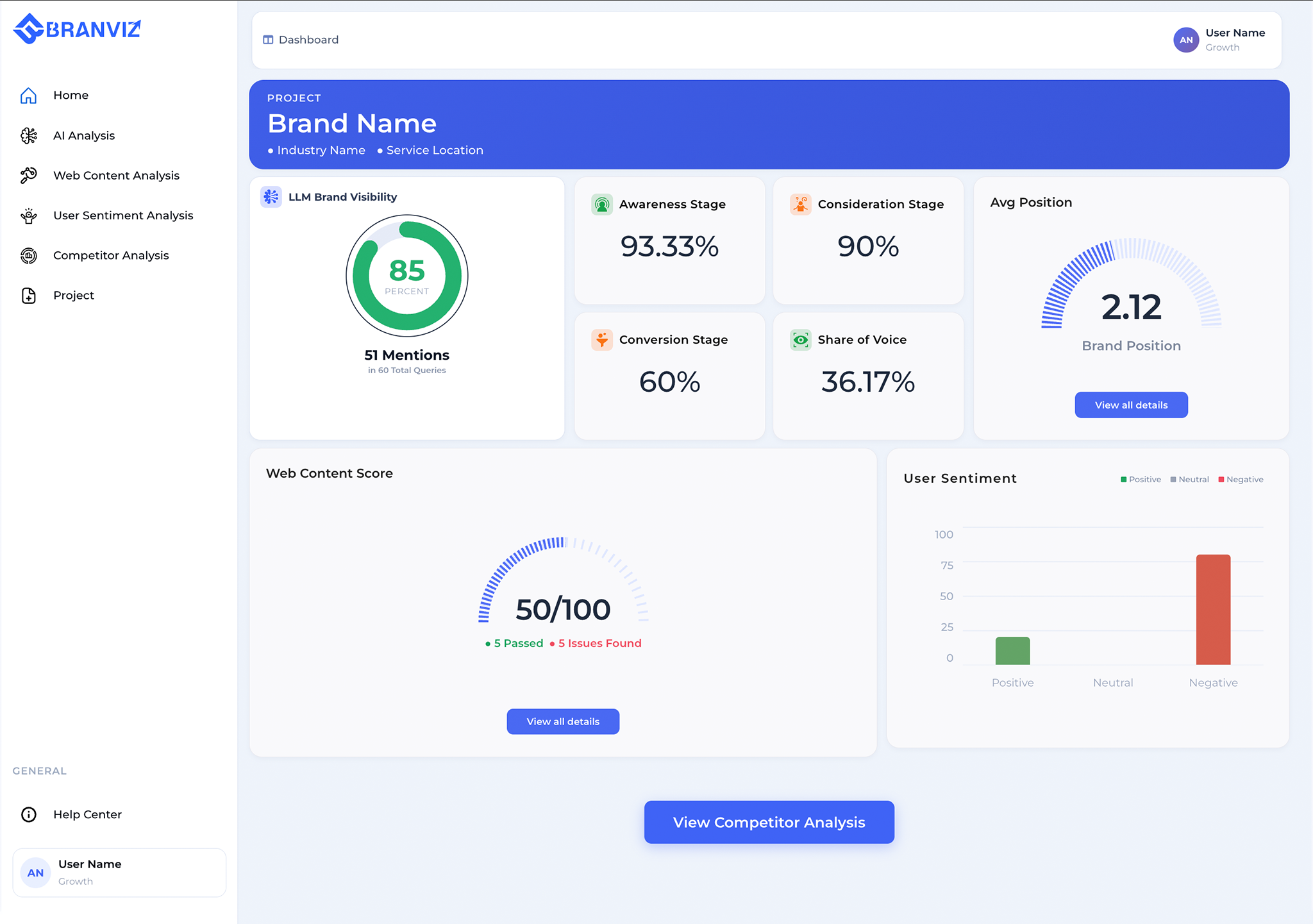
Branviz is built around measuring exactly these factors, tracking how consistently and accurately ChatGPT, Gemini, and Perplexity describe your brand over time, rather than leaving you to guess at where the gaps actually are.
Bringing It Together
Brand visibility in ChatGPT isn't random, and it isn't only about being mentioned once in a while. It comes down to how consistent, specific, and well documented your brand is across the sources the model actually draws from. Two brands with similar products can land in very different places, and the difference usually traces back to clarity rather than quality. Building stronger ai brand visibility starts with fixing that clarity first, and running an audit with Branviz is a fast way to see exactly where that clarity is currently strong or weak.

Varun
AuthorVarun is a dedicated search strategist and Technical SEO specialist focused on future-proofing digital brands. With deep expertise in Answer Engine Optimization (AEO) and Generative Engine Optimization (GEO), they help businesses dominate both traditional SERPs and AI-driven platforms. Known for rigorous technical audits and data-backed strategies, Varun shares actionable insights to help brands build undeniable authority, maximize AI visibility, and thrive in today’s complex search landscape.
FAQs