How to Localize Content for AI Search Across Multiple Countries
Jitender • 10/9/2026

A business operating across several countries doesn't just need its website translated, it needs its brand to be understood consistently by AI models in every market it serves. Multilingual ai search optimization is less about swapping words into another language and more about making sure an AI system in Germany, Japan, or Brazil can recognize the same brand, the same facts, and the same offering that a model in the US would describe.
Getting this wrong creates a quiet problem. A brand can be clearly understood in its home market and still appear vague, inconsistent, or barely present when the same questions get asked in another language.
Translation and Localization Are Not the Same Thing
Translation converts words from one language to another. Localization adapts content, formatting, currency, examples, and sometimes even structure, to fit how a specific market actually communicates and searches. A page that's only translated can still read as foreign or slightly off to both a local reader and a local AI model, since certain phrasing, measurements, or cultural references won't match how people in that market actually ask questions.
AI models trained or operating in a specific region tend to reflect the search habits and phrasing patterns of that region. A page built only through direct translation often misses the actual questions local users ask, even if every sentence is grammatically correct.
Why This Matters for International AI Visibility
International ai visibility depends on a model having confident, consistent information about a brand in the language and context it's being asked in. If your English content is detailed and well structured, but your French or Japanese content is thin, inconsistent, or auto-translated without review, a model answering a query in that language has far less to work with, even though the underlying business is identical.
This creates visibility gaps that are easy to miss from a single-market view of performance. A brand might look strong in overall visibility reporting while being nearly invisible in several of its actual markets, simply because the data is being averaged across languages that perform very differently.
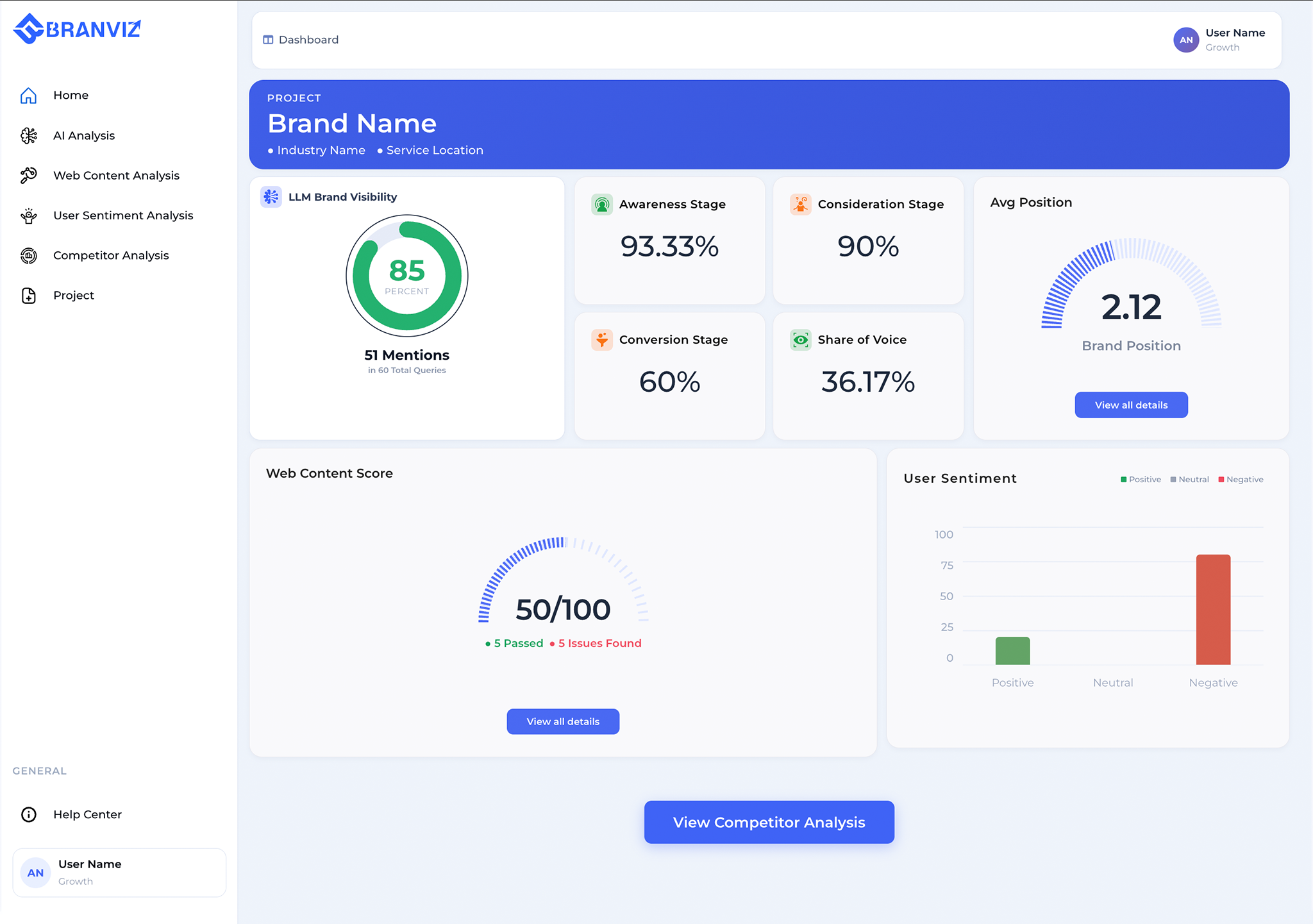
For businesses operating across multiple countries, measuring AI visibility separately across markets can help reveal gaps that overall performance figures may hide. Branviz helps businesses monitor brand mentions across AI platforms, analyze AI visibility, and compare their presence with competitors. By using these insights to assess performance over time, teams can identify where their brand has a stronger presence in AI-generated responses and where further work on localized content, brand consistency, and regional relevance may be needed.
Keeping Brand Facts Consistent Across Languages
The core facts about a business, its name, what it does, where it operates, should stay the same across every localized version of a site, even as the surrounding language changes. This gets harder in practice than it sounds, since local teams sometimes adjust a business name slightly for a market, or local directories list slightly different details than the main website does.
This is the same underlying issue covered in NAP inconsistencies, just applied across language borders instead of across business locations. A model that encounters a slightly different business name or description in each country has to work harder to confirm these all refer to the same entity, which makes confident recommendations less likely.
Technical Localization Signals AI Crawlers Rely On
A few technical details matter more than they might seem to. Hreflang tags tell crawlers which version of a page serves which language and region, preventing confusion about which localized page is the correct one to reference for a given market. Clear URL structures, separate subdirectories or subdomains per language rather than everything crammed under one URL, help both search engines and AI crawlers understand the site's language structure. Localized metadata, titles, descriptions, and headers translated and adapted rather than left in the original language, reinforces that a page is genuinely built for that market rather than just technically accessible to it.
Structuring Content Consistently Across Markets
Consistency in structure matters as much as consistency in facts. If your English content follows a clear pattern, direct answer first, supporting detail after, FAQs at the end, that same structure should carry over into localized versions rather than being rebuilt differently each time. A model is more likely to extract and cite information reliably from a page it can recognize a familiar, well organized pattern in, regardless of the language.
This extends to how your brand's identity holds together across markets more broadly. The kind of consistent entity signals that support entity clarity in one language need to carry through into every other language your brand operates in, not just the primary one your content strategy was originally built around.
Common Mistakes in Localizing for AI Search
Relying entirely on machine translation without a native speaker reviewing for accuracy and natural phrasing. Leaving metadata, titles, and schema untranslated while only translating the visible body content. Using inconsistent business names or descriptions across different language versions of a site. Treating one market's keyword research as universally applicable instead of researching how people in each region actually phrase their questions. Letting localized content go stale while the primary language version keeps getting updated.
Does Localization Guarantee AI Visibility in Every Market
Localizing content well removes a real barrier, since a model simply can't recommend a brand it can't understand clearly in the language a question was asked in. It does not guarantee visibility in every market on its own. Visibility still depends on the same broader factors in each region, content quality, entity consistency, technical accessibility, and genuine local relevance. Localization makes a brand legible in each market, it doesn't replace the deeper work of being a strong, well understood entity in that market.
Conclusion
Localizing content for AI search is less about word-for-word translation and more about making a brand equally clear, consistent, and recognizable in every market it operates in. Keep the core facts about the business identical across languages, adapt the phrasing and structure to how each region actually searches, and get the technical signals right so crawlers can tell which version belongs to which market. Done well, this closes the gap between how a brand performs at home and how it's actually understood everywhere else it does business.

FAQs