AI Visibility and Brand Trust: Why CMOs Need Both
Jitender • 10/19/2026
Customers now ask AI platforms which brands to trust, so CMOs need to track what AI says about their brand, not only whether it appears.
For years, digital marketing followed a clear playbook: find the right keywords, build authority, improve Google rankings, and move visitors through the funnel. That model still matters. But the way people discover and research brands is changing.
Buyers still use Google. Increasingly, they also ask ChatGPT, Gemini, Grok and other AI platforms which companies to consider, which product is better, and which brands to compare. This raises a new question for every CMO: what does AI actually say about our brand when potential customers ask?
Key takeaways
• AI visibility shows whether AI platforms mention, recommend and position your brand when customers ask relevant questions.
• Brand trust depends on AI systems finding information about your company that is accurate, consistent and backed by credible sources.
• Visibility without trust can amplify the wrong message. Trust without visibility can leave your brand out of the conversation entirely.
• The goal is not to be seen the most. It is to be seen accurately, consistently and in the right context.
How AI Search Is Changing Brand Discovery
Traditional search returns a list of links and lets the customer decide what to click. AI search works differently: it gives a direct answer, shaped around what the customer asked.
Customers now ask questions such as:
- Which top agencies help brands rank inside ChatGPT and AI search results?
- What are the top 3 alternatives to [Brand Name], and how do they compare on price?
- Which platform is best for a mid-sized company with a tight budget?
- Which specialized agencies or platforms deliver the highest ROI for AI Search Optimization (GEO) in B2B SaaS?
These are not research questions. The customer is building a shortlist, comparing options and making a decision. That changes the competition.
A brand is no longer competing only to rank on Google. It must also know whether it shows up when customers use AI to decide, and, just as important, how it shows up.
Why AI Visibility Matters for Brand Trust
A mention in an AI answer puts your brand in front of a potential customer. What happens next depends on what the AI says about you.
Suppose someone asks, "What are the best companies for improving AI visibility?" and your brand appears. That looks positive. But buyers rarely decide from one answer. They follow up, and each follow-up tests your brand:
• Is the product described correctly?
• Is the company placed in the right category?
• Are its strengths clear?
• Is outdated pricing being quoted?
• Are competitors presented as better alternatives?
• Is the brand recommended, or only mentioned?
These details shape first impressions, because AI answers are becoming part of the research process.
What the research shows
• McKinsey's 2025 AI Discovery Survey found that 44% of AI-powered search users called it their primary and preferred source of insight, ahead of traditional search at 31%.
• The same research found that a brand's own website may account for only 5–10% of the sources AI-powered search references.
The second finding matters most. The story AI tells about your brand may not come mainly from you. Reviews, publications, forums, social platforms and other websites all feed the answer.
Reputation management therefore now covers more than your website and your Google results. It also covers how AI describes your brand when customers ask about it.
Visibility Is Not the Same as Trust
The link between the two works as a progression:
1. Mention: the brand appears in an AI answer, which builds awareness.
2. Positive positioning: the brand is described favourably, which builds early confidence.
3. Consistent recommendation: the brand earns a place in the customer's consideration set.
But visibility is an exposure metric, not a trust score.
A brand might appear in 60% of relevant AI answers. If those answers contain outdated information, or consistently rank the company behind competitors, that visibility has limited value. The reverse also happens: a highly trusted brand may barely appear in AI answers at all.
So CMOs need to look beyond mention counts. When your brand is mentioned, ask:
• Is it recommended or just listed?
• How is it positioned?
• Which competitors appear beside it?
• What information is used to describe it?
This is where AI visibility and brand trust overlap. An effective strategy connects AI visibility measurement with reputation management, so the brand is not only visible but represented accurately, consistently and in the right context.
What Can Damage Brand Reputation in AI Search
AI search creates reputation risks that traditional SEO metrics can hide. Four are worth watching.
Google's people-first content guidance makes a similar point: it favours original value, expertise and trustworthiness over content made to manipulate rankings.
For CMOs, these are not only SEO problems. They are brand perception problems, and they affect how the market understands the company.
How CMOs Can Build AI Visibility Without Losing Trust
No single metric tells the whole story. A useful strategy looks at four things together: what the brand publishes, what the wider web says about it, how AI systems represent it, and how those views connect.
1. Measure where your brand appears
Start by checking whether your brand appears for the questions customers actually ask. Look beyond total mentions and track:
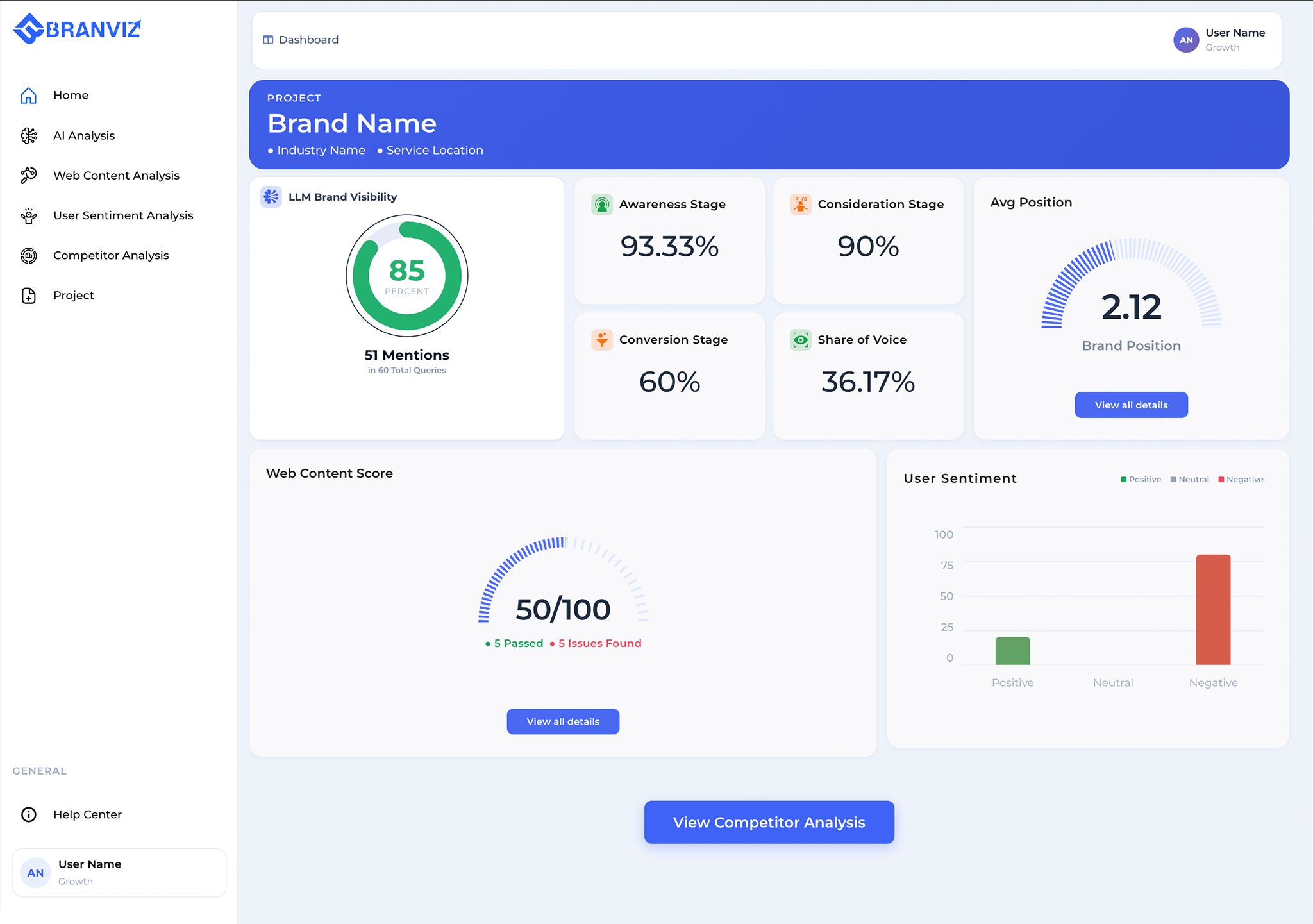
• AI position and share of voice
• Sentiment
• Visibility by funnel stage
• Visibility by product or service
• Recommendations and competitive comparisons
For example, if a competitor appears in most answers to an important category question and you appear only occasionally, your marketing team needs to know.
This is one area where Branviz can help. It lets brands monitor their presence across AI platforms and see how they are positioned against competitors. The value is not just knowing whether the brand appeared, but where it appeared, how it performed and where competitors gained more visibility.
2. Check what information AI can find about you
Your website should make clear what your company does, who it serves and why it is credible. But that is not enough. Review the information about your brand across the wider web too. If your site says one thing and other important sources say another, customers are likely to meet that inconsistency as well.
3. Monitor third-party reputation
Reviews, industry sites, comparison pages, communities and social platforms all shape how your brand is understood. This matters most when customers ask AI to compare brands. If several credible sources describe a competitor as stronger in one area, an AI system may reflect that in its comparison.
4. Look at sentiment, not just visibility
Suppose your brand appears in 40% of relevant AI answers. That number needs context. Ask:
• Is the brand being recommended?
• Is the sentiment positive?
• Is it described as a market leader, or as one of many alternatives?
• Does the AI highlight the strengths your customers care about?
These answers turn a visibility number into insight, and this is where visibility measurement meets reputation management.
Why Brand Trust Matters in AI Search
Consumers do not automatically trust what AI tells them. A September 2025 Gartner survey found that 53% of surveyed consumers distrusted, or lacked confidence in, the reliability and impartiality of AI search and summaries. Gartner also advised marketers to reinforce brand trust through reliable information while improving visibility in AI-powered results.
This creates a real tension. People increasingly use AI to research brands, yet they still question whether the answers are reliable. The answer is not to choose between visibility and trust. It is to build visibility that reinforces trust.
A brand should be easy for AI systems to find and understand. The information behind it should be accurate, consistent and credible.
A Five-Question Framework for AI Visibility and Trust
A practical strategy can be built around five questions. Together, they give a clearer picture than counting mentions.
1. Are we visible?
Do AI platforms mention our brand when customers ask important category and product questions? This is the starting point. Before you worry about how you are represented, you need to know whether you appear at all.
Branviz helps brands track visibility across relevant customer questions and see how often they appear in AI answers.
2. Are we visible in the right conversations?
Are we showing up when customers are simply learning about a category, or also when they compare and evaluate options? Not every mention has equal value. Appearing in an informational answer is different from appearing when someone asks, "Which brand should I choose?" or "What are the best alternatives?"
Branviz shows visibility across customer-journey stages, so teams can see whether they appear at awareness, consideration and decision.
3. Are we represented accurately?
Does AI describe our products, services, positioning and capabilities correctly? Visibility only helps if the information is right. If AI describes your product incorrectly, uses outdated details or misunderstands what you offer, higher visibility can work against you.
Branviz helps brands examine how AI answers describe them, and identify gaps between how the brand wants to be seen and how it actually appears.
4. What sources are influencing the answer?
Which websites, publications, communities or other sources shape how AI describes our brand? Your website is not the only influence. Large language models draw on many sources.
5. How are we being perceived?
Is the sentiment positive, neutral or negative? Are we recommended? How are we positioned against competitors? A brand may appear often yet be poorly positioned, overlooked in favour of competitors, or linked to the wrong attributes.
Branviz combines visibility, sentiment and competitor insights to show how a brand is positioned and perceived, not just how often it appears.
When AI Visibility Becomes a CMO-Level Priority
AI visibility becomes a priority the moment customers use AI to research and compare options in your category. Watch for questions like:
• Which brand should I choose?
• What are the alternatives to this brand?
• Compare these companies.
• Which solution is best for my business?
These are recommendation queries, not traditional searches. The customer is asking AI to help make a decision, and this is where visibility, positioning and trust meet.
In these answers, a competitor may be recommended instead of you. Another company may be described as a better fit. Or your brand may not appear at all. A brand that is consistently absent can lose consideration before a customer ever visits its website. And if it does appear, you still need to confirm the information is accurate.
The strategic goal is therefore not maximum visibility. It is relevant, accurate and trusted visibility: being present when the right questions are asked, and being described in a way that supports the brand.
Conclusion
AI search is becoming another way for customers to discover, compare and evaluate brands. For CMOs, Google rankings, website traffic and branded searches are no longer enough to show the full picture. The bigger question is whether your brand appears in the conversations that matter, and whether it is represented in a way that builds customer confidence.
Being visible gives a brand a chance to enter the conversation. The quality of that visibility decides whether it helps.
The brands that win in AI search will not necessarily be the ones that appear most often. They will be the ones that appear in the right conversations, are described accurately, and give customers a reason to trust what they see.
So do not only ask whether AI can see your brand. Ask: what does AI say about your brand when your customers are deciding what to choose?

FAQs