WHY DOESN'T AI RECOMMEND 7UP?
Jitender • 7/31/2026
Inside 7UP's AI Recommendation Journey
How Branviz uncovered AI visibility gaps preventing one of India's most recognized beverage brands from being consistently recommended across leading AI platforms.
The Business Problem
Every day, millions of consumers are replacing search engines with AI assistants.
Instead of browsing websites, they ask:
- Which is the most popular soft drink in India?
- Which lemon-lime drink tastes best?
- What are the best beverages for summer?
These recommendations influence buying decisions before a consumer ever visits a brand's website.
Despite being one of India's most recognizable (fido dido being mascot for 7UP in the late 1980s and 1990s) beverage brands, 7UP appeared far less often than expected across AI-generated recommendations.
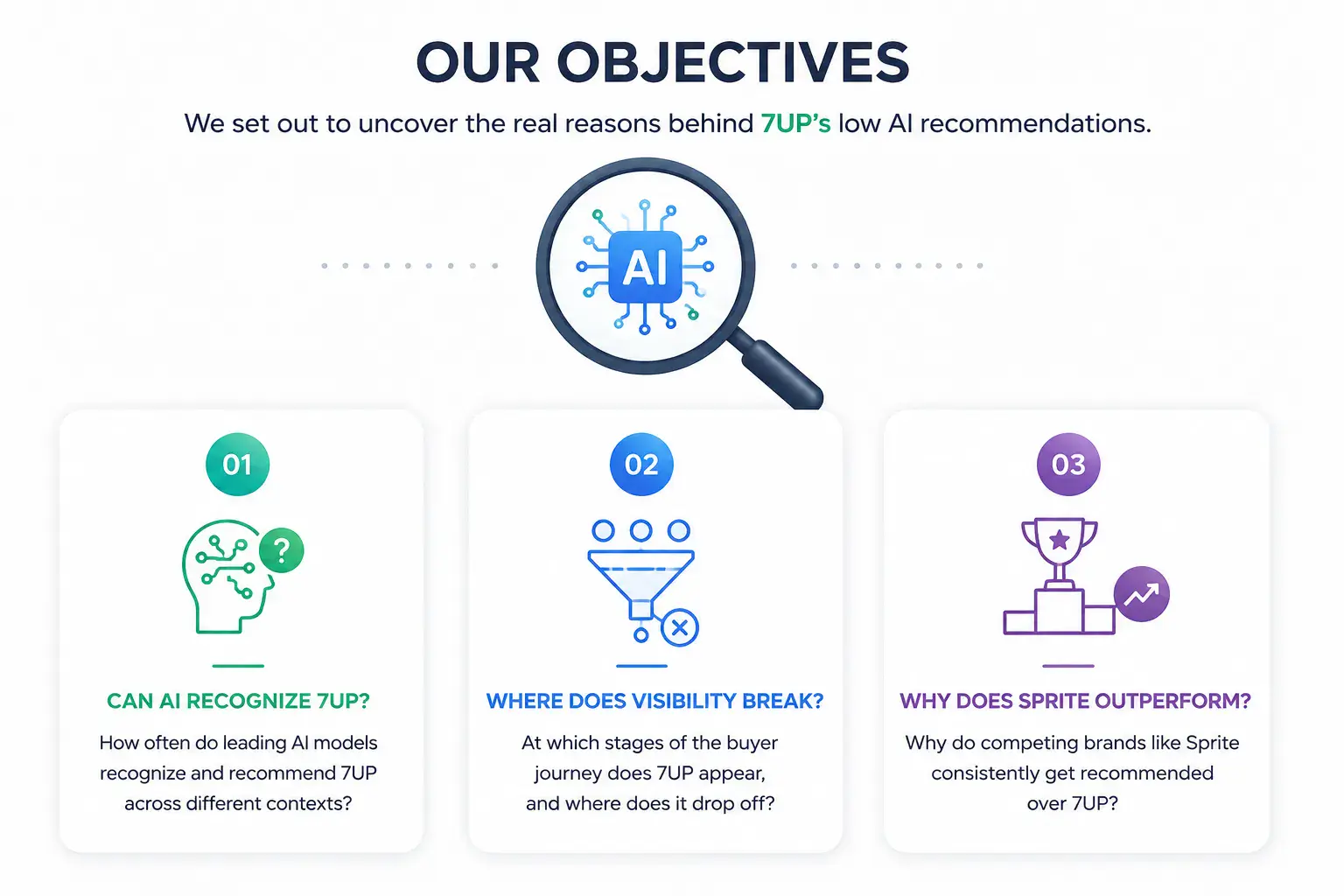
The obvious question became: “Why?”
How We Conducted the Analysis
Understanding AI recommendations requires more than asking a few questions to ChatGPT. AI responses vary based on user intent, product context, category definitions and the stage of the buyer journey. To accurately evaluate 7UP's AI discoverability, Branviz conducted a structured analysis across multiple AI platforms, product categories and recommendation scenarios.
AI Platforms Analyzed
ChatGPT • Gemini • Google AI Mode • Perplexity • Grok
Prompt Coverage
60 carefully designed prompts
12 prompts across each AI platform
Buyer Journey Stages
- Awareness
- Consideration
- Conversion
- Brand-Specific Queries
Product Categories Evaluated
- Carbonated Soft Drinks
- Lemon-Lime Carbonated Beverages
Key Metrics Measured
- LLM Visibility Score
- Brand Mentions
- Average Position
- Share of Voice
- Stage-wise Visibility
- User Sentiment
- Web Content Score
- Competitor Analysis
The First Discovery
One of the biggest misconceptions about AI recommendations is that brands have a single, universal visibility score. In reality, AI evaluates products within specific contexts and categories, meaning a brand's visibility can change significantly depending on how a user frames their question.
To understand this behavior, we analyzed 7UP across two closely related product categories—Carbonated Soft Drinks and Lemon-Lime Carbonated Beverages. Although the product remained the same, AI models interpreted its relevance differently, resulting in noticeably different visibility scores.
Carbonated Soft Drinks
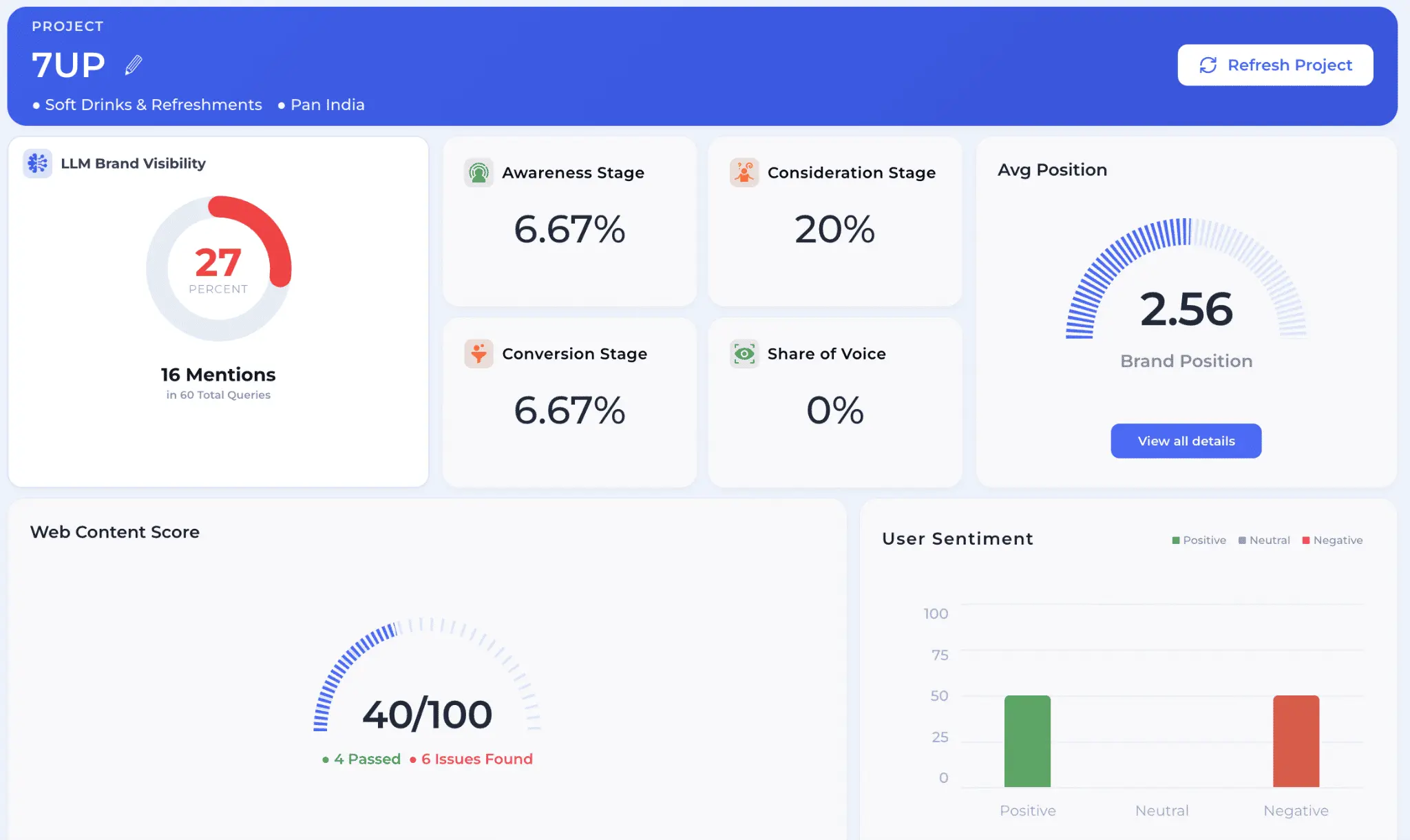
AI Visibility Score: 27%
When evaluated within the broader carbonated soft drinks category, 7UP appeared in only 16 out of 60 AI-generated responses. Visibility across the buyer journey was particularly weak, with the brand rarely appearing during awareness and conversion-stage queries. Despite being a globally recognized beverage brand, AI models largely favored larger and more
frequently associated competitors.
Lemon-Lime Carbonated Beverages
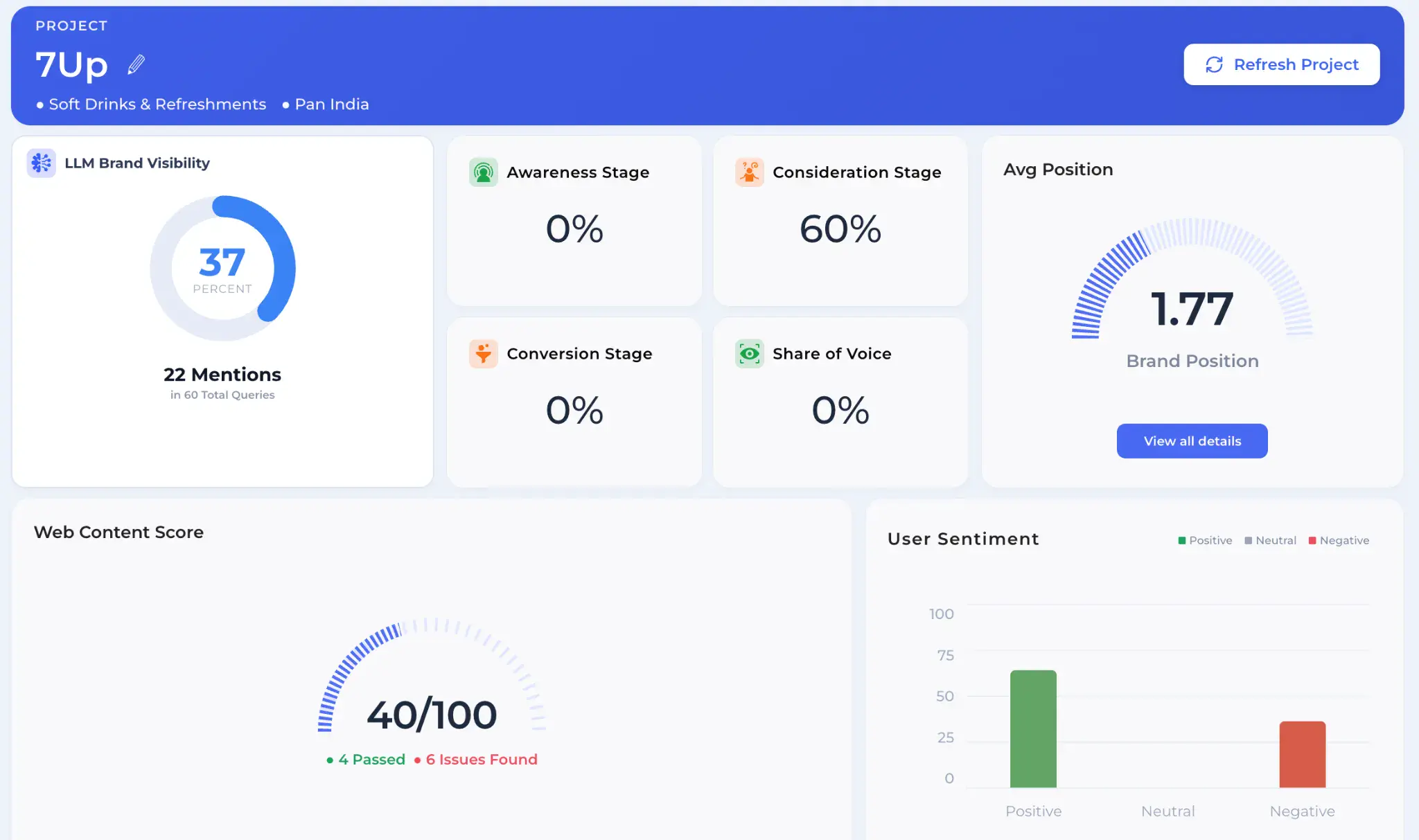
AI Visibility Score: 37%
When the category was narrowed to lemon-lime carbonated beverages, AI recommendations improved. 7UP was mentioned in 22 out of 60 evaluated prompts and showed stronger performance during consideration-stage queries. However, awareness and purchase-intent recommendations remained inconsistent, indicating that AI still lacked sufficient confidence to recommend the brand throughout the complete buying journey.
Breaking Down the Buyer Journey
Overall visibility scores only tell part of the story. To understand why AI wasn't consistently recommending 7UP, we analyzed its presence across the three critical stages of the buyer journey: Awareness, Consideration and Conversion.
Awareness
Awareness-stage prompts represent the first interaction between a consumer and AI. These are broad, informational questions where users are exploring available options without having a preferred brand in mind.
Examples include:
- What are the most popular soft drink brands?
- Which beverages are trending this summer?
- What are the best carbonated drinks?
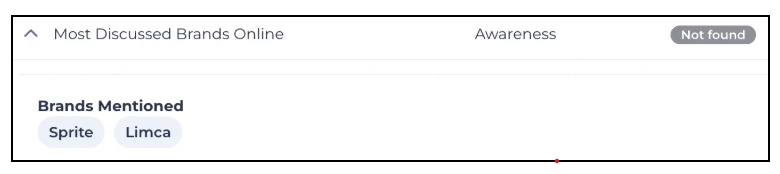
Across these discovery-focused prompts, AI consistently recommended brands such as Sprite, Coca-Cola, Thums Up, Fanta, and Limca, while 7UP was rarely mentioned. This limited exposure reduces the brand's opportunity to enter the consumer's consideration set at the very beginning of the purchase journey.

Consideration
Consideration-stage prompts are more specific and compare products based on taste, quality or suitability.
Examples include:
- Which lemon-lime soft drink tastes best?
- Sprite vs 7UP
- Best lemon soda in India
Within this stage, AI showed greater confidence in recommending 7UP, particularly when the conversation was limited to the lemon-lime beverage category. While this improvement demonstrates that AI recognizes the brand in specific contexts, the visibility remained inconsistent and heavily dependent on how the question was framed.


Conversion
Conversion-stage prompts represent the highest-intent moments in the buyer journey. These are queries where users are actively seeking recommendations before making a purchase.
Examples include:
- Best lemon soda to buy today
- Top beverages to order online
Despite the strong commercial intent behind these prompts, 7UP was almost entirely absent from AI-generated recommendations. This absence suggests that AI lacked sufficient confidence to recommend 7UP during the most commercially valuable stage of the customer journey.


The Benchmark: What Strong AI Visibility Looks Like
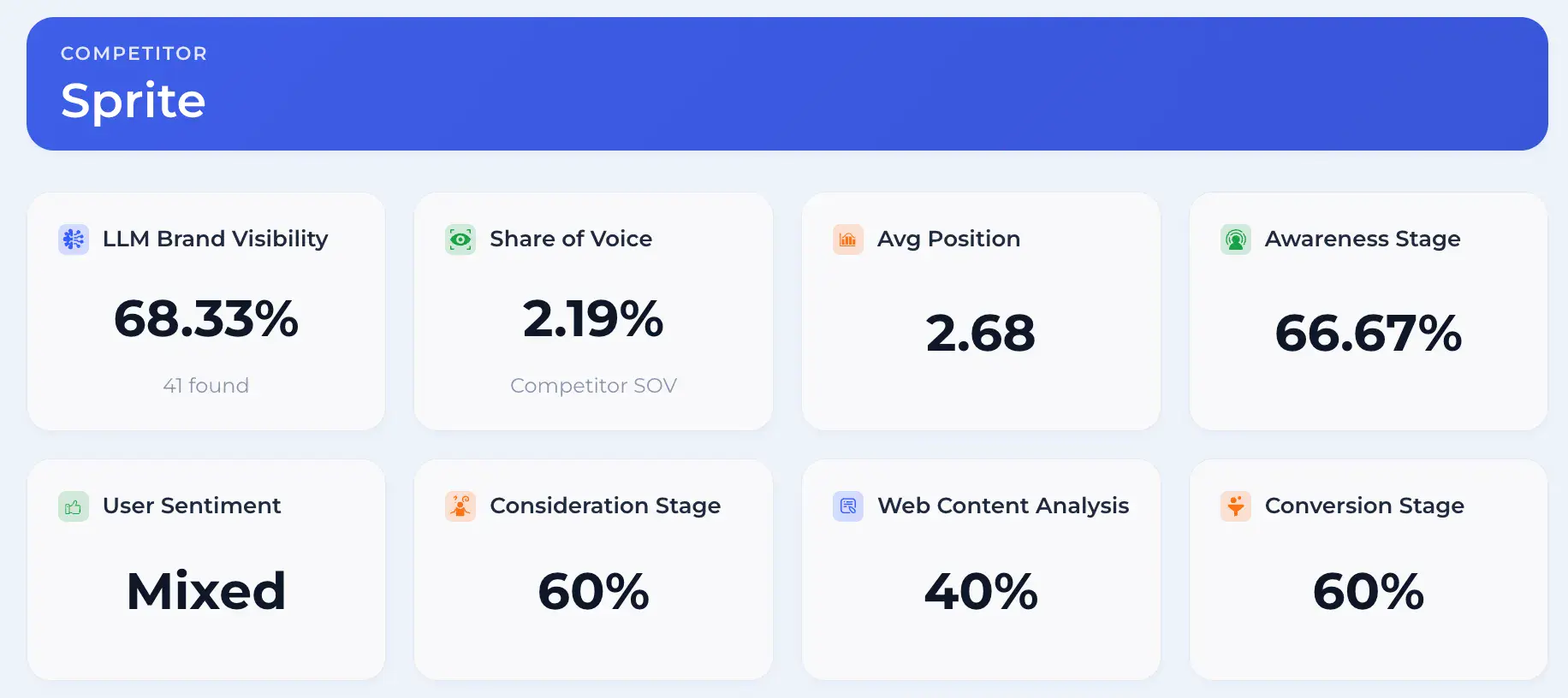
To understand whether 7UP's visibility was an isolated issue or part of a broader industry trend, we benchmarked its performance against Sprite, one of its closest competitors in the lemon-lime carbonated beverage category.
What Makes Sprite Different?
The analysis suggests that Sprite's stronger performance is not simply the result of brand popularity. Instead, AI models demonstrate greater confidence in recommending Sprite because they can more clearly understand its relevance across different contexts.
Unlike 7UP, Sprite maintains a stable presence across broad product categories as well as more specific lemon-lime beverage queries. Whether users are looking for popular soft drinks, comparing brands or asking for purchase recommendations, Sprite continues to appear consistently throughout the buyer journey.
Why AI Doesn't Confidently Recommend 7UP
Fragmented Brand Entity Recognition
AI relies on consistent entity recognition to understand whether different references point to the same brand. During our analysis, we found multiple variations of the 7UP brand name—including "7UP," "7 Up," "7-Up," and "Seven Up."
Although these variations refer to the same product, inconsistent usage across websites and publishers can weaken AI's confidence in associating all references with a single, authoritative entity.
For AI, consistency strengthens understanding. Fragmentation introduces uncertainty.
Stronger Association with a Niche Category
Our category-level analysis showed that AI recognized 7UP more readily as a Lemon-Lime Carbonated Beverage than as a broader Carbonated Soft Drink.
This indicates that AI's understanding of the brand is more narrowly defined than expected. When consumers ask broader beverage-related questions, AI often prioritizes competing brands with stronger category associations.
The result is reduced visibility during high-volume discovery queries, even for a well-known product.
Limited Third-Party Validation
AI models build confidence by referencing trusted information across the web, not just a brand's own website.
While 7UP is well represented on its owned channels, the analysis indicated fewer strong supporting signals from authoritative third-party sources within relevant recommendation contexts. This limits AI's ability to confidently reinforce the brand when generating responses.
The quality, relevance and consistency of external references can significantly influence recommendation confidence.
Inconsistent Visibility Across the Buyer Journey
Perhaps the most significant finding was the uneven distribution of visibility across the customer journey.
7UP appeared in selected consideration-stage prompts but was largely absent during awareness and conversion stages. This inconsistency means that consumers may encounter the brand while researching options, yet never see it when discovering new products or asking for purchase recommendations.
For AI, recommendation confidence isn't measured at a single point. It must be earned consistently across every stage of the journey.
AI models don't evaluate brands using a single metric. They synthesize multiple signals, including entity consistency, category relevance, source authority and contextual understanding, before deciding which brands to recommend.
This is precisely why traditional SEO metrics or brand awareness studies cannot fully explain AI recommendation behavior.
Branviz uncovers these hidden signals, enabling brands to identify the specific factors limiting their AI visibility and prioritize the improvements that will have the greatest impact.
Key Takeaways
Brand Awareness Doesn't Guarantee AI Visibility
Being a household name doesn't automatically translate into AI recommendations.
Despite decades of consumer recognition, 7UP struggled to appear consistently across AI-generated responses. This demonstrates that strong market presence alone is no longer enough. Brands must also build confidence within AI systems.
AI Recommends Brands It Understands
AI doesn't simply recognize logos or brand names. It develops an understanding of brands based on context, category relevance, entity consistency and trusted information available across the web.
The stronger these signals are, the more confidently AI recommends a brand.
Context Matters More Than Ever
A brand's AI visibility can change significantly depending on the category, user intent or stage of the buyer journey.
Measuring a single AI visibility score provides only part of the picture. Brands need visibility across multiple categories and recommendation scenarios to understand their true AI discoverability.
AI Visibility Requires Continuous Measurement
AI models evolve rapidly, along with the sources they reference and the way they interpret information.
Monitoring AI visibility cannot be treated as a one-time exercise. Continuous analysis helps brands identify emerging gaps, benchmark competitors and adapt their optimization strategies as AI search continues to evolve.
“The brands that win in AI search won't necessarily be the most recognized. They'll be the ones AI understands and trusts the most.”
Understanding how AI perceives your brand is no longer just a marketing advantage; it's becoming a fundamental requirement for staying discoverable in the next generation of search.
Is AI Confident Enough to Recommend Your Brand?
Branviz helps brands understand how leading AI platforms perceive, evaluate and recommend their products across the entire buyer journey.
Whether you're tracking a corporate brand, a product portfolio or individual SKUs, Branviz uncovers the hidden signals that influence AI recommendation behavior so that you know exactly where to focus your optimization efforts.
Ready to see how AI sees your brand?