Brand Visibility Tool Buying Checklist: 10 Features Every CMO Should Demand
Jitender • 8/24/2026
Every vendor in this space claims to track brand visibility ai now offers across ChatGPT, Gemini, and Perplexity. Fewer of them actually do it in a way that gives a CMO something reliable to act on. Before signing off on a budget line for this, it's worth knowing exactly what separates a tool that produces a real signal from one that just produces a dashboard.
This checklist covers the ten features worth demanding before you commit, based on what actually matters once a tool is running in production rather than what looks good in a sales demo.
1. Coverage Across Multiple AI Models, Not Just One
A serious AI brand visibility tool should not limit measurement to a single AI engine.
Buyers are asking questions across ChatGPT, Gemini, Perplexity, Grok, and AI Overviews, and different models can produce very different recommendations for the same prompt. If your tool only tracks one model, you're seeing only part of your actual AI presence.
Look for multi-model tracking that lets you compare how your brand performs across the major AI search and answer engines from one place.
2. LLM Mention Rate
One of the most important baseline metrics is simple: how often does AI actually mention or recommend your brand?
A useful tool should measure your brand's LLM Mention Rate across relevant, high-intent prompts rather than relying on a vague visibility score. This gives you a clear starting point for understanding whether AI models recognize your brand as an option in your category.
The important distinction is between a dashboard that says your visibility is "high" and one that tells you exactly how frequently your brand appears in AI-generated recommendations.
3. Full-Funnel Prompt Tracking
AI visibility isn't limited to "best [product]" searches.
A buyer might begin with a broad educational question, move into solutions or use cases, compare different providers, and eventually ask which product they should choose. Your brand can be highly visible at one stage and almost invisible at another.
A capable tool should therefore measure visibility throughout the funnel, from broad top-of-funnel questions to high-intent, ready-to-buy prompts.
This helps CMOs understand not just whether their brand appears, but where in the buyer journey AI is introducing or excluding the brand.
4. Average AI Position
Being mentioned by an AI model is only part of the story.
If an AI response recommends five companies, appearing first is fundamentally different from appearing fifth. Position can indicate how prominently the model is presenting your brand compared with competing recommendations.
Your visibility tool should therefore track average AI position, showing whether your brand is becoming a primary recommendation or remaining buried toward the bottom of generated answers.
This is the AI equivalent of understanding that ranking position matters in traditional search.
5. User Sentiment Analysis
A brand can have strong visibility and still have a reputation problem.
AI models don't simply mention brands. They can describe them as reliable, expensive, innovative, outdated, difficult to use, or problematic based on the information available to them.
That's why sentiment needs to be measured alongside visibility.
Look for a tool that separates positive, neutral, and negative sentiment so you can understand how AI is interpreting the public perception surrounding your brand not merely whether your name appears.
6. AI Share of Voice and Competitor Benchmarking
Your brand's visibility means much more when you can compare it with the companies competing for the same AI recommendations.
A strong tool should show your AI Share of Voice (SOV) and benchmark it against direct competitors appearing across the same prompts.
For example, if your brand appears in 30% of relevant AI recommendations while a competitor appears in 55%, that tells you something far more actionable than knowing your own visibility score in isolation.
The goal is to understand who owns the AI recommendation market in your category and where the opportunity exists to take share.
7. Product- or Service-Level Analysis
Enterprise brands rarely have just one thing to measure.
A company might have several products, service tiers, locations, or solutions, each targeting a different buyer and appearing in different AI conversations.
A blended brand score can hide these differences.
Your visibility tool should allow you to segment AI performance by specific product lines or service offerings. This makes it possible to identify which products are gaining AI visibility and which ones need more attention.
8. GEO Web Readiness Auditing
Visibility measurement tells you what is happening. A GEO readiness audit helps explain why.
AI engines rely on signals from websites and other sources to understand entities, content, products, services, and organizations. If your website has technical or structural weaknesses, simply knowing that your brand isn't appearing doesn't tell your marketing team what to fix.
A strong AI visibility platform should therefore audit your website for GEO readiness, including the technical and structural signals that can affect how AI systems crawl, understand, and interpret your brand.
The most useful audits don't just produce a score. They identify missing or weak AI trust signals that your team can actually address.
9. Consistent, Repeatable Tracking Over Time
A one-time audit is a snapshot, not a strategy. AI models update constantly, and so does the web content they draw from, which means your visibility today isn't guaranteed to hold next month. Demand a tool built for ongoing, repeatable tracking rather than a single report you run once and shelve.
10. Actionable Visibility Intelligence
The final feature is less about another metric and more about what the platform does with all the data.
A CMO doesn't need another dashboard filled with numbers. They need to understand:
- Where is our brand visible?
- Where are competitors beating us?
- Which products are underrepresented?
- How prominently are we being recommended?
- Is AI sentiment positive or negative?
- How much AI Share of Voice do we own?
- Is our website technically ready for AI discovery?
- What should we fix next?
The best AI brand visibility tools bring these signals together into a clear picture of how AI engines perceive and recommend the brand.
That turns AI visibility from a reporting exercise into a source of marketing and growth intelligence.
11. Clear, Actionable Reporting
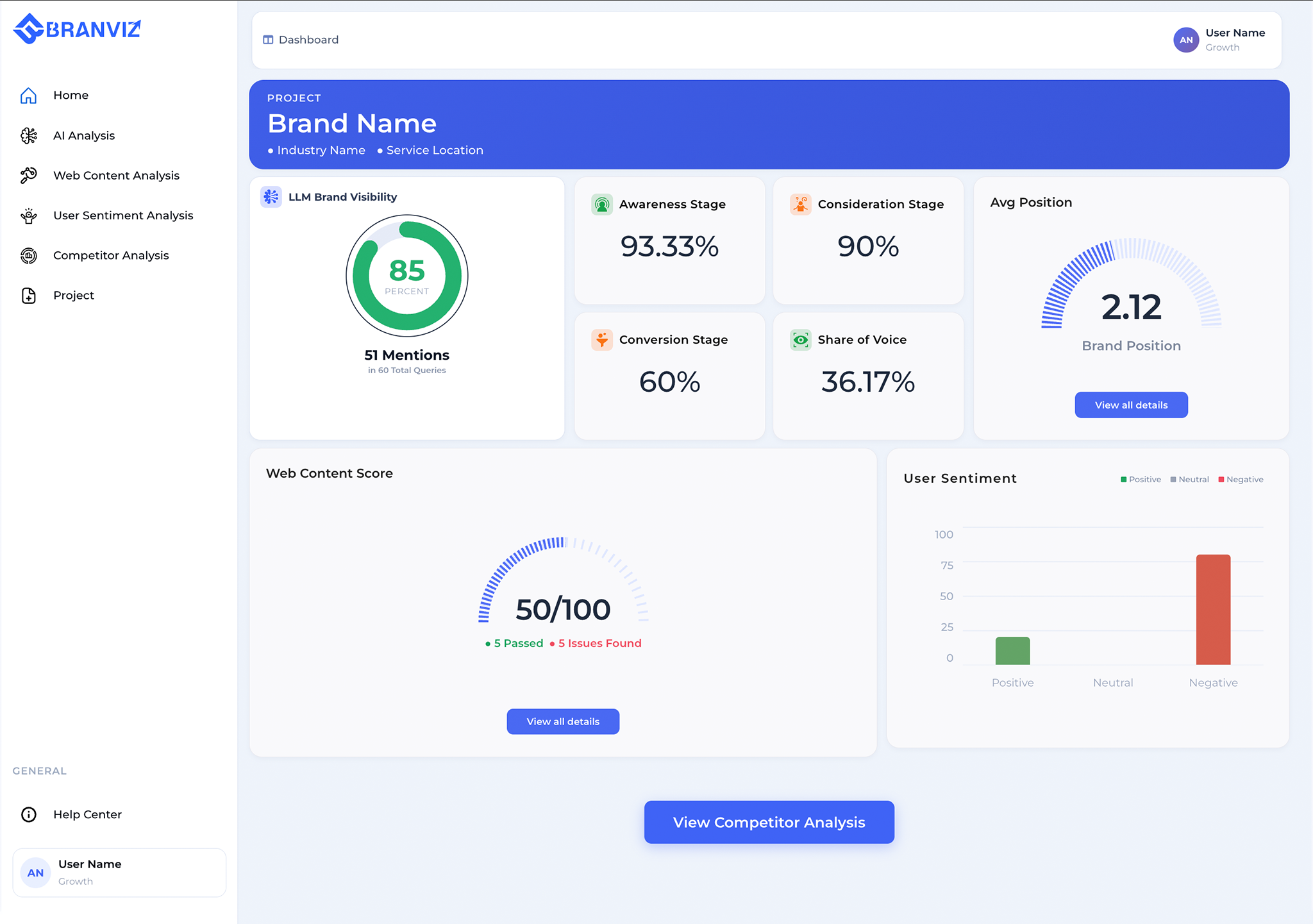
A good AI visibility tool should make the data easy to understand, not force you to dig through multiple dashboards. Branviz brings key signals like LLM visibility, funnel performance, average AI position, Share of Voice, web content score, and sentiment into one place. This gives CMOs a clear view of what is happening with their brand and how performance is changing. More importantly, the reporting makes it easier to spot where attention is needed next.
How to Actually Evaluate Vendors Against This List
The easiest way to separate marketing claims from real capability is to ask for a live example during a demo rather than a slide describing the feature. Ask the vendor to run a real prompt relevant to your category and show you the actual output, not a mocked-up screenshot. If a vendor can't demonstrate prompt-level detail, competitor benchmarking, or sentiment analysis live, on your own category, that's a meaningful signal about what the tool can actually do in practice.
It's also worth checking how the tool connects visibility tracking back to entity clarity, since a tool that only reports numbers without explaining the underlying reasons behind weak visibility leaves you with a score but no real path forward. The stronger platforms tie your tracking data back to the structural reasons a brand is or isn't being recognized clearly by AI models in the first place.
Where Branviz Fits Into This Checklist
This is the exact list we built Branviz around. Multi-model tracking across ChatGPT, Gemini, Claude, Perplexity, and Grok, prompt-level detail instead of a single blended score, full-funnel coverage, competitor benchmarking, sentiment analysis, and a GEO readiness audit that connects visibility results back to the technical and structural signals driving them. If you're working through this checklist with vendors, it's worth running an audit to see how a tool built against all ten of these points actually performs against your own brand.
Bringing It Together
A brand visibility ai tool is only as useful as the specificity it gives you. A blended score with no prompt detail, no competitor context, and no explanation of the underlying causes is closer to a vanity metric than a strategic tool. Hold vendors to this checklist before committing budget, and ask them to prove each point live rather than taking a feature list at face value.

FAQs